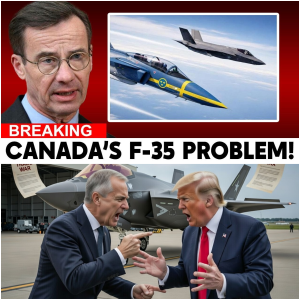
The Pentagon has issued a stark warning to Canada amid Ottawa’s dramatic reconsideration of its $33 billion F-35 fighter jet procurement, as the Canadian government contemplates switching to Sweden’s Gripen E. This escalating dispute threatens to reshape North American defense and strain the century-old Canada-US alliance.

Canada’s defense procurement crisis has erupted into a critical flashpoint, sending shockwaves through Washington. The deal for 72 F-35 jets is faltering under exploding costs, delayed upgrades, and burgeoning doubts about the technology’s maturity. Ottawa now faces a seismic choice: continue with a US-dependent fifth-generation fighter or pivot to Sweden’s Gripen E — a move rattling Pentagon nerves and reverberating across diplomatic channels.
Originally selected in 2010 and reaffirmed multiple times, Canada’s F-35 commitment was supposed to cement interoperability with the US-led NORAD defense framework. The contract signed in 2022 for 88 jets valued at 19 billion Canadian dollars has ballooned dramatically, with the total now approaching $33 billion once infrastructure and weapons systems are factored in.
A 2025 Canadian Auditor General report the staggering financial overrun, while a US Government Accountability Office report simultaneously revealed the F-35’s Block 4 upgrade—critical for unlocking the jet’s advanced combat potential—is five years behind schedule and $6 billion over budget. This dual revelation has raised alarms about the program’s viability and Canada’s anticipated capabilities.
Enter Saab’s Gripen E proposal, which has shifted the debate from mere cost considerations to national sovereignty. The Swedish fighter jet offer includes 72 aircraft plus six Global Eye early warning systems, bundled with a robust industrial partnership promising over 12,600 Canadian jobs and full technology transfer — proposing final assembly and maintenance on Canadian soil.
This offer does far more than propose alternative fighters; it raises fundamental questions about control. Unlike the F-35, where the U.S. governs software updates, mission parameters, and weapons integration, Gripen ownership confers operational sovereignty. Canada could independently modify software and integrate non-US weapons without Pentagon oversight or political red .
The Gripen’s design is tailored for Arctic operations, a crucial factor given Canada’s vast northern territories and mounting geopolitical tensions in the High North. It can operate from short, austere runways and even snow-covered highways, requires minimal maintenance crews capable of rapid turnarounds, and boasts a fraction of the F-35’s operating costs—$8,000 per flight hour versus $35,000 to $47,000.
Canadian officials emphasize job creation and industrial renewal alongside strategic autonomy. The Gripen package includes partnerships with Canadian aerospace giants Bombardier, IMP Aerospace, and GE Aviation, aiming to revive a sector beleaguered by decline. This industrial narrative intertwines with national security, complicating Washington’s warnings about jeopardizing NORAD interoperability.
US Ambassador Pete Hawkra has publicly conveyed Washington’s growing impatience, underscoring the critical importance of maintaining seamless integration within NORAD for continental defense. His pointed remarks suggest that Canada’s potential withdrawal from the F-35 project could destabilize longstanding defense arrangements, signaling a diplomatic rift.

Tensions have escalated further amidst the backdrop of a second Trump administration’s recommitment to aggressive trade policies and pointed rhetoric. Canada’s economic dependence on the US—75% of exports flow south—compounds Ottawa’s challenge, where decisions about defense procurement carry intense geopolitical weight beyond plane performance and procurement timelines.
Canada’s simultaneous accession to the European Union’s Safe Defense Program and a bilateral defense cooperation pact with Sweden in 2025 underline a strategic pivot. These moves signal Ottawa’s determination to diversify alliances, challenge technological dependence on Washington, and assert a more autonomous defense posture in an increasingly contested global environment.
The Arctic theater remains a critical accelerant in this unfolding . Russia’s military buildup and China’s ambitions as a “near-Arctic state” intensify security pressures. The Gripen’s rugged adaptability to extreme northern climates contrasts with the F-35’s superior stealth and long-range surveillance capabilities, highlighting a stark operational trade-off.
Analysts depict Canada’s dilemma as a test of sovereignty in an era defined by superpower rivalry. Does Ottawa prioritize the technological sophistication and integrated defense power offered by the US? Or does it seek technological and operational control vital for flexible, independent decision-making even if it risks alienating its closest ally?
Canada faces unp
recedented questions of control: Who holds the keys to mission software? Who dictates weapon integration? And what happens should US policies shift against Canadian interests? These concerns underscore a broader global challenge for middle powers balancing alliance benefits with sovereignty in a hyperconnected defense landscape.
The F-35 remains favored for its seamless intelligence sharing and dominance in high-threat scenarios, particularly for Arctic domain awareness. Yet, the Gripen’s cost efficiencies, sovereign sustainment model, and Arctic suitability create compelling counterarguments, illustrating the multifaceted nature of this strategic crossroads.
Despite intense diplomatic pressure and ongoing pilot training in the US, Canada has yet to finalize its choice. The first batch of 16 F-35s is still slated for 2026 delivery, but subsequent purchases—comprising the majority of the planned fleet—remain unresolved, leaving this pivotal defense acquisition in limbo.
As the clock ticks, this saga is more than a procurement decision. It represents a defining moment for Canada’s identity and its future partnership with the United States. At stake is the very nature of alliance, the capacity for independent defense policy, and the strategic autonomy of a middle power navigating complex geopolitical currents.
In this high-stakes game, Canada’s eventual choice will ripple far beyond North American airspace—it will resonate through Arctic geopolitics, global defense industries, and the architecture of 21st-century alliances, marking a historic juncture in the enduring Canada-US relationship.
There are no easy answers, only trade-offs between autonomy and integration, flexibility and power. Ottawa’s decision will command global attention, signaling whether Canada asserts its strategic independence or doubles down on the tight embrace of its greatest defense partner. The fallout is just beginning.