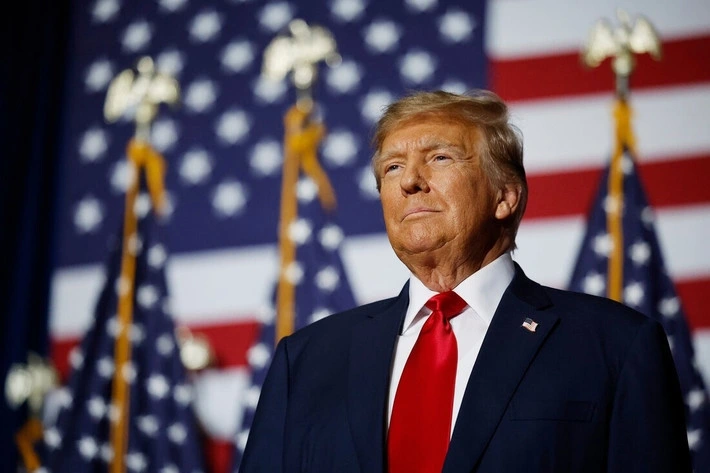
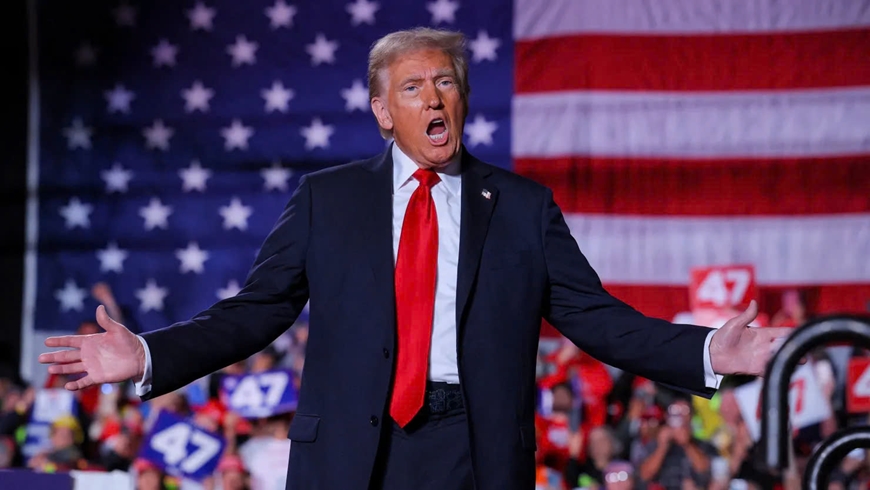
The campaign rally held by President Donald Trump in Rocky Mount, North Carolina, on Friday night was intended to be a routine stop designed to reinforce Republican support. Instead, it inadvertently exposed a range of political, economic, and social tensions weighing heavily on one of the most closely watched battleground states ahead of the 2026 midterm elections.
Rocky Mount sits within a newly redrawn congressional district—part of a broader redistricting strategy aimed at giving Republicans an advantage in securing additional House seats. But for Representative Don Davis, who is seeking reelection, the new map represents more than a political calculation. It has become a symbol of a larger struggle over representation and which communities are being left behind.
In a televised interview, Mr. Davis avoided a direct attack on the president. Instead, he adopted an unusually restrained tone in an increasingly polarized political climate. He emphasized that his campaign is not built around a national agenda, but rather focused on families in eastern North Carolina—many of whom are grappling with job losses, rising living costs, and the looming risk of losing health care coverage.
That message resonated against the backdrop of a fragile local economy. Eastern North Carolina has long ranked among the nation’s most economically distressed regions, marked by low incomes, underdeveloped infrastructure, and a steady outmigration of young people seeking opportunity elsewhere. Layoffs tied to tariffs and trade disruptions, Mr. Davis argued, have only deepened fears that the region is being left behind—even as the White House promotes a narrative of a national “golden age.”
Those doubts are not confined to Democrats. Interviews with Trump supporters at the Turning Point USA conference revealed a more complicated picture. When asked to grade the economy, many offered cautious assessments—“C-plus,” “B-minus”—and some openly questioned whether the prosperity touted by the administration matched their lived experiences. One voter who supported Mr. Trump in 2024 publicly expressed regret, saying the administration had failed to deliver on its promises.
At the same time, the controversy surrounding redistricting continues to inflame political tensions. North Carolina is far from alone. Across the country, legal and political battles over congressional maps have raised broader questions about democratic representation. Mr. Davis acknowledged that courts have ruled and that candidates must compete under the current map. Still, he warned that when communities lose their voice, public trust in democratic institutions erodes.
These challenges are further compounded by federal policy disputes, particularly the Federal Emergency Management Agency’s decision to deny North Carolina’s request for extended full reimbursement of storm cleanup costs in western parts of the state. The decision forces North Carolina taxpayers to shoulder billions of dollars in additional expenses, diverting funds away from economic recovery, small business grants, and infrastructure rebuilding. For many residents, the move reinforced a growing sense that Washington is increasingly disconnected from local realities.
Amid these pressures, early speculation about the Republican Party’s future beyond Mr. Trump—including the potential role of Vice President J.D. Vance—appears premature. Political analysts suggest that if the president’s approval ratings continue to decline and Republicans suffer significant losses in the midterms, internal calls to “turn the page” could intensify rather than double down on the current leadership.
Viewed through that lens, the Rocky Mount rally was more than a campaign stop. It was a snapshot of a volatile political moment in which redistricting strategies, economic messaging, and voter confidence are colliding. In a purple state like North Carolina, those collisions may shape not only the outcome of a single House race, but also the broader political trajectory in the years ahead.