When former President Donald Trump publicly criticized Prime Minister Mark Carney following remarks delivered at the World Economic Forum in Davos, the exchange might have been expected to ignite a familiar cycle of cross-border escalation. Instead, the episode has prompted a more subtle reassessment of leverage, rhetoric and political strategy between two countries whose relationship has long been defined by asymmetry.
Mr. Trump’s comments, posted across social media and reiterated in subsequent appearances, accused Canada of drifting from Washington’s economic orbit and warned of consequences if Ottawa pursued what he described as “misaligned trade experiments.” The criticism followed Mr. Carney’s speech in Davos, where the Canadian leader spoke broadly about the risks of economic coercion and the need for middle powers to diversify supply chains in an era of geopolitical fragmentation. Though he did not mention Mr. Trump by name, the timing left little doubt about the target of his analysis.
In previous years, similar rhetoric might have triggered swift rebuttals from Ottawa. This time, Mr. Carney declined to respond directly. Canadian officials instead emphasized ongoing trade diversification efforts and reaffirmed commitments to stable bilateral cooperation. According to advisers familiar with internal discussions, the decision to avoid public sparring was deliberate. “The prime minister’s view is that stability speaks louder than reaction,” one official said on condition of anonymity because they were not authorized to comment publicly.
The restraint has drawn notice in Washington. Some Republican lawmakers defended Mr. Trump’s critique, arguing that Canada benefits disproportionately from access to American markets and should align more closely with U.S. economic priorities. Others, including several business groups, expressed concern that rhetorical escalation could unsettle already sensitive supply chains. The United States remains Canada’s largest trading partner by a wide margin, but recent tariff threats and regulatory disputes have introduced uncertainty into sectors ranging from steel to agriculture.
Political analysts say the episode reflects a deeper structural tension. For decades, Canada has balanced economic integration with the United States against efforts to preserve policy autonomy. Under Mr. Carney, that balancing act has become more explicit. His government has accelerated trade talks with Asian and European partners, explored new energy export corridors and emphasized what aides describe as “optionality” in foreign policy — a strategy designed to reduce vulnerability to sudden shifts in American politics.
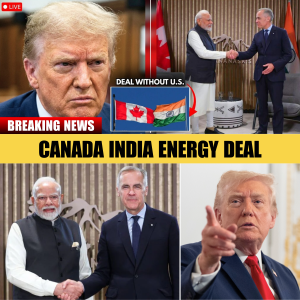
Mr. Trump’s reaction, some observers argue, inadvertently reinforced that strategy. “Economic leverage depends on the perception that there are no alternatives,” said one international relations scholar based in Ottawa. “If Canada can demonstrate credible alternatives, the dynamic changes.” Recent agreements in energy and technology cooperation with countries outside North America have been cited by Canadian officials as evidence that diversification is not merely rhetorical.

Still, the risks of miscalculation remain significant. Bilateral trade between the two countries exceeds hundreds of billions of dollars annually, and integrated supply chains mean that policy shocks on one side of the border quickly reverberate on the other. U.S. officials privately note that American manufacturers rely heavily on Canadian inputs, including energy and critical minerals, while Canadian exporters depend on predictable access to American consumers. Any deterioration in trust could complicate negotiations surrounding the scheduled review of the United States–Mexico–Canada Agreement.
Beyond the immediate economic stakes, the exchange has also taken on symbolic weight. At Davos, Mr. Carney framed his remarks around systemic pressures in global trade, arguing that smaller and medium-sized economies must cooperate to avoid becoming collateral in disputes among larger powers. Mr. Trump’s counterattack personalized the debate, casting it instead as a matter of loyalty and alignment. The contrast in tone has fueled commentary in Europe and Asia, where policymakers are grappling with similar questions about dependence and diversification.
In Canada, public reaction has been measured but attentive. Polling suggests that a majority of Canadians support efforts to broaden trade relationships, even as they value close ties with the United States. Opposition leaders have urged caution, warning that provoking Washington could have unintended consequences. Government officials insist that the objective is not confrontation but resilience.
Whether this episode marks a turning point or simply another chapter in a long and occasionally turbulent partnership remains unclear. The fundamentals of geography and economic interdependence are unlikely to change. Yet alliances are shaped as much by perception as by proximity. If both sides continue to test the limits of rhetoric without disrupting substantive cooperation, the relationship may absorb the strain. If, however, political signaling begins to alter policy decisions, the consequences could extend well beyond a single exchange of words.
For now, the immediate shock has subsided, but the underlying questions linger. How much autonomy can a close ally assert without inviting retaliation? And how durable is leverage in a world where diversification is increasingly feasible? As Canada pursues new partnerships and the United States recalibrates its own economic posture, the answers will unfold gradually — not in headlines alone, but in the structure of trade flows and diplomatic choices that follow.