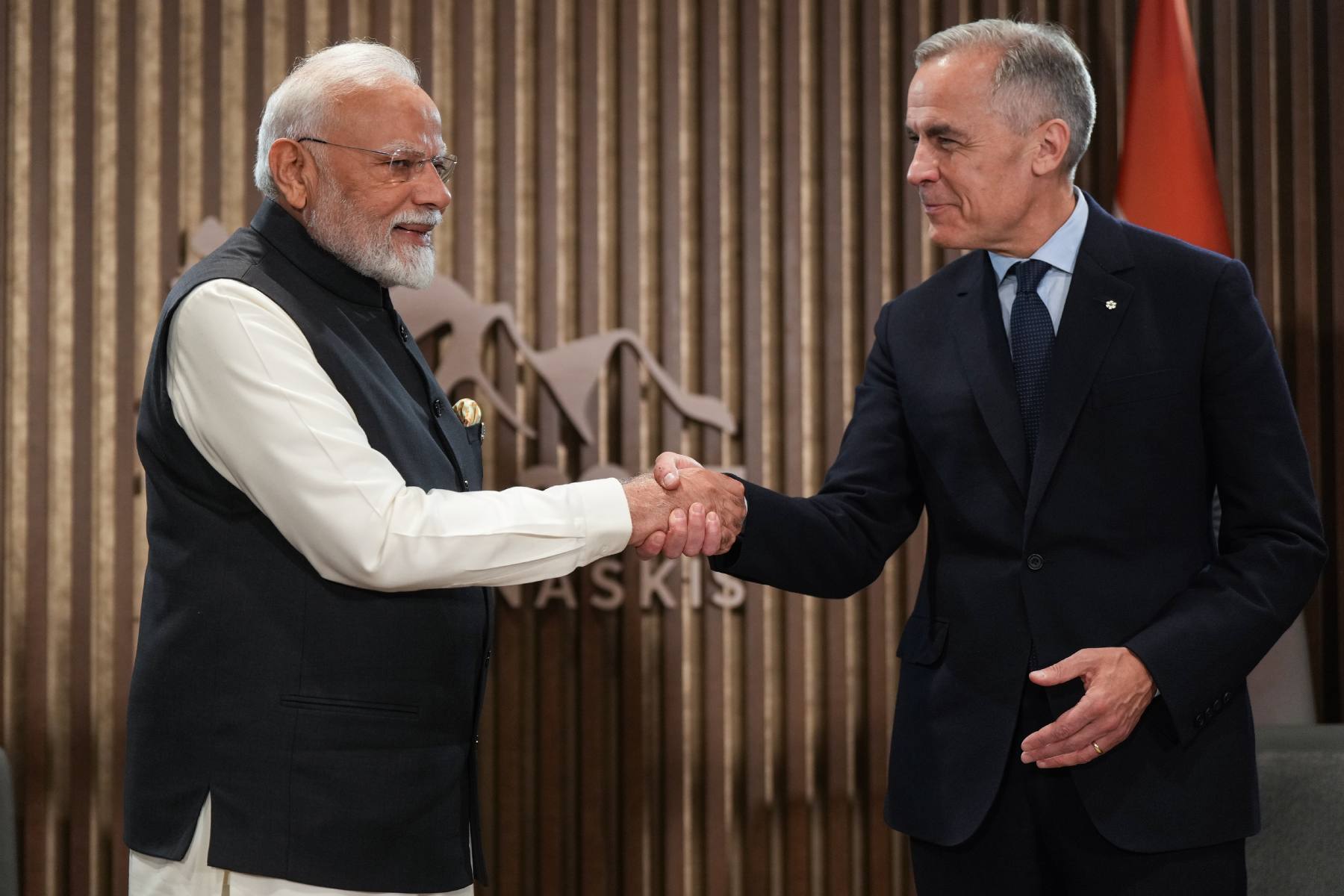
Less than a day after Prime Minister Mark Carney arrived in Mumbai for a five-day diplomatic visit, provincial and federal officials confirmed that Canada and India had opened formal discussions on a new long-term uranium supply agreement valued at approximately $3 billion over 10 years. While framed publicly as a commercial negotiation between Saskatchewan-based producers and India’s Department of Atomic Energy, the talks carry implications that extend well beyond fuel contracts.
At the center of the discussions is Cameco Corporation, one of the world’s largest uranium suppliers, headquartered in Saskatoon. According to officials familiar with the matter, the proposed agreement would provide uranium concentrate beginning in 2026 under a decade-long framework designed to support India’s ambitious expansion of nuclear energy capacity. The scale of the deal would far exceed a previous five-year arrangement signed in 2015, reflecting both rising global uranium demand and India’s accelerated energy transition plans.
India currently operates more than two dozen nuclear reactors and has set a target of dramatically increasing capacity by mid-century as it seeks to reduce reliance on coal, which still accounts for roughly 70 percent of its electricity generation. Government planning documents call for a substantial build-out of reactors to meet surging power demand from industrial growth, urbanization and the rapid expansion of data centers. Nuclear energy, Indian officials argue, offers a stable, low-carbon source of baseload power essential for sustaining economic growth while meeting climate commitments.
Securing long-term uranium supply is central to that strategy. Domestic production covers only a fraction of projected demand, and energy planners have prioritized diversification of import sources amid broader geopolitical volatility. In recent years, India has balanced energy purchases from Russia, the Middle East and Western suppliers, a posture that has at times generated tension with Washington. By deepening ties with Canada, a politically stable democracy and a top global uranium producer, Indian officials appear to be seeking both reliability and strategic balance.
For Canada, the logic runs in parallel but from a different starting point. Approximately three-quarters of Canadian exports flow to the United States, leaving Ottawa exposed to shifts in American trade policy. Under President Donald Trump, tariff threats and sharp rhetoric about trade imbalances have reintroduced uncertainty into the bilateral relationship. While uranium itself has not been at the center of recent disputes, Canadian officials have increasingly emphasized the need to diversify export markets across Asia and Europe.
“This is about long-term resilience,” said one senior Canadian official involved in the discussions, speaking on condition of anonymity because negotiations are ongoing. “Energy resources are a strategic asset. Expanding where and how we sell them strengthens our position in a more fragmented global economy.” Prime Minister Carney has framed his broader trade policy around what he calls “middle-power pragmatism” — cultivating partnerships that reduce dependence on any single great power.

The uranium talks are unfolding alongside discussions on liquefied natural gas, crude oil exports and critical minerals cooperation. India, now the world’s most populous country and one of its fastest-growing major economies, has signaled strong interest in securing Canadian supplies across multiple sectors. For provincial leaders such as Saskatchewan Premier Scott Moe, who joined portions of the Mumbai delegation, the negotiations also carry domestic economic weight. Uranium mining remains a major employer in northern Saskatchewan, including in Indigenous communities, and long-term contracts offer revenue stability in a historically volatile market.
Industry analysts note that the global uranium market has tightened in recent years amid renewed interest in nuclear power. Several countries have pledged to expand nuclear generation as part of climate mitigation strategies, and financial institutions project significant capital flows into the nuclear value chain through 2050. Long-term contracts, rather than spot-market purchases, have become increasingly attractive to utilities seeking price predictability and fuel security.
Still, the diplomatic backdrop remains delicate. Relations between Ottawa and New Delhi deteriorated sharply in 2023 following allegations by the previous Canadian government linking Indian agents to a killing on Canadian soil. India denied the accusations, and both countries expelled diplomats. Since taking office, Mr. Carney has sought to reset the relationship, toning down public rhetoric while expanding economic engagement. The uranium negotiations suggest that reset may be gaining traction, though legal proceedings related to the earlier case continue in Canadian courts.
In Washington, the emerging partnership is being monitored but has not drawn formal criticism. U.S. utilities are themselves significant consumers of Canadian uranium, and cross-border nuclear supply chains remain deeply integrated. Yet the symbolism of a large, direct Canada–India energy agreement, negotiated without American mediation, underscores a broader shift: allies increasingly pursuing parallel economic relationships as insurance against geopolitical uncertainty.
Whether the talks culminate in a signed contract will depend on pricing terms, regulatory approvals and long-term political stability in both capitals. But even at the negotiation stage, the discussions reflect a changing calculus. Energy security, once embedded within a tightly U.S.-centered North American framework, is becoming more diffuse. As countries hedge against volatility and seek diversified supply chains, commercial agreements are doubling as strategic instruments. The uranium deal, if finalized, would not only fuel reactors in India but also illuminate how middle powers are quietly redrawing the map of economic alignment — a process still unfolding, and far from complete.