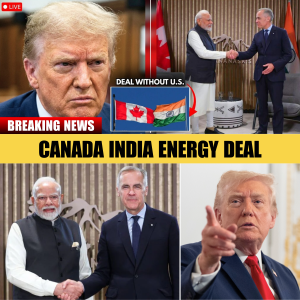
When India’s high commissioner to Canada declared this week that his country was willing to purchase “whatever Canada is offering” in energy supplies, the remark landed with unusual force in Ottawa. Made on the eve of Prime Minister Mark Carney’s five-day visit to New Delhi, the statement signaled not merely commercial interest but a potential reordering of energy relationships at a moment when both countries are reassessing their strategic dependencies.

For Canada, the timing is significant. Nearly all of its crude oil exports — roughly 93 percent last year, according to federal data — flow to the United States. That concentration has long been viewed as efficient, given geography and integrated infrastructure, but recent trade tensions with President Donald Trump’s administration have sharpened concerns in Ottawa about overreliance on a single customer. Mr. Carney has framed diversification as an economic imperative, and India’s overture offers a tangible pathway.
India’s energy appetite is formidable. Now the world’s most populous nation, it imports more than 80 percent of its oil and is rapidly expanding its liquefied natural gas capacity. Its government has set a goal of raising natural gas’s share of the energy mix to 15 percent by 2030, up from just over 6 percent today. Even more striking are its nuclear ambitions: New Delhi aims to expand installed nuclear capacity to 100 gigawatts by 2047, a more than tenfold increase from current levels. Such growth would require steady uranium supplies and technology partnerships, areas in which Canada holds competitive advantages.
Officials familiar with the discussions say a 10-year uranium supply agreement valued at approximately $3 billion is under active consideration, alongside broader talks on liquefied natural gas and crude oil exports. Saskatchewan, home to some of the world’s highest-grade uranium deposits, stands to benefit directly. Indian companies have also expressed interest in potential equity stakes in Canadian mining operations, according to provincial officials.
The overture reflects India’s own recalibration. In recent years, it has balanced energy imports among Russia, the Middle East and the United States. Washington’s imposition of tariffs and pressure campaigns over Russian oil purchases have underscored the risks of concentrated dependence. “Diversification is not optional; it is strategic,” said one Indian policy adviser who was not authorized to speak publicly. Canada, with its reputation for regulatory stability and large resource base, fits that calculus.
The rapprochement is notable given the recent chill in bilateral relations. Diplomatic ties deteriorated sharply after former Prime Minister Justin Trudeau accused Indian agents of involvement in a 2023 killing on Canadian soil, an allegation India denied. Trade talks stalled and high-level visits were curtailed. Mr. Carney’s decision to invite Prime Minister Narendra Modi to the Group of 7 summit in Alberta earlier this year was viewed as an attempt to reset the relationship without revisiting unresolved grievances. That gesture appears to have paved the way for renewed economic dialogue.

Energy infrastructure will determine how quickly any partnership can materialize. Canada’s export pipelines and terminals are overwhelmingly oriented southward. While liquefied natural gas facilities on the Pacific Coast are under development, and expansion of oil export capacity to British Columbia has been endorsed, analysts caution that significant volumes to India would require sustained investment and regulatory approvals. “The ambition is there,” said an energy economist at the University of Calgary. “The constraint is logistics.”
Still, even incremental diversification could alter negotiating dynamics with the United States. Energy trade has historically been insulated from political disputes, but recent tariff battles have eroded that assumption. By cultivating Asian buyers, Canada would gain leverage in future discussions. At the same time, Indian officials emphasize that their interest is not exclusive. “No single country can meet our entire demand,” the high commissioner noted, suggesting that Canada would join a diversified portfolio rather than replace existing suppliers.
For Mr. Carney, the visit offers both opportunity and risk. A breakthrough agreement would bolster his narrative of resilience and global engagement. Yet the relationship must navigate sensitive terrain, including diaspora politics and security cooperation. Domestic critics in Canada caution against subordinating human rights concerns to commercial gain, while industry leaders urge swift action to secure long-term contracts.
The broader implications extend beyond bilateral trade. As global energy markets fragment under geopolitical pressure, middle powers are seeking to insulate themselves from coercive leverage. Canada’s effort to broaden its customer base and India’s drive to expand its supplier pool reflect parallel strategies of autonomy. Whether the talks in New Delhi yield binding agreements or simply a framework for future cooperation, they underscore a shift in how both governments conceive of economic security.
What remains uncertain is the durability of this convergence. Infrastructure timelines, political transitions and shifting market prices could complicate implementation. Yet the statement that India is prepared to buy “whatever Canada is offering” has already reframed expectations. It suggests that in an era defined by volatility, partnerships forged around shared vulnerability may prove as consequential as those rooted in geography.