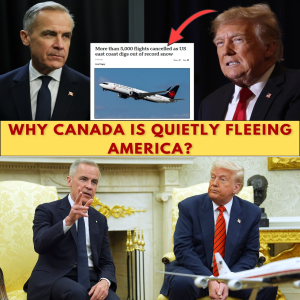
Tensions between Ottawa and Washington sharpened this week after President Donald Trump suggested that Canada would need to “accept higher tariffs” as a condition for advancing a new bilateral trade arrangement.
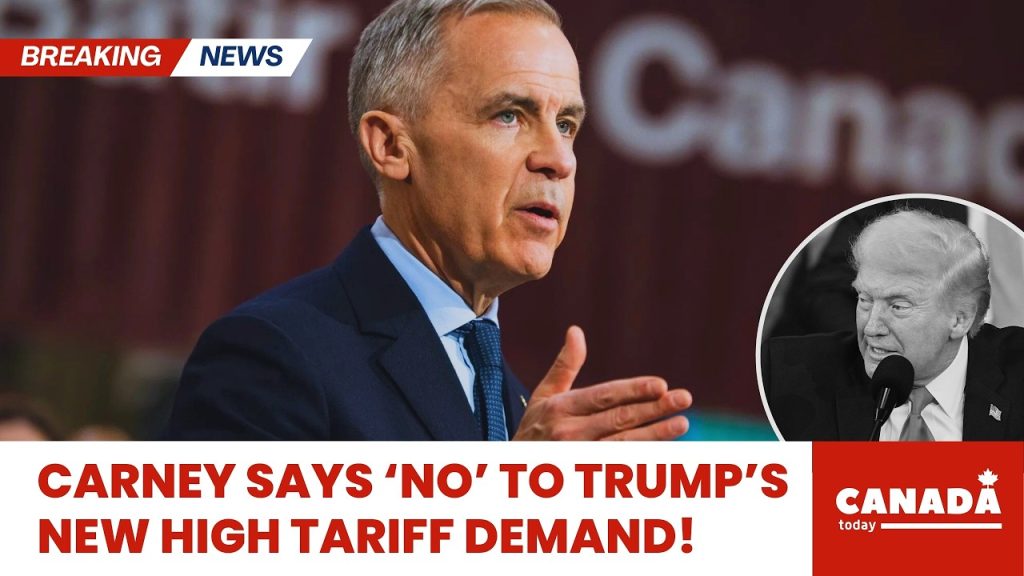
The remarks, delivered during a nationally televised address and later reiterated by the U.S. Trade Representative, framed tariffs not as a temporary pressure tool but as a structural expectation. “If Canada wants a deal,” the trade chief said, “there has to be some level of higher tariff while markets open further.” The message was clear: concessions first, relief later.
Prime Minister Mark Carney responded without direct confrontation but with unmistakable intent. In remarks to reporters, he avoided inflammatory language and instead emphasized what he called “economic resiliency” and “diversification beyond North America.” The subtext was equally clear: Canada will not negotiate from a position of dependence.
The exchange marks the most visible escalation in months of quiet trade friction. The United States remains Canada’s largest export market, accounting for roughly three-quarters of Canadian goods exports. Yet Ottawa has accelerated efforts to expand trade ties with the European Union, Indo-Pacific partners and Gulf states — moves that predate the current dispute but have taken on new urgency.
Carney’s approach reflects a broader strategy: reduce concentration risk. Canadian officials point to recent agreements boosting agricultural access in Asia, expanded defense procurement cooperation with Europe and infrastructure investment pledges from Middle Eastern sovereign funds. While none of these initiatives replace the scale of U.S. trade, together they form a hedge against tariff volatility.
Trade economists note that leverage in negotiations depends on asymmetry. Historically, the United States has been able to exert pressure on smaller economies because access to the American market carries outsized weight. That dynamic shifts, however, when alternative channels expand. “The more diversified your export base,” said one Toronto-based analyst, “the less coercive tariff threats become.”
For Washington, the tariff stance aligns with President Trump’s longstanding negotiation doctrine: use economic pressure to secure structural concessions. The administration argues that higher protective tariffs can revive domestic industries and compel partners to liberalize their own markets, particularly in sectors such as dairy and manufacturing.
But tariffs also carry domestic costs. U.S. manufacturers reliant on Canadian inputs — especially in automotive, energy and aerospace supply chains — face potential price increases. Cross-border production corridors are deeply integrated, with components often crossing the border multiple times before final assembly.

Inside Congress, reactions have been mixed. Some lawmakers support a tougher line, arguing that trade imbalances require recalibration. Others caution that escalating measures against Canada risk destabilizing one of America’s most economically intertwined relationships.
Financial markets have so far responded cautiously. Currency traders have noted modest volatility in the Canadian dollar, while agricultural futures reflected uncertainty about potential retaliatory measures. Neither side has formally announced new tariffs, but officials in Ottawa have confirmed that contingency frameworks are being reviewed.
Carney’s rhetoric has remained notably restrained. Rather than framing the dispute as confrontation, he has positioned it as a structural evolution. “Our responsibility,” he said this week, “is to ensure that Canadian workers and exporters have access to diversified opportunities.” The phrasing avoids direct rebuttal while signaling that Ottawa will not validate the premise of unilateral tariff elevation as a negotiating baseline.
Analysts describe this as disciplined resistance. Instead of counterthreats, Canada is emphasizing optionality. That strategy does not eliminate short-term economic pain should tariffs rise, but it shifts the psychological terrain. A partner with alternatives negotiates differently than one boxed into a single market.
The coming weeks will determine whether the dispute hardens into formal tariff action or evolves into a recalibrated agreement. Trade officials on both sides say communication channels remain open.
Beyond the immediate standoff lies a broader question about North American alignment. For decades, economic gravity in the region centered overwhelmingly on Washington. If Ottawa continues diversifying successfully, that gravitational pull could weaken — not dramatically, but incrementally.
For now, the dispute is less about pride than about structure. The United States is signaling that tariffs remain its preferred instrument of leverage. Canada is signaling that it intends to reduce exposure to that leverage.
In trade politics, outcomes are rarely decided in a single exchange. They unfold through patterns — investment decisions, contract renewals, supply chain adjustments. The present moment may prove less about whether Canada “accepts higher tariffs” and more about whether both countries recalibrate their expectations of dependence in an increasingly multipolar trade environment.