The ‘Brewers Karen’ Backlash: From Stadium Rant to Social Exile
In the charged atmosphere of MLB playoffs, where rivalries burn bright, a single outburst can outshine the game itself. On October 15, 2025, during Game 3 of the National League Championship Series at American Family Field in Milwaukee, the Los Angeles Dodgers crushed the Milwaukee Brewers 5-1, taking a 3-0 series lead. Amid the tension, a confrontation between fans went viral, branding one woman as the infamous “Brewers Karen.” Now, Shannon Kobylarczyk, a 45-year-old Wisconsin resident, has spoken out, pleading for relief from the relentless public shaming that has upended her life.
The incident occurred in the eighth inning, with Dodgers pitcher Yoshinobu Yamamoto dominating and their offense piling on runs. Ricardo Fosado, a 38-year-old U.S. Army veteran and Dodgers fan from Los Angeles, had traveled to Milwaukee to support his team in a hostile sea of Brewers fans. After a Dodgers score, Fosado taunted the quiet crowd: “Why’s everybody so quiet? What is this?” His words sparked a fire. Kobylarczyk, a lifelong Brewers supporter seated nearby with her husband, leaned toward Fosado, her face twisted with anger. “Let’s call ICE,” she snapped, a jab implying Fosado, who is Latino, didn’t belong in the country. Fosado, unfazed, shot back: “I’m a U.S. citizen, war veteran, baby girl. Call ’em—tell ’em to come get me.” The exchange escalated when Kobylarczyk swatted at Fosado’s arm, prompting security to eject both fans. Fosado was later cited for disorderly conduct and public intoxication, unrelated to the verbal spat, per Brewers officials.

The 27-second video, recorded on Fosado’s phone, exploded online, amassing over 10 million views on X and TikTok. Kobylarczyk was dubbed “Brewers Karen,” a nod to the stereotype of entitled, racially insensitive white women. Social media buzzed with memes and outrage, with hashtags like #BrewersKaren and #CallICE trending nationwide. Some mocked her, tying her outburst to the Brewers’ playoff collapse: “Karen energy cursed Milwaukee.” Others compared it to a prior “Phillies Karen” incident, where a fan berated another over a foul ball. Within hours, online sleuths identified Kobylarczyk as a compliance specialist at ManPowerGroup and a Make-A-Wish Wisconsin board member.
The consequences were swift. ManPowerGroup fired Kobylarczyk, stating zero tolerance for discriminatory behavior. Make-A-Wish announced her resignation amid donor backlash. The Brewers banned both fans from future games, emphasizing that offensive remarks about race, gender, or national origin are unacceptable. Fosado, celebrating the Dodgers’ series-clinching win the next night, showed surprising empathy. “Everybody messes up,” he told reporters outside Dodger Stadium. “She shouldn’t lose everything over one bad moment.”
On October 18, Kobylarczyk broke her silence in a tearful five-minute video from her Milwaukee home. Visibly shaken, she clutched a tissue, her voice trembling. “I can’t leave my house without people yelling ‘Karen Ballsnatcher’ at me,” she said, referencing a crude meme twisting her name into a taunt. “It’s everywhere—grocery stores, my neighborhood. Kids are chanting it. My husband’s getting glares at work. It’s not fair. I was upset about the game, said something stupid. I’m not racist; I’ve volunteered with Make-A-Wish, helping kids of all backgrounds. But one video ruined my life.”
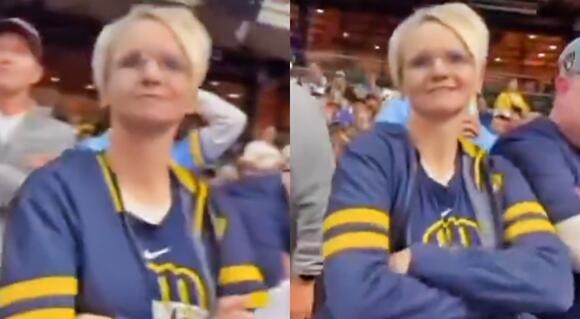
Kobylarczyk, a mother of two teens, described the toll: harassing calls, vandalized lawn signs, and social isolation. “The internet’s made me a monster,” she said. “I respect Ricardo’s service. The ICE comment was thoughtless. But this mob justice? I’ve lost my job, my volunteer role, my season tickets. How do I explain this to my kids?” She vowed to seek counseling and support anti-racism causes, pleading, “Stop the hate. Let me make this right.”
Reactions split sharply. Some on X defended her, calling the backlash excessive: “Cancel culture’s out of control—Brewers fans aren’t the enemy.” Others were unforgiving: “You targeted a veteran with racism—own it,” one Dodgers fan posted. Fosado, in a TikTok follow-up, urged calm: “No hard feelings, Shannon. Heal.” Yet the “Ballsnatcher” taunts linger, a digital scar from a night when playoff passion turned ugly.
This saga reflects deeper tensions in sports fandom: the thrill of rivalry colliding with accountability in an age of instant virality. As the Dodgers eye another World Series, the Brewers reel, and Kobylarczyk faces a world reshaped by 27 seconds of fury. Baseball thrives on unity, not division—perhaps Milwaukee’s October holds that lesson.