WASHINGTON — What began as a routine Senate hearing on future defense priorities quickly hardened into one of the most consequential exchanges of the year, as Senator Mark Kelly confronted Defense Secretary Pete Hegseth over the proposed “Golden Dome” missile defense system. With projected costs that could climb from an initial $25 billion to nearly $1 trillion over its lifespan, the program has become a flashpoint in a broader debate about feasibility, oversight, and the strategic risks of betting America’s security on unproven technology.
Kelly, a former astronaut, Navy combat pilot, and engineer, approached the hearing not as a partisan exercise but as a technical interrogation. His questions were precise, methodical, and rooted in physics as much as policy. At stake, he argued, was not merely the size of the price tag, but whether the United States was on the verge of committing to a system that may never work as advertised.

“This is not a concept drawing on a napkin,” Kelly said during the exchange. “This is a massive national investment that depends on assumptions about physics, detection, and interception that have not been demonstrated at scale.”
The Promise—and the Price—of Golden Dome
The Golden Dome proposal envisions a layered missile defense shield capable of intercepting ballistic, hypersonic, and cruise missiles, potentially including space-based sensors and interceptors. Supporters describe it as a transformative leap in homeland defense, arguing that evolving threats from near-peer adversaries demand an equally ambitious response.
But Kelly focused on the gap between aspiration and execution. He noted that even limited missile defense systems have struggled under test conditions, and that scaling such capabilities to defend an entire continent introduces exponentially greater complexity.
“Intercepting a single target under controlled conditions is hard enough,” Kelly said. “Intercepting multiple, maneuverable targets launched simultaneously is a different problem altogether.”
As Kelly pressed Hegseth, the discussion turned to cost controls — or the lack thereof. Independent analysts have warned that initial estimates often understate long-term expenses, particularly for systems that rely on emerging technologies. Kelly cited historical examples in which ambitious defense programs ballooned far beyond their original budgets, leaving Congress and taxpayers to absorb the overruns.
Oversight Under Scrutiny
Perhaps the most pointed moment of the hearing came when Kelly questioned proposed reductions to the Pentagon’s testing and evaluation office — the very entity responsible for independently assessing whether complex systems actually perform as claimed.
To Kelly, the contradiction was stark: a program of unprecedented scale paired with diminished independent oversight.
“You are asking Congress to trust projections while simultaneously weakening the office that verifies them,” Kelly said. “That is not how responsible engineering works.”
Hegseth defended the proposed changes as a streamlining effort, arguing that excessive bureaucracy can slow innovation and inflate costs. He emphasized the need for agility in a rapidly evolving threat environment.
But Kelly was unconvinced. Drawing on his experience in spaceflight, he warned that sidelining independent testing invites catastrophic failure.
“In aerospace,” Kelly said, “you don’t cut corners on verification because the consequences are unforgiving. National defense is no different.”
Physics Versus Politics
The exchange underscored a deeper tension that has followed missile defense efforts for decades: the collision between political urgency and physical limits. While technology has advanced significantly, intercepting high-speed, evasive missiles remains one of the most difficult challenges in modern engineering.
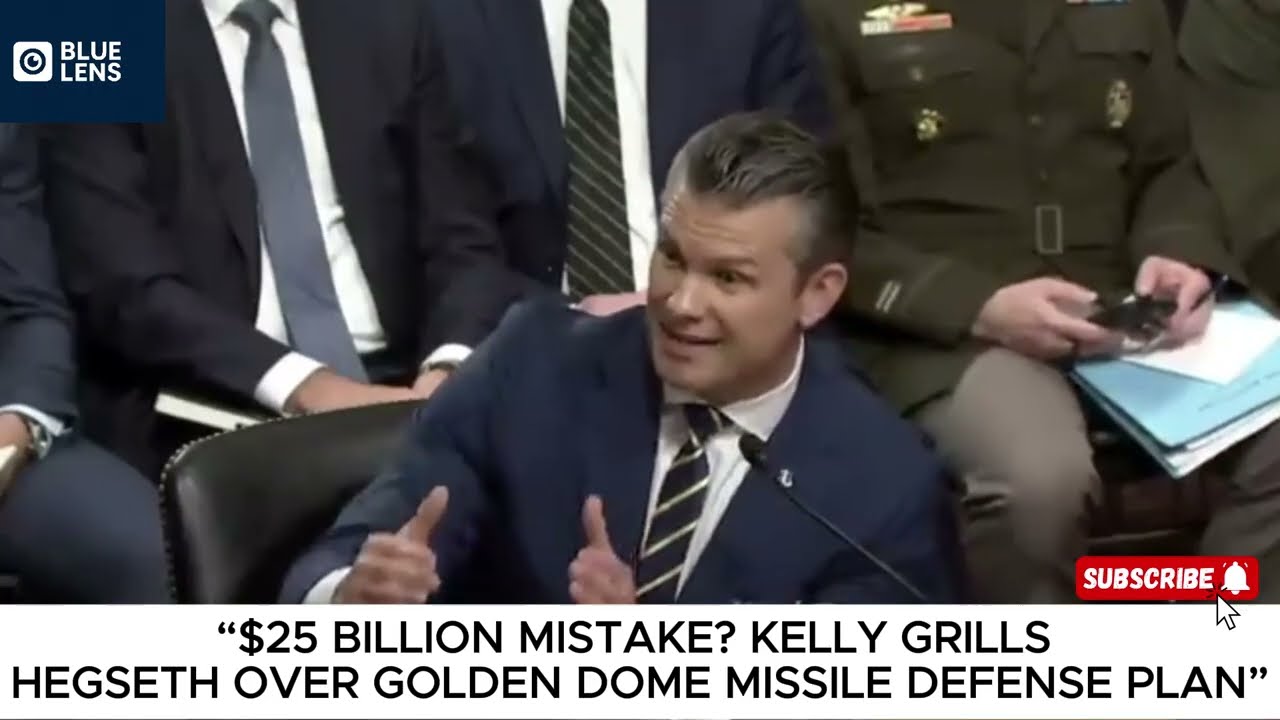
Kelly pressed Hegseth on the basic mechanics of detection and interception, asking how the system would reliably distinguish real warheads from decoys, particularly in a mass-launch scenario. He also raised concerns about hypersonic weapons, which can maneuver unpredictably and compress decision timelines to mere minutes.
“These are not abstract questions,” Kelly said. “They are the difference between a system that protects the country and one that offers false confidence.”
Hegseth responded by pointing to ongoing research and classified capabilities, arguing that adversaries’ advances necessitate bold investment even amid uncertainty. He framed Golden Dome as a deterrent as much as a defensive tool, suggesting that its mere existence could alter adversaries’ calculations.
A Broader Budgetary Reckoning
Beyond technical feasibility, Kelly tied Golden Dome to a larger fiscal reality. With competing demands on the defense budget — from shipbuilding to cyber capabilities to service member readiness — he questioned whether an open-ended missile defense program would crowd out more reliable investments.
“A trillion dollars spent here is a trillion dollars not spent elsewhere,” Kelly said. “We owe it to the American people to be honest about those trade-offs.”
The senator emphasized that skepticism does not equal complacency. He acknowledged the reality of emerging missile threats but argued that realism, not ambition alone, should guide policy.
An Exchange That Resonated
The hearing quickly drew attention on Capitol Hill and beyond, not for rhetorical fireworks but for its substance. Observers noted that Kelly’s approach stood out in an era when complex defense issues are often reduced to slogans. His questions forced a rare public examination of the technical and institutional foundations of a marquee Pentagon proposal.
Whether Golden Dome advances in its current form remains uncertain. What is clear is that Kelly’s interrogation shifted the conversation. It reframed the debate from one of political will to one of engineering discipline and accountability.
As the hearing adjourned, Kelly offered a closing note that captured the stakes.
“Ambition is not a plan,” he said. “And hope is not a strategy. If we are going to spend this kind of money in the name of national security, the system has to work — not in theory, but in reality.”
For a program that promises near-perfect defense at a near-unimaginable cost, that distinction may determine whether Golden Dome becomes a cornerstone of U.S. security — or a cautionary tale of overreach.