When Arithmetic Breaks the Fourth Wall on Fox News
For years, Donald Trump’s political style has thrived on exaggeration so large that it bends reality, daring critics to chase it and supporters to cheer it. But on Wednesday night, during what was supposed to be another safe primetime echo of presidential bravado, something unusual happened: basic math intervened.
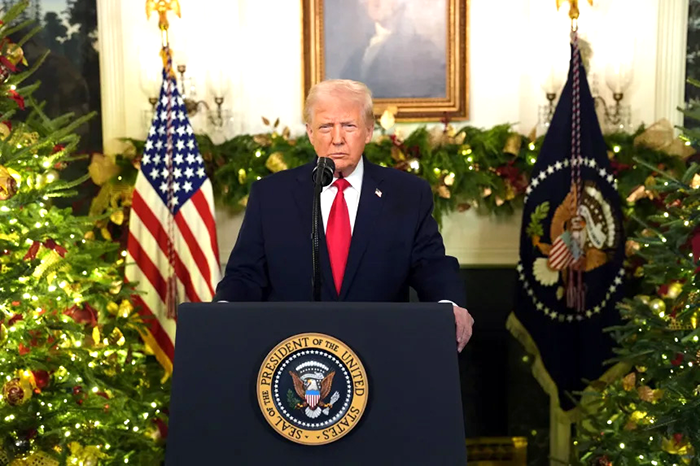
In a speech meant to showcase his economic credentials, President Trump once again claimed that his administration had slashed prescription drug prices by “400, 500, even 600 percent.” It was not a new line. He has repeated variations of it dozens of times, often to applause. What was new was what came next. On Fox News — a network that has long served as a friendly amplifier rather than a skeptical filter — a host paused, leaned into the numbers, and asked a question that many Americans have quietly wondered: How is that even possible?
John Roberts, a veteran Fox News anchor known for a more traditional, straight-news approach, laid it out plainly. A price cut cannot exceed 100 percent without crossing into absurdity. Cut something by 100 percent, and it costs zero. Cut it by 600 percent, and, mathematically speaking, the seller would be paying the buyer to take it. The moment was brief, calm, and devastating.
Roberts directed his skepticism at Howard Lutnick, a prominent Trump ally and senior administration surrogate. Lutnick’s response — an attempt to reframe percentage decreases as reverse increases — quickly unraveled. He offered a hypothetical: a drug that once cost $100 now costs $13. From $13, he argued, returning to $100 would require a roughly 700 percent increase. Therefore, he suggested, bringing it “down” from the old price could be described as a 700 percent reduction.
It was, as critics immediately noted, a semantic sleight of hand. In standard arithmetic, the price drop from $100 to $13 is an 87 percent reduction. No economics textbook, no pricing model, no middle-school math class describes that change as a 600 or 700 percent cut. On social media, the clip spread rapidly, not because it revealed a new policy failure, but because it exposed something more basic: the administration’s casual relationship with numbers.
Within hours, the exchange was trending across platforms. Commentators replayed the clip, often slowing it down, sometimes adding graphics, always emphasizing the same point — this was not a partisan “gotcha,” but a factual correction delivered on Trump’s own media turf. For many viewers, that was the real shock.
Fox News has, on occasion, allowed moments of mild dissent, but rarely in such a clean, unembellished form. Roberts did not mock Lutnick. He did not editorialize. He simply stated a mathematical reality and asked how much of the president’s speech should be understood as hyperbole versus fact. That restraint only sharpened the impact.

Behind the scenes, according to people familiar with the network’s operations, the moment caused visible tension. Producers were reportedly caught off guard by how far Roberts pressed the point. There was no immediate cutaway, no commercial break rescue. The segment ran its course, and the damage — at least in viral terms — was done.
The episode taps into a larger pattern of the Trump era, one in which language, facts, and even numbers are treated as flexible tools rather than fixed references. Trump has long coined words, reshaped meanings, and brushed aside corrections. When he typed “covfefe,” supporters insisted they understood exactly what he meant. When he boasts of impossible percentages, allies rush to reinterpret rather than refute.
Lutnick’s performance illustrated the dynamic perfectly. His explanation was not born of confusion but of loyalty. He is widely regarded as sharp and numerate, which only made the sputtering defense more striking. The goal was not to clarify reality, but to protect the narrative — even if that meant redefining how percentages work.
What made this moment resonate was not just the math lesson, but who delivered it and where. Fox News has been central to sustaining Trump’s political mythology. For a Fox host to puncture that mythology, even briefly, felt to many viewers like a crack in a carefully maintained wall.
Whether that crack widens remains to be seen. The network quickly moved on. Trump has not corrected his language and is unlikely to. His supporters, accustomed to grandiose claims, may shrug it off as media nitpicking. But for others — especially those exhausted by years of rhetorical inflation — the exchange offered something rare: a reminder that facts still exist, and occasionally, even friendly venues acknowledge them.
In an age when political debate often feels untethered from shared reality, a few seconds of seventh-grade math managed to do what hours of punditry could not. It slowed the narrative, exposed the exaggeration, and left viewers with a simple, uncomfortable question: If the numbers don’t add up, what else doesn’t?