Trump’s Canada Tariff Ultimatum Backfires as Mark Carney Accelerates Trade Diversification
Trump’s Tariff Threat and the Sovereignty Debate
Tensions between the United States and Canada have escalated after former President Donald Trump threatened sweeping 100% tariffs on Canadian goods if Ottawa does not align with Washington’s trade demands.
The proposed tariffs would affect roughly $865 billion in annual bilateral trade — impacting automobiles, oil, steel, electricity, agricultural exports, and critical minerals. The ultimatum, framed by Trump as a corrective measure to protect American interests, has instead triggered political resistance in Washington and accelerated strategic recalibration in Ottawa.
Prime Minister Mark Carney has publicly rejected any suggestion that Canada must subordinate its economic or foreign policy decisions to American pressure. Speaking at the World Economic Forum in Davos, Carney warned against the weaponization of economic interdependence, arguing that middle powers must build partnerships to avoid becoming vulnerable to coercion.
The confrontation is not merely about tariffs. It reflects a broader dispute over sovereignty, leverage, and the future structure of North American economic integration.
Congressional Pushback Undermines the Tariff Strategy
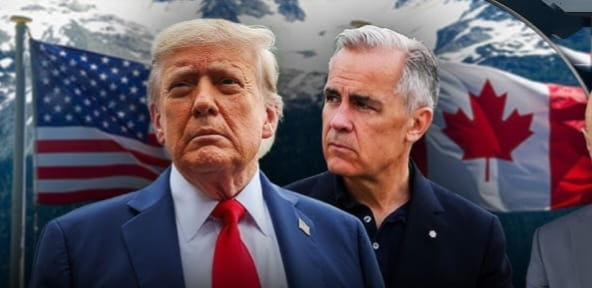
In a significant development, the U.S. House of Representatives reportedly voted 219–211 to terminate existing emergency tariff authorities related to Canada, with six Republicans joining Democrats in opposition to Trump’s strategy.
The vote highlights a critical reality: Canada is deeply integrated into American supply chains, particularly across the industrial Midwest.
-
Automotive production often crosses the U.S.–Canada border multiple times during assembly.
-
Approximately 60% of U.S. crude oil imports originate from Canada.
-
Canada supplies a substantial portion of U.S. electricity imports.
-
American construction, manufacturing, and defense sectors rely on Canadian aluminum, steel, uranium, and critical minerals.
Members of Congress from Michigan, Ohio, Pennsylvania, Wisconsin, Illinois, Indiana, and Minnesota face direct economic consequences if cross-border supply chains are disrupted. Industry groups have quietly lobbied against aggressive tariffs, warning of higher production costs and job losses in American districts.
This internal resistance suggests Trump’s ability to fully execute a tariff blockade may be constrained by domestic political and economic realities.
The Limits of Economic Leverage
Trump’s approach appears rooted in a straightforward calculation: roughly 75% of Canadian exports go to the United States, creating structural dependence. Therefore, threatening market access should produce compliance.
Historically, that leverage has existed. But leverage depends on alternatives — and alternatives can evolve.
Carney’s strategy emphasizes reducing vulnerability through diversification rather than responding solely through retaliatory measures.
Canada’s Trade Diversification Strategy
1. Expanded Access to Asian Markets
Canada has negotiated targeted trade arrangements with China focused on agricultural exports, including canola, seafood, and lobster — generating billions in additional export pathways for Canadian producers.
While not a full free trade agreement, the arrangement reduces tariff exposure in specific sectors. For Canadian farmers, this creates options beyond the U.S. market.
Options alter negotiating dynamics.
2. Deepening Defense and Industrial Cooperation with Europe
Canada has moved to participate in the European Union’s €150 billion defense procurement framework, becoming the only non-European participant in certain collaborative programs.
This opens pathways for:
-
Joint weapons development
-
Technology transfers
-
Manufacturing partnerships with France and Germany
-
Reduced dependence on American defense contractors
For decades, U.S. defense firms operated as Canada’s near-exclusive suppliers. Increased European integration introduces competition into that ecosystem.
3. Arctic Security Partnerships
Canada has strengthened security coordination with Denmark, including Arctic surveillance cooperation involving Greenland and the Faroe Islands.
The Arctic remains strategically vital for shipping lanes, energy exploration, and geopolitical positioning. Multilateral cooperation reduces the perception that Canada must rely solely on Washington for northern security alignment.
Infrastructure as Strategic Autonomy
Carney’s approach also focuses on domestic infrastructure:
-
Expanding pipelines to Canadian ports for Asian exports
-
Developing domestic mineral processing facilities
-
Strengthening east–west energy interconnections between provinces
-
Reducing sole reliance on north–south supply corridors
Diversification is not immediate disengagement from the United States. It is risk mitigation.
Dependence is not permanent; it is a function of infrastructure, logistics, and market access. Those variables can change with investment and time.
American Industry’s Quiet Resistance
One of the most significant dynamics in this dispute is the role of U.S. industry.
Automotive manufacturers cannot easily replace Canadian components. Energy companies cannot quickly substitute Canadian crude. Construction firms rely on Canadian metals. Defense contractors require Canadian uranium and minerals.
Public confrontation with a former president may carry political risks for corporations. However, lobbying through congressional channels provides a quieter mechanism of resistance.
The House vote signals that Trump’s tariff strategy lacks unanimous Republican support — particularly in states heavily tied to cross-border trade.
Without sustained domestic backing, sweeping tariffs become difficult to maintain.
The USMCA Review as a Flashpoint
The upcoming review of the United States-Mexico-Canada Agreement (USMCA) could become a pivotal moment.
Trump may attempt to use renegotiation as leverage to demand concessions. However, Canada’s evolving diversification efforts provide greater flexibility than in past trade disputes.
Gradual reduction of export concentration — from 75% dependence on the U.S. toward lower levels over several years — is structurally possible if infrastructure and alternative agreements continue expanding.
Markets shift incrementally, not overnight. But once supply chains reorient, reversals become costly.
Sovereignty vs. Integration
At its core, the dispute raises a larger question: Does deep economic integration imply subordination?
For decades, Canada balanced cooperation with pragmatic accommodation, prioritizing access to American markets and security guarantees.
However, rhetoric suggesting annexation, economic blockade, or enforced compliance alters that calculation.
When partnership is framed as dominance, diversification becomes politically defensible.
Carney has emphasized autonomy rather than confrontation — maintaining cooperation while ensuring Canada retains the capacity to refuse unreasonable demands.
The Strategic Miscalculation Risk
Trump’s approach assumes:
-
Canadian dependence is permanent.
-
American industries will tolerate supply chain disruption.
-
Political pressure in Ottawa will force capitulation.
Yet each tariff threat may accelerate exactly what it seeks to prevent — Canadian diversification.
Economic coercion can sometimes produce compliance. It can also incentivize structural independence.
If alternative markets solidify, American leverage diminishes over time.
The Future of the U.S.–Canada Relationship
The $865 billion trade relationship is unlikely to collapse. Geographic proximity, cultural ties, and decades of integration anchor the partnership.
However, the character of that relationship may shift:
-
From exclusive reliance to diversified alignment
-
From implicit hierarchy to negotiated equality
-
From structural dependence to strategic autonomy
For the United States, maintaining influence may require cooperation rather than coercion.
For Canada, diversification does not mean anti-Americanism. It means optionality.
Conclusion
Trump’s tariff ultimatum was designed to assert leverage. Instead, it has exposed the complexity of North American interdependence.
Congressional resistance, industrial lobbying, and Canada’s expanding global partnerships suggest the situation is more balanced than headline rhetoric implies.
Leverage functions only when the other side believes it has no alternative.
Mark Carney’s strategy centers on proving that alternatives exist.
If diversification continues, future trade negotiations between Washington and Ottawa may unfold on more equal footing — not through submission, but through mutual recalibration.
The next chapter in U.S.–Canada relations will not be defined solely by tariffs, but by infrastructure, alliances, and the strategic choices both nations make in response to pressure.
And those choices are already reshaping the equation.