Canada’s Export Shift Sends Shockwaves: Is the U.S. Losing Its Economic Grip?
A Historic Trade Shift Hidden in Plain Sight
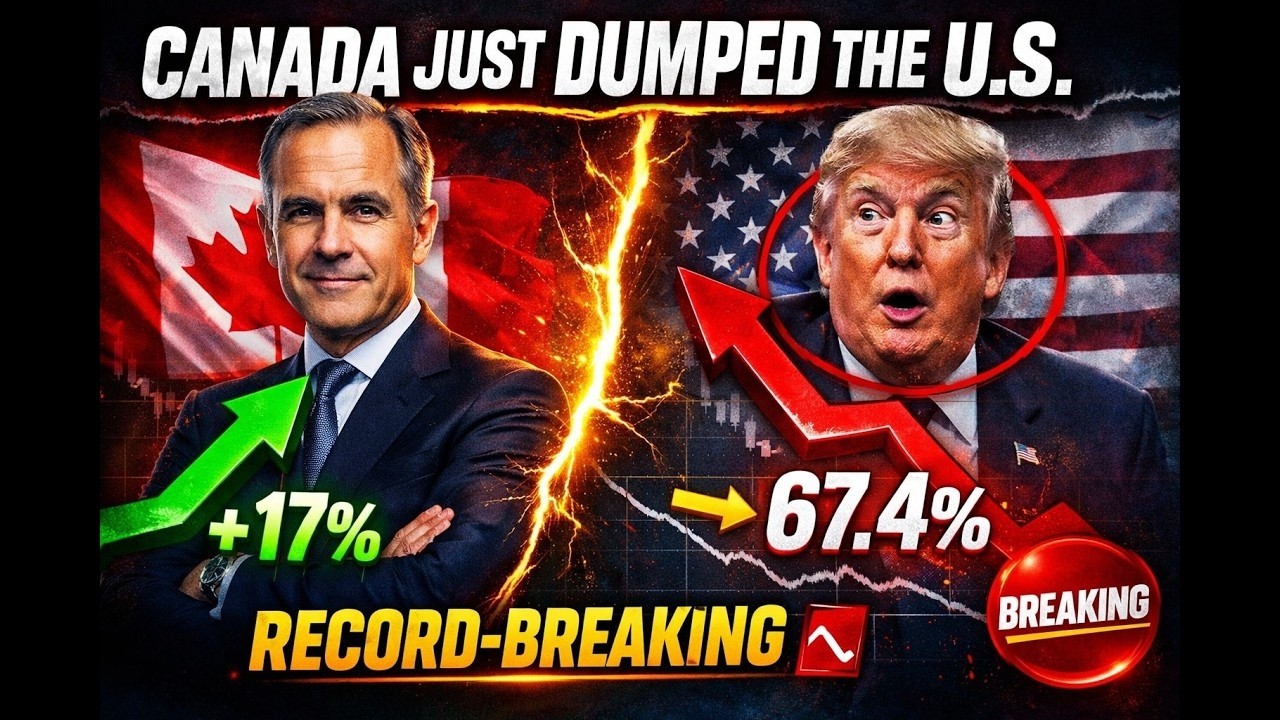
Canada’s latest trade report has ignited intense debate among economists and policymakers. According to newly released data from Statistics Canada, the share of Canadian exports heading to the United States has fallen to 67.4% — the lowest level ever recorded in modern trade history.
For decades, the assumption was simple: Canada sells primarily to America. Roughly three-quarters of Canadian exports traditionally flowed south. That economic architecture shaped supply chains, energy infrastructure, and manufacturing strategies across North America.
Now, that foundation appears to be shifting.
The Numbers Behind the Shock
Let’s examine the key figures:
-
December export share to the U.S.: 67.4%
-
One year earlier: 76.2%
-
Full-year drop (2025): from 76% to 72%
-
Non-U.S. exports growth in 2025: +17%
This is not a minor fluctuation. A nearly nine-percentage-point drop in 12 months represents one of the fastest directional shifts in Canadian trade patterns in modern history.
Three consecutive months below 69% — October, November, December — signal what economists describe as a potential structural trend rather than a temporary anomaly.
Stuart Bergman, chief economist at Export Development Canada, characterized the development as “more likely an indication of a trend than a single month movement.”
That is economist language for something fundamental is changing.
The Role of Trump’s Tariff Policies
The trade relationship between the United States and Canada experienced significant tension during the presidency of Donald Trump. Steel and aluminum tariffs imposed under national security provisions strained diplomatic and economic ties.
While those tariffs were framed as protective measures for American industry, they also created incentives for Canada to diversify its export markets.
Economic pressure often forces structural change. In this case, the numbers suggest diversification accelerated dramatically.
Where Are Canadian Exports Going Instead?
If exports to the United States are shrinking as a share, where is the growth occurring?
According to December data:
-
Gold shipments to the United Kingdom surged.
-
Energy discussions intensified with Japan and South Korea.
-
Metals and minerals exports expanded to Europe.
-
Manufacturing exports to non-U.S. destinations also increased.
The significance here is not simply commodity redirection. Manufacturing diversification suggests long-term contractual realignment.
When supply chains are rebuilt and distribution agreements are signed abroad, those relationships rarely reverse overnight.

The Structural Implications
The U.S.-Canada trade framework has been shaped by major agreements over decades, including:
-
The 1965 Auto Pact
-
NAFTA (1994)
-
USMCA (2020)
Each agreement reinforced the idea of a deeply integrated North American economy.
A sustained drop in U.S. export share below 70% challenges that integration model.
Economically, this resembles a river gradually changing course. Once alternative trade corridors are established, infrastructure investments follow. Ports expand. Shipping contracts lock in. Refining and processing hubs reorient.
Reversing such structural adjustments becomes difficult.
The Asymmetry Washington May Be Overlooking
While Canada’s export share to the U.S. is declining, American exports to Canada have actually increased modestly — rising 3.5% in December.
Canada’s trade surplus with the U.S. narrowed from CAD 6.5 billion to CAD 5.7 billion month-over-month.
This creates a potential asymmetry:
-
Canada is diversifying its customer base.
-
The United States remains heavily reliant on Canadian energy, minerals, lumber, and critical inputs.
Certain Canadian exports — heavy crude oil, aluminum, uranium, potash — are not easily replaceable in the short term.
This does not mean supply will be cut. It means bargaining power dynamics could shift.
What This Means for American Industry
For U.S. manufacturers and refiners, the implications are subtle but meaningful.
If Canadian producers increasingly secure alternative buyers:
-
Input competition may intensify.
-
Contract pricing could shift.
-
Lead times may lengthen.
-
Energy and raw material leverage may rebalance.
Midwestern states, Great Lakes manufacturing hubs, and Gulf Coast refineries have historically operated under the assumption that Canadian supply flows south by default.
The new data suggests that assumption may no longer be automatic.
Financial Markets: Why the Reaction Has Been Muted
Interestingly, market reaction to the trade report was relatively calm.
-
The Canadian dollar moved only marginally.
-
Bond yields ticked up slightly.
-
Equity markets did not display extreme volatility.
This muted reaction suggests markets may have already anticipated gradual diversification.
Structural economic shifts often move slowly enough that investors adjust expectations incrementally rather than dramatically.
The Strategic Dimension
Canadian Prime Minister Mark Carney, with a background as former Governor of the Bank of Canada and the Bank of England, is widely viewed as financially sophisticated.
Whether engineered directly or accelerated by circumstance, the diversification aligns with a broader strategy of reducing overreliance on a single trading partner.
Economic independence does not require severing ties — it requires optionality.
Optionality is what the December trade numbers appear to demonstrate.
Two Possible Paths Forward
1. Recalibration and Partnership
Washington could interpret the data as a signal to de-escalate trade tensions and reinforce cooperative economic ties.
Mutual interdependence has historically been a stabilizing force between the two countries.
2. Continued Divergence
If tariffs and confrontational rhetoric persist, Canada’s export share to the U.S. could continue declining.
Some projections suggest that, at the current rate, U.S. share could fall below 65% within two years.
That would represent a fundamental redrawing of the North American economic map.
The Broader Question: Is This Permanent?
The critical issue is durability.
Temporary trade distortions occur frequently. Structural shifts endure.
Indicators suggesting structural change include:
-
Multi-month consistency in trend lines
-
Manufacturing export growth (not just commodities)
-
New long-term energy contracts
-
Geographic diversification across multiple regions
Current data shows several of these elements present simultaneously.
The Bottom Line
The 67.4% export share figure is more than a statistical curiosity. It may mark a turning point in U.S.-Canada economic relations.
This does not signal economic collapse.
It does not indicate immediate supply disruption.
It does not confirm hostile decoupling.
But it does suggest leverage dynamics are evolving.
For sixty years, the assumption was clear: Canada depends heavily on the U.S. market.
The latest trade report suggests that dependency is no longer absolute.
Whether Washington interprets this as a warning, an opportunity, or a temporary fluctuation will shape the next phase of North American economic history.
One thing is certain:
When structural trade relationships shift, they rarely snap back to their previous form.
And sometimes, the most consequential economic transformations begin quietly — inside a routine monthly spreadsheet.