When news broke that President Trump had authorized coordinated airstrikes on Iranian nuclear and military facilities, Prime Minister Mark Carney was thousands of miles from Ottawa, concluding trade meetings in Mumbai. Within hours, he issued a carefully worded statement: Canada supports efforts to prevent Iran from obtaining a nuclear weapon. It was a response that sought to balance alliance solidarity with strategic restraint — and it illuminated the delicate architecture of Canada’s foreign policy at a moment of sudden escalation.
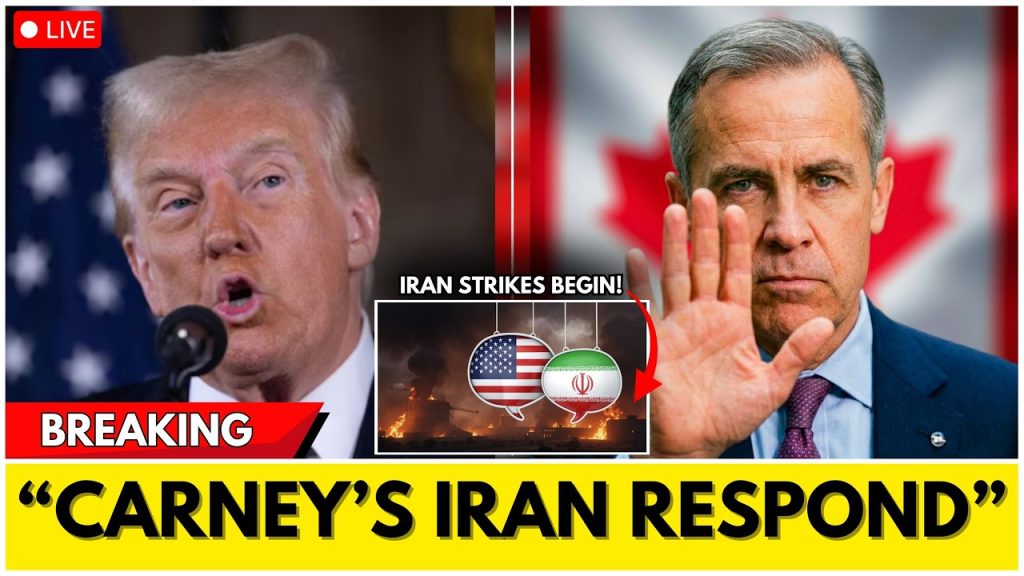
The American operation, described by the Pentagon as a targeted effort to degrade Iran’s nuclear capabilities, was launched without a formal congressional authorization for the use of force. That procedural detail has ignited debate in Washington, but it also reverberates among allies. For Canada, a founding NATO member and a core Five Eyes intelligence partner, the immediate question was not whether to endorse nonproliferation objectives — Ottawa has long opposed a nuclear-armed Iran — but how closely to associate itself with the method.
Mr. Carney’s statement was calibrated. He endorsed the strategic objective while underscoring that Canada was neither consulted on operational planning nor participating militarily. Canadian Armed Forces personnel stationed in Qatar, Bahrain and Jordan were placed on heightened alert, and travel advisories were updated. Diplomats described the response as a reaffirmation of long-standing policy rather than an embrace of unilateral military action.
The episode underscores a persistent tension in Canada’s grand strategy. The country’s security architecture is deeply intertwined with that of the United States through NORAD, NATO and intelligence-sharing agreements. Yet successive Canadian governments have also sought to maintain an independent diplomatic profile, particularly when American administrations pursue controversial military interventions. Mr. Carney’s language reflects that dual imperative: align with the principle, distance from the execution.
Domestically, the reaction has split along familiar lines. Conservative leader Pierre Poilievre voiced strong support for the strikes and framed them as a necessary stand against a destabilizing regime. New Democratic Party leader Jagmeet Singh condemned the action as escalatory and called for a renewed push for diplomacy. Mr. Carney’s position, neither fully hawkish nor overtly critical, places him in the political center — a posture that may prove sustainable at home but less decisive abroad.
International responses have varied. Britain offered qualified backing, emphasizing defensive measures against potential Iranian retaliation. France and Germany called for de-escalation, while Spain criticized the strikes outright. Canada’s stance aligns most closely with that of other middle powers integrated into U.S. security frameworks: support the nonproliferation goal, avoid direct entanglement in offensive operations.

Beyond the immediate security implications, the strikes intersect with Canada’s economic strategy. Mr. Carney was in India advancing trade and energy partnerships designed to diversify export markets and reduce reliance on the United States. Rising tensions in the Persian Gulf have already pushed oil prices upward, creating short-term gains for Canadian producers but raising broader concerns about inflation and global economic slowdown. For a government promoting Canada as a stable supplier of energy and critical minerals, Middle East volatility both complicates and reinforces the case for diversification.
Some analysts have raised a more speculative concern: whether President Trump’s willingness to act militarily without broad allied consultation signals a more unpredictable phase in American foreign policy. While comparisons between Iran and Canada are far-fetched — the two countries are treaty allies with deeply integrated economies — the episode reinforces a broader lesson about power asymmetry. Canadian officials cannot assume that U.S. decision-making will always align with Ottawa’s preferences or timelines.
Still, structural constraints remain powerful. The economic interdependence between Canada and the United States, encompassing hundreds of billions of dollars in annual trade and tightly linked supply chains, creates significant deterrents against severe rupture. Military conflict between the two is not a credible scenario. But diplomatic friction and economic coercion are persistent features of the relationship, particularly under administrations inclined toward unilateralism.
In that context, Mr. Carney’s approach can be read as pragmatic hedging. By endorsing the objective of preventing Iranian nuclear capability, he preserves alliance credibility. By declining operational participation and accelerating trade outreach to Asia, he reinforces Canada’s room to maneuver. The Iran strikes did not originate in Ottawa, yet they have become a stress test for Canada’s strategic design.
Whether the crisis deepens or subsides will shape the durability of that design. If the conflict expands, pressures on allies to contribute materially could intensify. If it stabilizes, the episode may be remembered as another moment when Canada managed to straddle competing imperatives. For now, the prime minister’s statement from Mumbai captures the essence of his foreign policy doctrine: close alignment where interests converge, measured distance where autonomy requires it, and constant adjustment in a world where decisions made elsewhere can alter Canada’s trajectory overnight.