By XAMXAM
For three-quarters of a century, North American trade rested on an assumption so stable it barely required articulation: Canada would move in economic lockstep with the United States. Not because Ottawa lacked autonomy, but because the depth of integration—factories, farms, rail lines, ports—made divergence seem impractical. That assumption cracked last week, quietly but decisively, when Canada signed a far-reaching trade reset with China that reorders agricultural access and industrial incentives at a moment of extraordinary uncertainty.
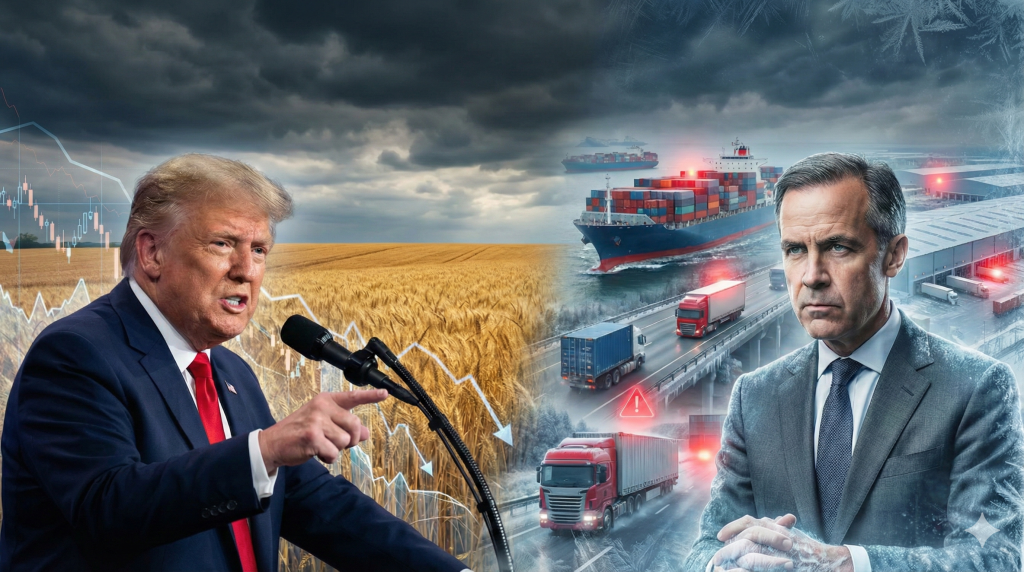
The agreement was unveiled as Mark Carney met Xi Jinping in Beijing, the first visit by a Canadian leader in eight years. What emerged was not symbolism but arithmetic: a steep reduction in Chinese tariffs on Canadian canola—long a pillar of prairie economies—in exchange for sharply lower Canadian duties on Chinese electric vehicles. The numbers mattered. Tariffs that had rendered exports uneconomic fell to levels that restore viability. Quotas that had closed markets reopened them.
In Washington, the deal landed as the United States-Mexico-Canada Agreement heads toward a mandatory review this summer. The agreement that replaced NAFTA was designed to provide certainty; instead, it has become a backdrop to unpredictability. Donald Trump has repeatedly questioned the pact’s value, floated withdrawal, and framed tariffs as leverage rather than last resort. For firms whose supply chains cross borders multiple times before a product is finished, uncertainty itself is the shock.
Agriculture makes the consequences concrete. Canada sends millions of tons of grain south each year—wheat, canola, barley—through a web of elevators, mills, and rail corridors optimized over decades. That system presumes open borders and predictable rules. When China imposed punitive duties on Canadian canola, producers were stranded. When relief did not arrive from Washington, Ottawa sought it elsewhere. Beijing offered it.
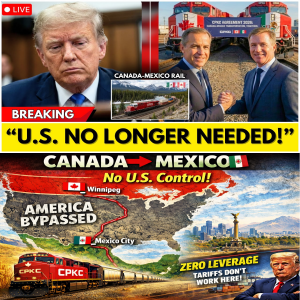
The move has immediate effects and longer shadows. In the near term, farmers regain access to a vast market; rural communities avoid the cliff edge. Over time, however, contracts get signed, logistics get re-engineered, and habits harden. Supply chains, once redirected, rarely snap back on cue. Infrastructure follows commerce, not rhetoric.
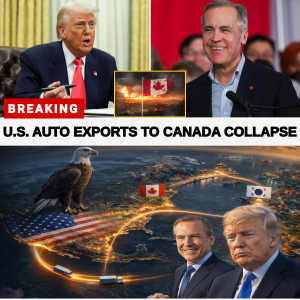
The auto sector underscores the risk. North American vehicle manufacturing is a choreography of parts and processes that span Ontario, Michigan, and Mexico. A single car may cross borders half a dozen times. Introducing a new stream of Chinese vehicles into Canada—at precisely the moment the United States has erected prohibitive barriers—adds a variable Detroit has no clean way to model. Will Canada become a magnet for assembly? Will retaliation follow? Will firms hedge by delaying investment? Each question slows decisions; together they freeze them.
None of this requires confrontation to have effect. Paralysis is incremental. It appears as postponed expansions, padded inventories, deferred hiring. It shows up in farmers hesitating over planting decisions and manufacturers extending supplier audits because tomorrow’s rules are unknowable. It is the cost of unreliability.
Canadian officials insist the Beijing agreement is not a pivot away from the United States but insurance against volatility. The logic is straightforward. When a country sends the majority of its exports to a single market, and that market signals that commitments may be conditional, diversification becomes prudence, not provocation. China, for its part, has been patient in offering alternatives to partners unsettled by Washington’s posture. It does not need to force a choice; it needs only to be available.
The broader implications extend beyond Canada. Europe is accelerating deals elsewhere; emerging economies are spreading risk. The world is reorganizing around the premise that predictability is scarce and must be purchased. For the United States, whose influence long flowed from indispensability, that is the deeper danger. Power dissipates not with a bang but with workarounds.
The coming USMCA review will test whether damage can be contained. A clean extension would calm markets and reaffirm integration. A protracted renegotiation would entrench caution. A collapse would redraw the map. The irony is that the costs would not fall on abstractions but on households—through higher food prices, delayed vehicles, and jobs suspended between plans and permits.
Canada’s Beijing bet is thus less a geopolitical drama than a lesson in systems. Trade architectures endure when trust is routine. When trust erodes, even allies seek exits. The agreement signed in Beijing did not break North American trade; it exposed how brittle it had become.