By XAMXAM
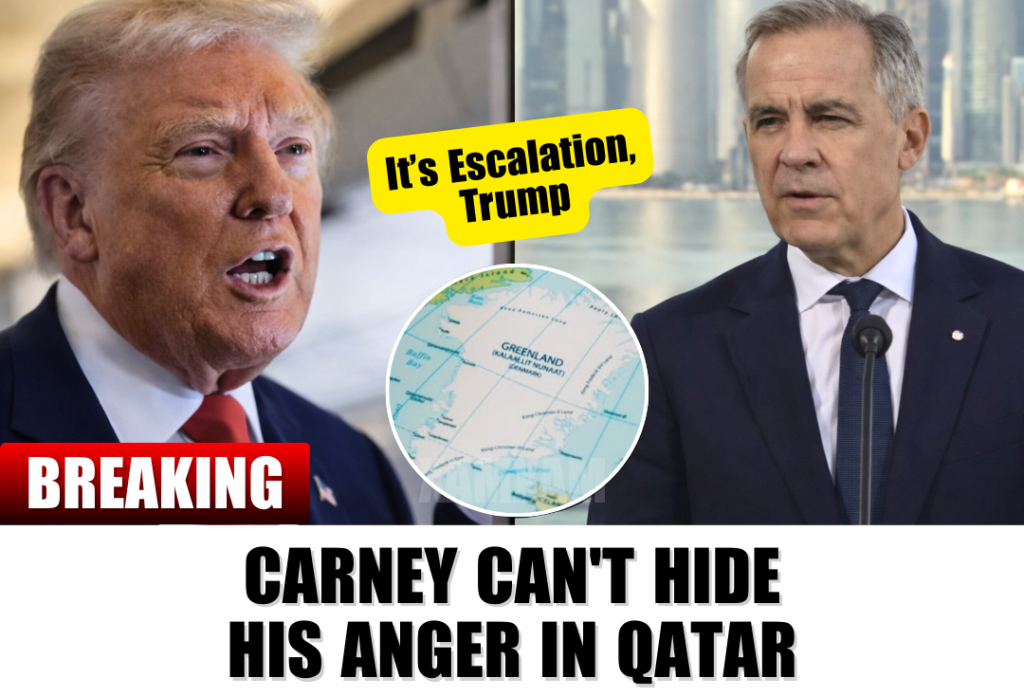
In diplomacy, words are chosen with care because some of them cannot be taken back. When Prime Minister Mark Carney stood before reporters and described President Donald Trump’s threats over Greenland as an “escalation,” he crossed a threshold that Ottawa has historically avoided. This was not a rhetorical flourish. It was a signal.
For decades, Canada’s approach to Washington has been defined by restraint. Disagreements were handled quietly, language softened, intentions framed as misunderstandings rather than confrontations. That tradition broke the moment Carney publicly framed Trump’s use of tariffs and pressure against European allies as an escalation. In diplomatic terms, escalation is not commentary. It is a warning that normal rules are no longer sufficient to manage the situation.
The context matters. Trump’s proposal was not simply to reopen a conversation about Greenland’s strategic value. According to public statements, it involved the threat of punitive tariffs on Denmark and other European allies unless they agreed to the island’s transfer to U.S. control. What might once have been dismissed as rhetorical bravado was now tied explicitly to economic punishment. Carney refused to treat that combination as routine.
Standing outside Washington, he articulated a principle that left little room for ambiguity: sovereignty and territorial integrity are non-negotiable, regardless of geography. Greenland’s future, he said, belongs to Greenland and Denmark, not to external pressure. With that statement, Canada aligned itself openly with European allies and placed the issue squarely within NATO’s collective framework rather than a bilateral bargaining table.
What made the moment consequential was not only what Carney said, but when and where he said it. The remarks came amid a period of intense diplomatic activity, as leaders prepared for high-level meetings in Europe and the Middle East. Behind the scenes, Canada had already been coordinating with NATO partners and Nordic governments. By acknowledging those conversations publicly, Carney transformed private alignment into visible posture.
This was not a dramatic gesture. There were no raised voices, no ultimatums. Instead, Canada adopted a tone of calm insistence. That restraint made the message harder to dismiss. By avoiding theatrics, Carney denied Trump the ability to frame the disagreement as emotional overreaction or partisan hostility. What remained was a clear assertion of limits.
The response in Washington was telling. Trump is accustomed to criticism from adversaries and activists, which often reinforces his instinct to double down. What he is less accustomed to is resistance from a close ally that does not depend on his approval to function. Canada’s message was unsettling precisely because it suggested preparation rather than defiance. Ottawa was not threatening retaliation; it was signaling resilience.

That resilience has been built deliberately. Over recent months, Canada has diversified trade relationships, strengthened ties with Europe, and secured capital partnerships beyond North America. These moves did not eliminate exposure to U.S. pressure, but they reduced it enough to change the calculus. When Carney spoke of escalation, he did so from a position that assumed Canada could withstand the consequences of disagreement.
The Greenland episode thus became more than a dispute over territory. It became a test of whether economic coercion can still compel compliance among allies. By naming the tactic publicly, Canada forced others to choose how they would interpret it. Silence, in this framing, would imply acceptance. Response would imply solidarity.
For NATO, the implications are significant. The alliance is built on the premise that borders are not bargaining chips and that security threats are addressed collectively. Allowing tariff pressure to blur those lines risks normalizing a form of coercion that weakens the alliance from within. Carney’s intervention sought to halt that drift before it became precedent.
There is also a domestic dimension. Canadian leaders have long been cautious about appearing confrontational toward Washington, mindful of economic integration and political sensitivity. By speaking plainly, Carney signaled to Canadians that alliance does not require acquiescence. Cooperation, in this framing, is compatible with firmness.
The coming weeks will determine how far this shift goes. Trump may escalate further, converting threats into action, or he may recalibrate to avoid confirming the charge of coercion. Either path carries costs. Action risks validating Carney’s warning and accelerating allied coordination. Retreat risks demonstrating that pressure no longer produces results.
What is already clear is that a line has been drawn. Canada has redefined how it will respond when economic tools are used to challenge sovereignty. It has done so without dramatics, but with clarity. In international politics, that combination can be more disruptive than confrontation.
The significance of this moment lies not in a single word, but in what that word makes unavoidable. Once escalation is named, ambiguity disappears. Allies listen differently. Assumptions change. And power, which often relies on others’ hesitation, finds itself facing something it cannot easily manage: quiet resolve.