By XAMXAM
When Prime Minister Mark Carney arrived in Doha in mid-January, the visit carried a symbolic first: no sitting Canadian prime minister had ever made an official trip to Qatar. What followed, however, was more than symbolism. In a series of joint announcements with Sheikh Tamim bin Hamad Al Thani, Canada and Qatar unveiled a strategic partnership that reaches across trade, defense, artificial intelligence, aerospace, and long-term investment—without routing through Washington.
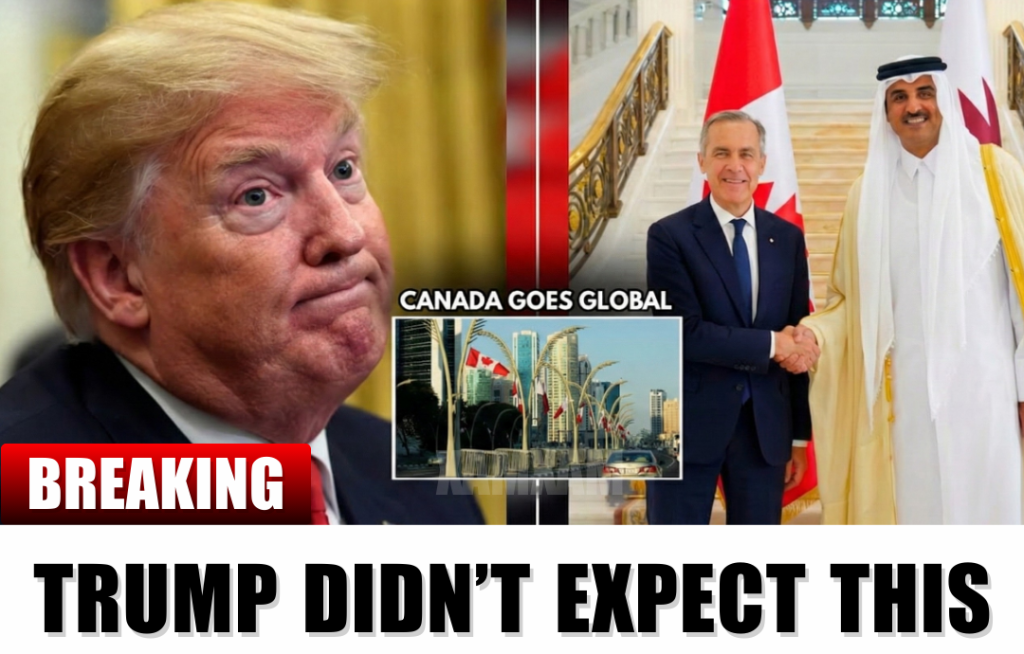
For Ottawa, the message was unmistakable. Canada is no longer content to treat the United States as the unavoidable intermediary in its relations with the Gulf. For Washington, the implication was more uncomfortable: a close ally had demonstrated that it could build consequential economic and security ties in the Middle East while quietly bypassing American influence.
Qatar, with an economy approaching $290 billion and one of the world’s most powerful sovereign wealth funds, has long been a central node in U.S. Gulf strategy. American military bases, defense contracts, and energy ties dominate the relationship. Yet the Canadian approach offered something different: partnership rather than patronage. The joint statement spoke not of transactions but of “shared stability, security, and prosperity,” language that underscored mutuality rather than hierarchy.
At the core of the agreement is investment. Qatar’s sovereign wealth arm, the Qatar Investment Authority, manages hundreds of billions of dollars and has been seeking to diversify geographically and politically. Canada, facing immense capital needs in infrastructure, energy transition, and advanced technology, is an attractive destination. Officials from both countries confirmed that negotiations are underway to finalize a foreign investment promotion and protection agreement by 2026, a framework that would lock in legal certainty for capital flows in both directions.
Defense cooperation may prove even more consequential. Canada announced plans to open its first defense attaché office in Doha, signaling a permanent military-diplomatic presence. The scope of cooperation extends beyond arms sales to training, joint exercises, and technology collaboration. For decades, the Pentagon assumed near-total dominance of Gulf defense markets. Canada’s entry does not displace the United States, but it does dilute exclusivity—offering Gulf partners diversification without overt political conditions.
Technology is another pillar. Canada’s growing reputation in artificial intelligence and quantum research—anchored in cities like Montreal, Toronto, and Waterloo—aligns neatly with Qatar’s ambitions to move beyond hydrocarbons. Notably, the partnership emphasizes direct bilateral cooperation rather than reliance on American technology giants. For Qatari planners wary of geopolitical entanglements, Canadian firms represent advanced capability with lower political exposure.

This recalibration did not occur in a vacuum. It follows months of tension between Ottawa and Washington under Donald Trump, whose second term revived tariffs, annexation rhetoric, and a transactional view of alliances. Canadian officials privately acknowledge that unpredictability in U.S. policy accelerated the search for alternatives. The Doha visit was not an act of defiance, but of insurance.
What distinguishes the Canada–Qatar partnership is its permanence. The two governments established a joint commission to oversee cooperation across sectors, institutionalizing the relationship beyond any single deal or political moment. Expanded air services, health-technology collaboration, and even cultural exchanges are designed to weave ties that are difficult to unwind.
For Qatar, the logic is clear. Diversification is strategic. Reducing reliance on a single dominant partner—however powerful—limits vulnerability to political swings elsewhere. For Canada, the benefits are equally tangible: access to Gulf capital, new export markets for high-value industries, and a diplomatic profile that reflects autonomy rather than dependency.
The United States is not excluded from the Gulf, nor from Canada’s global strategy. But it is no longer the default conduit. That shift matters. Influence built on assumption weakens when partners demonstrate credible alternatives. Washington retains unmatched military and economic weight, yet episodes like Doha suggest that leverage now competes with choice.
In geopolitical terms, the Canada–Qatar partnership is not a rupture but a signal. Middle powers are adapting to a world where alliances feel less predictable and diversification feels prudent. They are not abandoning old relationships; they are hedging against their volatility.
For years, American leadership in allied networks was sustained by trust in its steadiness. The question raised by Canada’s Gulf pivot is not whether that leadership ends, but whether it can still be taken for granted.