By XAMXAM
For decades, American power rested less on coercion than on trust. Allies built their defenses, economies, and digital infrastructure around U.S.-linked systems because they believed those systems would remain stable, neutral, and available regardless of political change. That assumption is now quietly eroding.
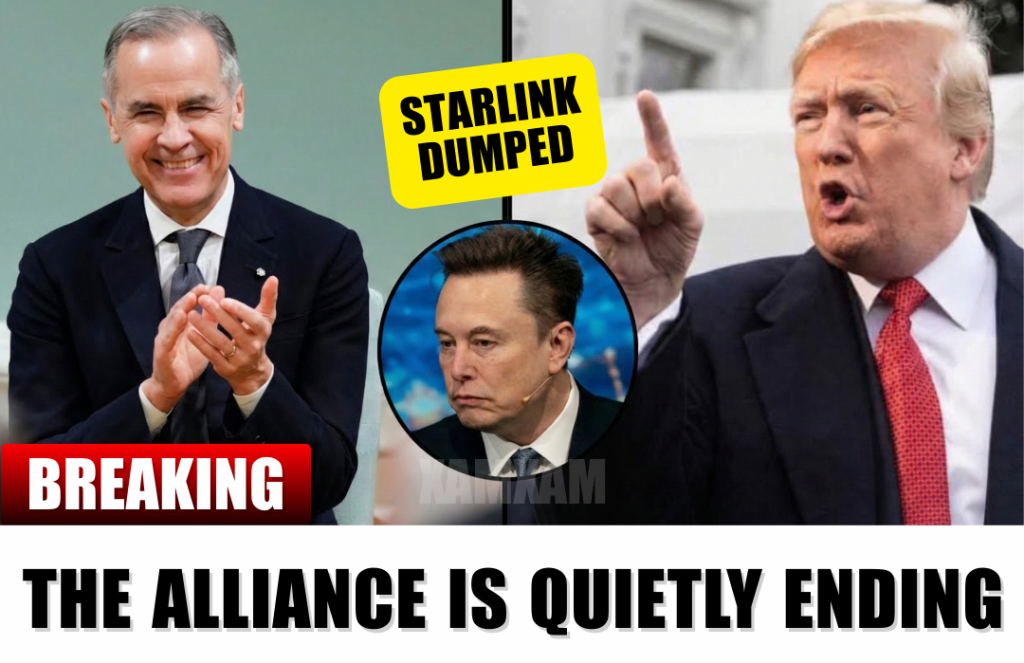
The shift is not dramatic. There have been no emergency summits announcing a rupture, no formal declarations of separation. Instead, the change is technical and incremental—embedded in procurement decisions, satellite contracts, and infrastructure planning. Yet taken together, these moves point to a deeper reassessment among America’s closest partners, particularly Canada and Europe, about how much reliance on the United States is prudent in an era of renewed volatility under Donald Trump.
In Ottawa, that reassessment has become visible in the Arctic. Satellite connectivity in Canada’s far north is not a consumer convenience; it underpins surveillance, communications, and air defense across vast territory where redundancy is scarce. For years, Starlink, operated by Elon Musk, has filled gaps that traditional systems could not. The service remains widely used and technically effective. But confidence in who ultimately controls that connectivity has weakened.
Last year, Ontario quietly canceled a major Starlink contract intended to expand service in remote communities. Officials cited tariffs and concerns about long-term reliability amid shifting political conditions. The explanation was restrained, but the message was not: performance alone is no longer enough. Control—and insulation from political leverage—has become paramount.
That logic has opened space for alternatives. European satellite operators, some with partial state ownership in France and the United Kingdom, have positioned themselves as providers of what they call “sovereign capacity”—bandwidth that governments control directly, protected from unilateral decisions by private actors or foreign politics. According to officials familiar with the discussions, the idea was raised not merely through technical channels but at the political level, including conversations between European leaders and Canada’s prime minister, Mark Carney.
The appeal is not lower cost or superior technology. It is predictability. Governments are increasingly wary of critical infrastructure concentrated in private hands when those hands are closely aligned with a particular political project. The widely reported episode years ago in which Starlink connectivity was disrupted during a sensitive phase of Ukraine’s war—whatever the precise causes—left a lasting impression in allied capitals: access can change, and when it does, the consequences are immediate.

Europe is reaching similar conclusions. Trump’s renewed use of tariffs as tools of pressure—most recently tied to threats over Greenland—has unsettled allies who once assumed that economic integration provided insulation from coercion. French, Swedish, and British officials have openly criticized the idea of using trade penalties against NATO partners, calling it destabilizing. Less visibly, European defense and technology planners are accelerating efforts to reduce exposure to U.S.-controlled systems where alternatives exist.
This recalibration extends beyond satellites. In digital governance, supply chains, and even consumer markets, reliance on American platforms is increasingly treated as a risk to be managed rather than a default to be embraced. The goal is not to sever ties with Washington, but to ensure that those ties cannot become choke points.
The consequences are already spilling into the private sector. In both Europe and Canada, sales of high-profile American technology brands have softened sharply. Analysts point to many factors—competition, pricing, incentives—but timing matters. The declines coincide with rising political tension and public backlash against figures associated with Trump’s return to power. For some consumers and institutions, buying American no longer feels politically neutral. Once purchasing decisions acquire geopolitical meaning, loyalty becomes fragile.
For the United States, the danger is not a sudden loss of allies but a gradual thinning of influence. Power that once flowed from indispensability now faces quiet circumvention. Each alternative satellite contract, each diversified supply chain, reduces the leverage Washington might once have exercised without effort.
History suggests that great powers rarely lose influence in a single dramatic break. More often, it fades as partners hedge, then adapt, then discover they no longer need what once felt essential. Canada and Europe are not turning away from the United States in anger. They are stepping back in caution, redesigning systems so that no single election, personality, or policy swing can disrupt their security or economies.
If American leadership was built on trust in its stability, the question now confronting Washington is whether that trust can be restored—or whether allies, having invested in alternatives, will decide they are better off never being dependent again.