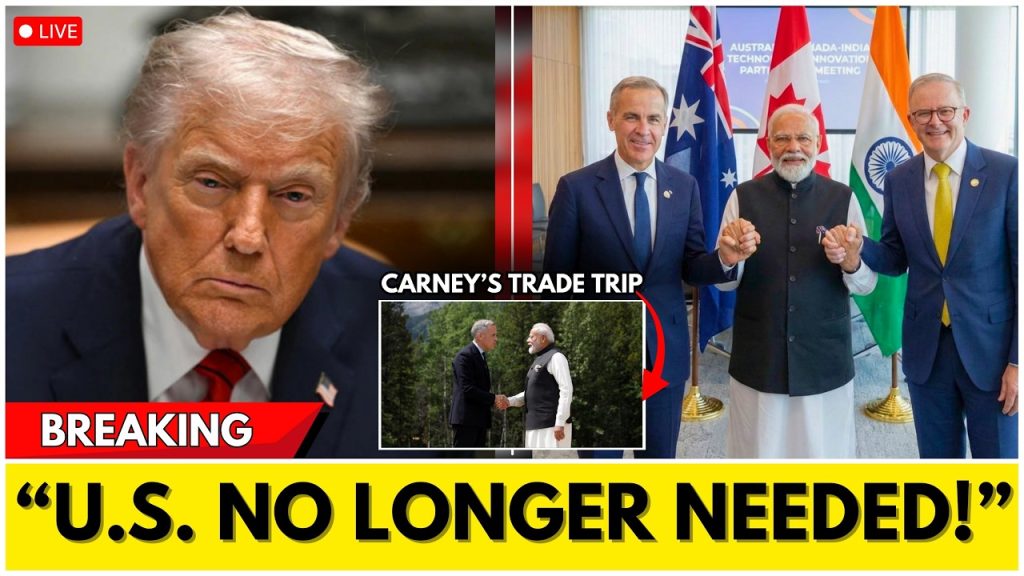
When Prime Minister Mark Carney departs for India, Australia and Japan this week, the itinerary reads like a conventional trade mission: meetings with business leaders, parliamentary addresses, joint statements on clean energy and technology. But beneath the diplomatic choreography lies a more consequential calculation. Canada is attempting to rebalance an economy in which roughly three-quarters of exports still flow to a single country — the United States.
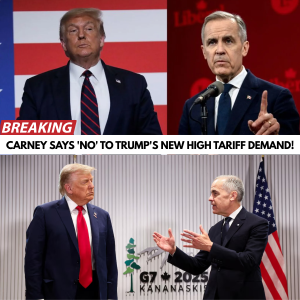
The timing is not incidental. In recent months, President Donald Trump has revived the threat of sweeping tariffs on Canadian goods, including the possibility of punitive rates in response to Ottawa’s trade engagement with China. While Canada and the United States remain bound by the United States–Mexico–Canada Agreement, the renewed volatility has sharpened long-standing concerns in Ottawa about concentration risk.
Mr. Carney, a former central banker who led both the Bank of Canada and the Bank of England, has framed the trip as “trade diversification.” Yet the destinations — New Delhi, Canberra and Tokyo — suggest something more strategic: the construction of a deeper Indo-Pacific corridor that reduces reliance on American market access without severing it.
India stands at the center of that effort. Bilateral trade between Canada and India reached roughly $30 billion last year, modest by global standards but expanding. Officials in both countries have signaled interest in concluding a comprehensive economic partnership agreement within a year. Such a deal could significantly lower tariffs on agricultural exports like canola and pork while opening India’s vast consumer and technology markets to Canadian firms.
For India, the appeal is reciprocal. Canada offers uranium, liquefied natural gas and critical minerals essential for battery production and renewable energy deployment. Canadian pension funds, which manage trillions of dollars in assets, are increasingly active investors in Indian infrastructure and technology ventures. A formalized trade agreement would institutionalize that flow of capital.
Australia represents a different dimension of the strategy. Merchandise trade between the two countries is comparatively small, but investment ties are substantial. Canadian direct investment in Australia approaches $60 billion, while Australian firms maintain tens of billions in assets in Canada. Both countries share similar economic profiles — resource-rich, export-dependent, and wary of overreliance on larger powers. Their cooperation is anchored in the Comprehensive and Progressive Agreement for Trans-Pacific Partnership, or Comprehensive and Progressive Agreement for Trans-Pacific Partnership, which has reduced tariffs on the vast majority of goods between members.
Japan, meanwhile, is Canada’s fifth-largest trading partner and a pivotal buyer of energy and agricultural products. Bilateral trade exceeds $35 billion annually, with Japanese investment in Canada spanning automotive manufacturing and advanced technologies. Tokyo has long championed stable trade frameworks in the Asia-Pacific, and its participation lends institutional credibility to any diversification push.

Taken together, trade flows with India, Australia and Japan currently total more than $70 billion annually. If projected growth targets are met over the next five years, that figure could approach $130 billion. The absolute numbers remain smaller than Canada’s trade with the United States, but the directional shift matters. Even a 10 to 20 percent reallocation of export dependence alters the calculus in future tariff disputes.
Economists caution that diversification is not decoupling. The United States remains Canada’s dominant partner, accounting for integrated supply chains in automotive, aerospace and energy. No Indo-Pacific arrangement can replicate overnight the depth of North American integration built over three decades. But incremental diversification can reduce the leverage inherent in asymmetry.
The political subtext is equally significant. At the World Economic Forum in Davos earlier this year, Mr. Carney argued that “middle powers must act together” in an era of great-power volatility. His remarks were widely interpreted as a veiled critique of Washington’s increasingly transactional trade posture. By deepening ties with Asian democracies and Pacific partners, Ottawa is positioning itself within a coalition of countries seeking resilience against unilateral economic shocks.
The United States has historically encouraged allies to strengthen Indo-Pacific engagement as a counterweight to China. Yet diversification that reduces American centrality carries its own strategic implications. If Canada and other middle economies embed trade and investment networks that function independently of U.S. policy swings, Washington’s leverage diminishes proportionally.
Whether that evolution becomes structural depends on implementation. Trade agreements must be negotiated, ratified and operationalized. Investment flows must translate into physical infrastructure and supply-chain reconfiguration. Domestic political support in each country must sustain momentum beyond the tenure of individual leaders.
For now, the mission is as much signal as substance. By sequencing high-level visits across three Indo-Pacific capitals within nine days, Mr. Carney is underscoring that Canada has options. Not replacements for the American market, but alternatives substantial enough to matter.
Trade architecture rarely commands headlines until it fractures. This week’s journey suggests Ottawa is intent on reinforcing its foundations before the next shock arrives. In an era defined by tariff threats and geopolitical recalibration, diversification has shifted from aspiration to necessity.