As U.S. Signals a Harder Trade Line, Canada Builds Its Leverage
WASHINGTON — When the United States Trade Representative, Jameson Greer, sat down this week with journalists from CBC News on Capitol Hill, his message was delivered calmly, almost casually. But its implications were anything but.
“When we go to other countries and we make a deal with them,” he said, “they agree that we can have a tariff on them.”
It was a striking formulation. For decades, North American trade has been organized around the gradual reduction — and often elimination — of tariffs. Now, Washington appears to be proposing something different: tariffs not as temporary leverage, but as a permanent feature of future agreements.
The comments come as the United States–Mexico–Canada Agreement — the successor to North American Free Trade Agreement — approaches its mandatory review deadline on July 1. Each of the three signatories must declare whether they intend to extend the pact, renegotiate its terms, or allow it to lapse.
For months, trade analysts in Toronto and Washington had assumed that whatever political turbulence accompanied President Trump’s second term, the core architecture of continental trade would endure. The integrated supply chains linking auto plants in Ontario with assembly lines in Michigan were widely viewed as too economically valuable to dismantle.
But Mr. Greer’s remarks suggest a more fundamental shift.
Among Washington’s priorities: expanded U.S. access to Canada’s protected dairy market; the return of American wine and spirits to Canadian shelves following retaliatory measures; reopened procurement contracts for U.S. firms; and tighter automotive “rules of origin” designed to prevent Chinese or Vietnamese components from entering the American market through Canadian or Mexican assembly.
These demands are not new. Versions of them surfaced during the original renegotiation that produced the U.S.M.C.A. What is new is the framing. The administration appears prepared to treat tariffs as structural — embedded into the relationship rather than used as bargaining chips.
Yet if Washington is raising the temperature, Ottawa is not responding in kind.
On Wednesday morning, Canada’s finance minister, François-Philippe Champagne, pointed to trade data showing that Canada, despite targeted U.S. tariffs on steel, aluminum and softwood lumber, still faces comparatively low barriers entering the American market. “If you look at the data,” he said, “Canada is still the country paying the lowest price to enter the U.S. market.”
The statement reflects a broader Canadian strategy: absorb selective pressure while quietly diversifying options.
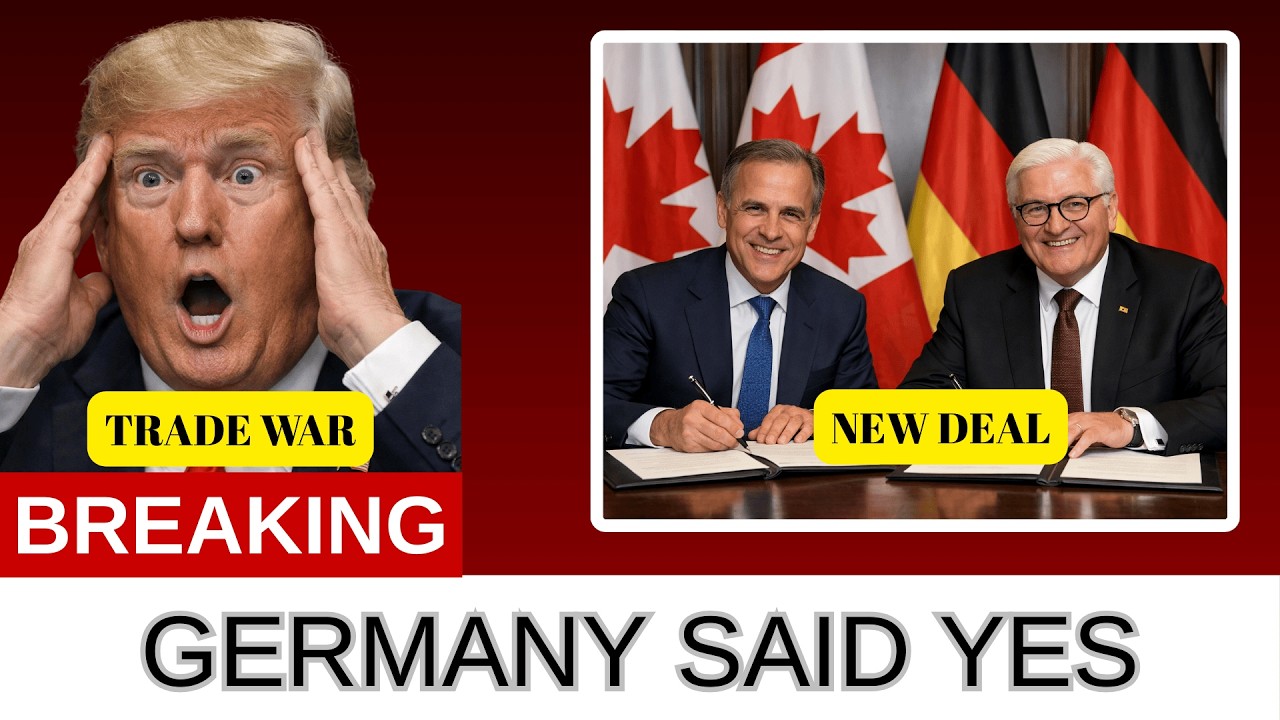
That diversification has accelerated. This week, Katherina Reiche, Germany’s economic minister, traveled to Ottawa for meetings with Canada’s industry minister, Mélanie Joly, and other officials. The visit culminated in a joint declaration of intent on automotive and mobility cooperation.
Germany’s outreach was notable not only for its content but for its direction. Berlin came to Ottawa.
The symbolism is not lost on Canadian policymakers. If Washington is intent on reshoring automotive and metals supply chains within U.S. borders, Canada has signaled it will look elsewhere for capital and partnerships. Ms. Joly has openly referenced interest from Korean and European manufacturers, and has indicated that investment from a range of countries could help offset job losses tied to shifting North American production.
Prime Minister Mark Carney has paired that outreach with a new defense industrial strategy aimed at channeling procurement spending toward sectors affected by American tariffs. The policy is framed as both economic stimulus and strategic insurance — a way to keep industrial capacity domestic if U.S. contracts become less reliable.
None of this means that Canada seeks to decouple from its largest trading partner. The United States remains, by far, Canada’s most significant export market. But Canadian officials increasingly speak of diversification not as an aspiration but as a necessity.
Mr. Greer acknowledged in his interview that Canada has often resisted American demands — and yet the relationship has endured. That endurance, from Ottawa’s perspective, underscores an important reality: interdependence runs both ways. American manufacturers rely on Canadian inputs, just as Canadian exporters rely on American consumers.
As negotiations begin in the coming weeks, both sides will face constraints. The Trump administration’s insistence on permanent tariffs may satisfy domestic political imperatives. But it also risks encouraging precisely the outcome Washington says it wants to avoid: the gradual reorientation of supply chains beyond North America.
For Canada, the strategy appears to be one of deliberate patience. Retaliatory measures remain in place. Concessions have not been offered in advance. Partnerships with Europe and Asia are being cultivated before formal talks begin.
The July deadline looms. The outcome is uncertain. What is clear is that the era of uncomplicated free trade on the continent has passed. In its place is a more transactional framework, one in which economic sovereignty and geopolitical alignment are negotiated alongside tariff schedules.
Whether that shift strengthens North America’s competitiveness — or fragments it — will depend not only on what is demanded at the bargaining table, but on how many viable alternatives exist beyond it.