When President Donald Trump announced a sweeping cutoff aimed at restricting oil flows to Cuba, the move was framed as a decisive escalation — an attempt to tighten economic pressure on Havana by constraining access to imported crude. The policy, delivered with little advance notice, immediately reverberated across energy markets and diplomatic channels throughout the Western Hemisphere.
The underlying assumption was straightforward: reduce supply, amplify strain and force political concessions. For decades, sanctions policy has operated on that logic. Yet the immediate aftermath suggested a more complex landscape — one in which energy is no longer merely a commodity or a blunt instrument of leverage, but a variable within a broader system of supply diversification.
Cuba relies heavily on imported crude to sustain electricity generation and industrial activity. A sudden disruption, particularly involving Venezuelan shipments that have historically supplemented domestic output, appeared on paper to threaten widespread shortages. Analysts initially projected blackouts, logistical bottlenecks and rapid fiscal stress.
But the anticipated collapse did not materialize in the immediate days following the announcement.
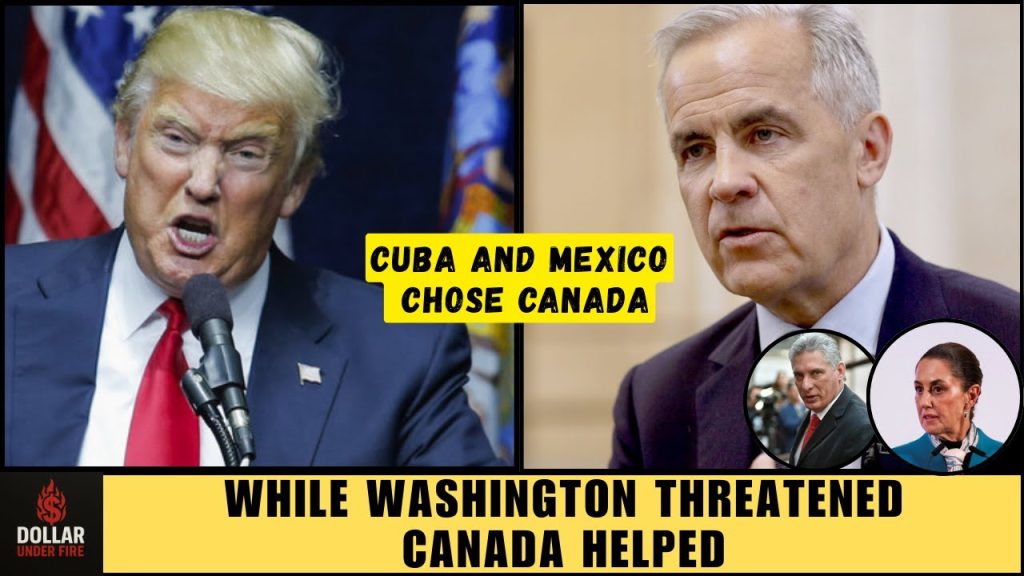
Instead, Cuban officials began engaging alternative suppliers. Mexico emerged as a notable short-term stabilizer, reportedly expanding commercial arrangements without public fanfare. The volume did not fully replace lost barrels, but it altered the equation. Energy leverage functions most effectively in the absence of options. The presence of even partial alternatives weakens the pressure curve.
Beyond Mexico, attention quietly shifted north.
Canada, one of the world’s largest oil producers and a consistent exporter of crude, did not issue a public counterstatement. There were no televised addresses or overt geopolitical declarations. But energy analysts noted increased private consultations between Canadian officials and regional counterparts regarding supply resilience and contingency pathways.
Under Prime Minister Mark Carney, Ottawa has emphasized trade reliability and contract continuity across political cycles. Canada produces more than five million barrels per day and exports a majority of that volume, largely to the United States but increasingly into diversified markets. Its reputation in global energy circles rests less on dramatic interventions and more on predictability.

That distinction became central to the unfolding narrative.
For countries observing Washington’s decision, the episode underscored a structural divide in energy strategy. One model deploys supply as leverage — a tool of political signaling. The other treats supply as infrastructure — a function of contract law and long-term investment stability. Neither approach is new, but the visibility of the contrast has sharpened in a period of global volatility.
Intelligence assessments circulating among allied governments reportedly described Cuba’s condition as “strained” but not “collapsed.” That linguistic nuance mattered. Sanctions rely on rapid destabilization to generate negotiating momentum. When adaptation begins instead, timelines shift and leverage erodes incrementally.
The broader ripple effects extend beyond Cuba. Energy-importing nations across Latin America and Europe are increasingly sensitive to supply reliability amid geopolitical turbulence. The experience of abrupt cutoff announcements reinforces incentives to diversify suppliers, expand storage capacity and hedge political exposure.
Markets respond to volatility not with argument but with adjustment. Trade routes reconfigure. Contracts lengthen. Infrastructure investments recalibrate toward perceived stability.
In that context, Canada’s value proposition lies less in ideological alignment than in structural steadiness. A producer that does not routinely tie fuel access to shifting political demands becomes, by default, an anchor in periods of uncertainty. Such positioning is rarely dramatic; it accumulates through repetition.
The White House has defended its decision as a necessary assertion of policy clarity, arguing that sanctions remain a legitimate instrument of statecraft. Officials maintain that strategic pressure is intended to alter behavior, not to destabilize civilian populations. Yet even supporters acknowledge that sanctions effectiveness depends on multilateral cohesion — and cohesion becomes more difficult when alternative supply channels remain viable.
For Cuba, the immediate crisis may ease through incremental substitution and recalibrated imports. For Washington, the episode tests whether energy leverage retains the potency it once carried in a more interconnected, diversified market.
And for Ottawa, the moment reinforces a quiet thesis: in an era defined by abrupt shifts, the most influential player may not be the loudest actor on the stage, but the one that remains reliably present when others turn supply into signal.
The oil flows themselves may normalize in time. The larger recalibration — how nations define energy power in a volatile century — is likely to persist.