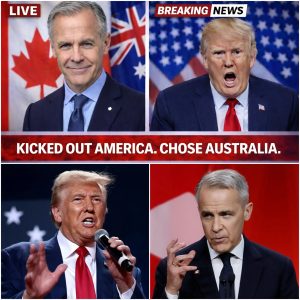
The Middle Power’s Manifesto: Mark Carney’s Australian Address Signals a Historic Rift with Washington
CANBERRA — Standing before a high-profile audience in the heart of Australia, Canadian Prime Minister Mark Carney delivered what many are calling the most significant and scathing critique of American leadership since the dawn of the 21st century. The address, characterized by an unnerving, strategic calm, marked the moment Canada officially stopped whispers of dissent and began a public campaign for a new international order.
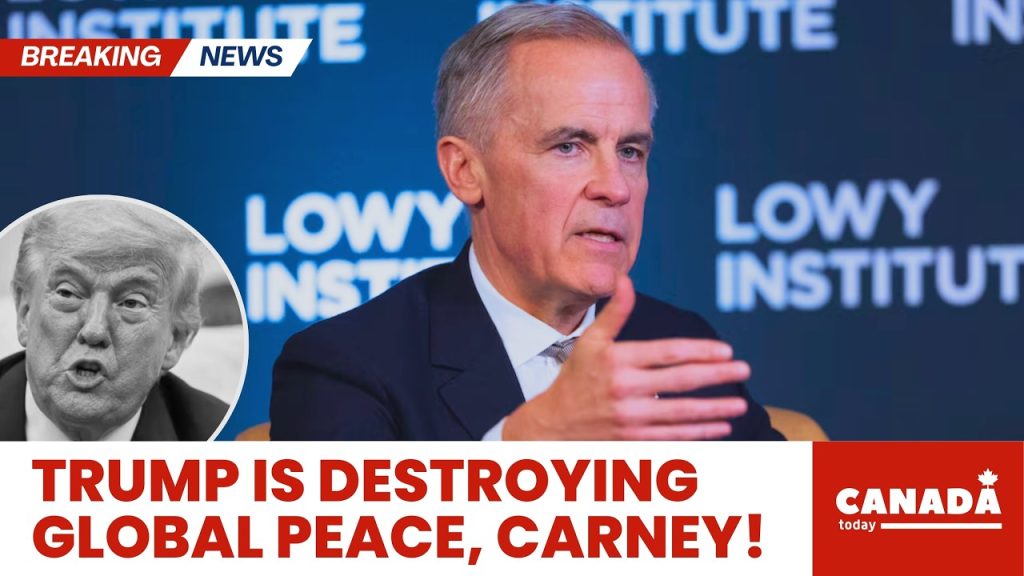
While the “Special Relationship” between Ottawa and Washington has long been a cornerstone of North American stability, the 2026 landscape has proven that historical ties are no match for current volatility. In a room filled with diplomats and strategic analysts, Carney did not hedge. He spoke of a “rupture” in the global order—a break initiated, in his view, by the unilateral actions of Donald Trump.
A Rupture of Rules
The centerpiece of Carney’s address was the recent escalation of hostilities involving the United States and Israel in Iran. Carney revealed that the strikes were carried out without engaging the United Nations or consulting with traditional allies, including Canada and Australia.
“We take this position with some regret,” Carney told the audience, “because the current conflict is another example of the failure of the international order.” By acting without constraint or respect for international norms, Carney argued, the United States is no longer leading a rules-based system but is instead enforcing a strategy of “monetized hegemony.”
The Weaponization of Integration
Carney’s most profound critique targeted the very heart of modern trade. He argued that the era of “mutual benefit through integration” has been replaced by a system where integration is used as a source of subordination. Under the current U.S. administration, supply chains have become vulnerabilities to be exploited, and tariffs have been transformed into weapons of coercion.

“Countries cannot live within the lie of mutual benefit when integration becomes their source of subordination,” Carney declared. He described a Washington that now “charges for access” to its markets, demanding political and cultural concessions in exchange for trade—a strategy he warned would inevitably lead to a global exodus from the American sphere of influence.
The “Third Path” Strategy
The Canadian Prime Minister’s visit to Australia is not merely a diplomatic tour; it is part of a calculated “Second Wave” of national strategy. Facing a hyper-power that acts without consultation, Carney is building what he calls a “dense web of connections”—ad-hoc coalitions of middle powers that can coordinate to create a “third path” with global impact.
This strategy of “insulation over confrontation” is already taking shape. From India to Australia and the upcoming mission to Japan, Canada is securing $9.5 billion in strategic contracts, critical mineral supply chains, and energy partnerships that bypass the U.S. dollar and American infrastructure. The message to the Australian Parliament was clear: in a world of great power rivalry, middle powers must “combine to create a third path” or risk being “on the menu.”
A Sovereign Declaration
The reaction in Canberra was a mixture of stunned silence and seismic approval. Many observers noted that Carney’s refusal to be intimidated by late-night social media pressure or “all-caps” diplomatic communiqués has turned Canada into a magnet for other nations seeking stability.
While the White House has previously asserted that “Canada lives because of the United States,” Carney’s Australian address serves as a sovereign rebuttal. By proving that Canada has options everywhere—from nuclear fuel deals in New Delhi to defense technology partnerships in Sydney—the Carney administration is demonstrating that true power does not come from volume, but from clarity.
The Road Ahead
As Carney prepares to conclude his mission in the Indo-Pacific, the global community is parsing every word of his “Australia Manifesto.” The old world order, once anchored by a predictable Washington, is fading. In its place is a more complex, multipolar reality where leaders like Mark Carney are no longer waiting for permission to fix the international system.
For the first time in generations, the most important conversation on the global stage is one where the United States is the subject of the critique, rather than the moderator of the debate. As the Prime Minister noted before his departure, “The reaction is to diversify.” And in the spring of 2026, the world appears to be doing exactly that.