New Delhi — Canadian Prime Minister Mark Carney concluded a four-day official visit to India on March 2, 2026, during which he and Indian Prime Minister Narendra Modi announced a package of agreements and initiatives designed to strengthen bilateral economic and sectoral cooperation following a period of strained diplomatic relations.
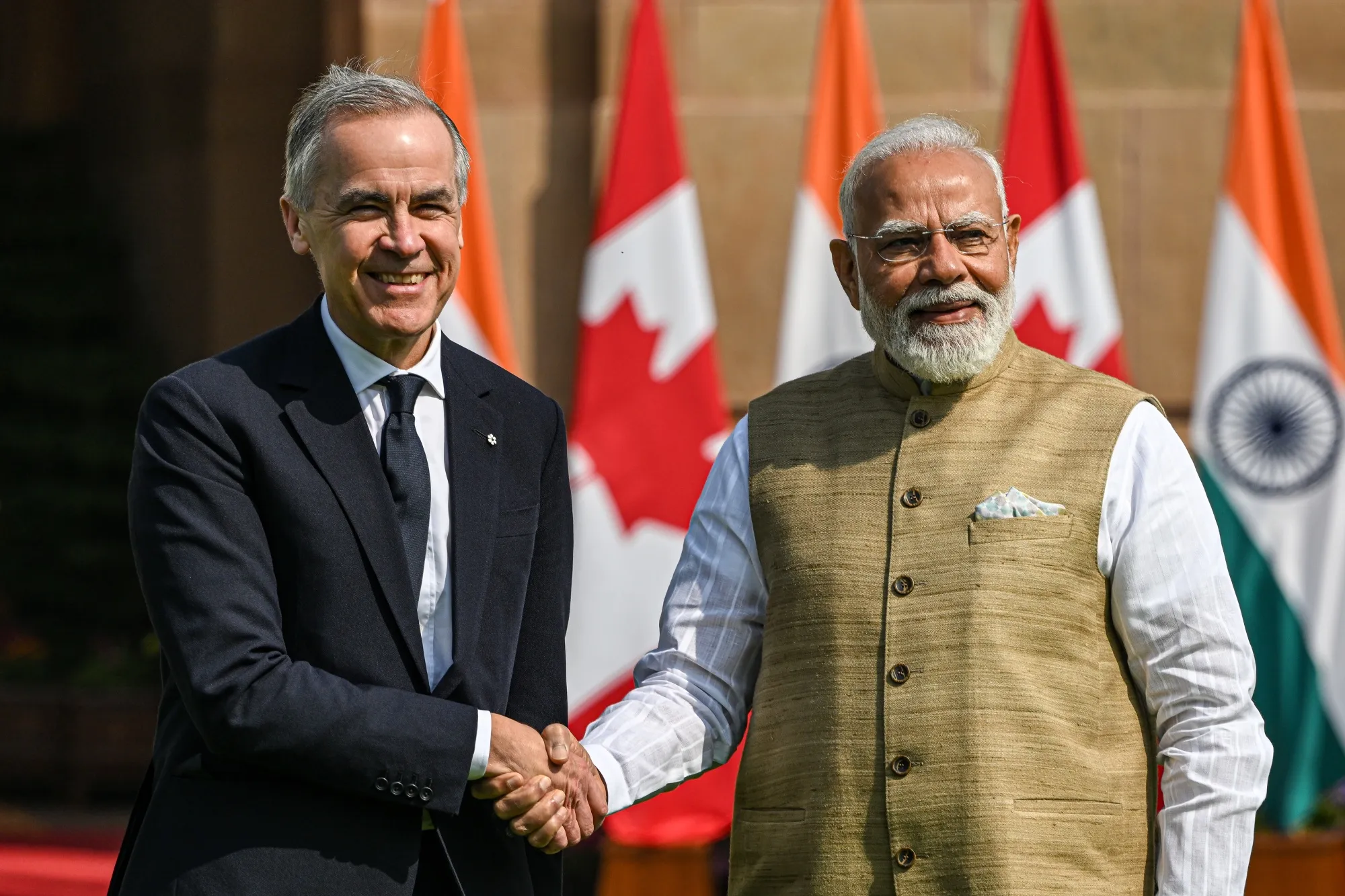
The leaders formalized commitments totaling more than $5.5 billion across multiple domains, including energy, critical minerals, technology and artificial intelligence, talent development, culture, and defence. Central to the announcements was the launch of formal negotiations for a Comprehensive Economic Partnership Agreement (CEPA), with both sides signing the Terms of Reference and expressing intent to conclude the agreement by the end of 2026. The CEPA is expected to serve as a foundation for expanding two-way trade toward CAD 70 billion (approximately INR 4.65 lakh crore) annually by 2030, building on current volumes estimated in the CAD 30-40 billion range in recent years.
A prominent element of the commercial outcomes was a landmark 10-year uranium supply agreement between India’s government and Saskatoon-based Cameco Corporation, valued at CAD 2.6 billion (approximately USD 1.9 billion). The deal provides for the delivery of nearly 22 million pounds of uranium from 2027 to 2035, supporting India’s civil nuclear energy expansion and contributing to reliable, low-carbon baseload power generation. Additional energy-related initiatives include a reconstituted Strategic Energy Partnership encompassing liquefied natural gas, uranium, solar, hydrogen, and small modular reactor collaboration.
In the technology sector, Indian IT services company HCL Technologies—India’s third-largest in its field—committed to significant expansion in Canada. The firm plans to establish new AI innovation and cybersecurity centres in Mississauga, Ontario, and Calgary, Alberta, while scaling operations in Vancouver and other provinces such as New Brunswick and Québec. This is projected to increase HCL’s Canadian workforce from around 3,000 to more than 5,250 employees by 2030, generating thousands of high-skilled jobs in artificial intelligence, cybersecurity, and related fields.
Other agreements covered critical minerals cooperation to secure supply chains for clean energy technologies, renewable energy promotion, cultural exchanges, and structured defence dialogue at senior official levels. A trilateral memorandum involving India, Canada, and Australia on technology and innovation was also highlighted, alongside plans to reconstitute the India-Canada CEO Forum as a platform for private-sector engagement.

The joint leaders’ statement emphasized shared principles of sustainability, inclusivity, and mutual benefit, invoking the concept of “Vasudhaiva Kutumbakam” (One Earth, One Family, One Future). Both governments described the outcomes as a pragmatic reset, focusing on economic complementarity rather than revisiting past diplomatic frictions. Carney’s visit—the first bilateral trip by a Canadian prime minister to India since 2018—followed earlier signals of re-engagement, including interactions at the 2025 G7 Summit in Kananaskis, Alberta.
Analysts view the developments in the context of broader strategic priorities. For Canada, the push supports trade diversification efforts amid uncertainties in global markets and efforts to reduce reliance on dominant partners. India, pursuing accelerated growth in clean energy, digital infrastructure, and advanced manufacturing, sees value in partnerships that provide resource security, technology access, and talent mobility.
Implementation will hinge on the progress of CEPA talks, which now have a defined roadmap following the Terms of Reference signing. Subsequent rounds are expected to address tariff reductions, investment protections, regulatory harmonization, and sector-specific commitments. Observers will track how quickly these translate into tangible outcomes, including increased Canadian exports in resources and services, and expanded Indian investment in Canadian technology and infrastructure.
The agreements also reflect growing middle-power alignment in the Indo-Pacific, where functional cooperation on energy transition, digital economy, and supply-chain resilience takes precedence. No immediate adjustments to consular or security arrangements were detailed, though both sides noted ongoing dialogue on transnational issues.
The visit included several symbolic and substantive elements. Carney addressed business audiences in New Delhi and Mumbai, participated in cultural events showcasing shared heritage, and held separate meetings with Indian industry leaders to discuss investment opportunities. Modi, for his part, underscored India’s commitment to becoming a reliable partner in global value chains, particularly in sectors critical to the energy transition and digital future.
Economic data provides context for the ambition. Bilateral merchandise trade has grown steadily in recent years despite diplomatic headwinds, with Canadian exports to India dominated by pulses, potash, and energy products, while Indian exports to Canada include pharmaceuticals, textiles, and engineering goods. Services trade, particularly in IT and business process outsourcing, has been a bright spot, with Indian firms employing tens of thousands in Canada already.
The uranium deal stands out as particularly strategic. India’s ambitious target of tripling nuclear capacity by 2032 requires secure, long-term fuel supplies, and Cameco’s position as one of the world’s largest uranium producers makes it a natural partner. The agreement includes provisions for technology collaboration and joint research, potentially opening doors for Canadian firms in India’s expanding nuclear ecosystem.

Similarly, the HCL expansion aligns with Canada’s need to bolster domestic AI and cybersecurity capacity while addressing skilled-labour shortages in key provinces. Ontario, home to Canada’s largest technology corridor, is positioned to capture a significant share of the new jobs and innovation activity.
Defence and security elements remain deliberately low-key in public messaging, with officials describing them as confidence-building measures rather than operational shifts. Dialogue on transnational crime, including cyber threats and organized crime networks, is expected to continue through established law-enforcement channels.
Looking ahead, the success of the partnership will depend on execution. Regular stocktaking meetings, private-sector involvement via the CEO Forum, and steady progress in CEPA negotiations will be key indicators. Both governments have signaled willingness to address regulatory and market-access barriers incrementally, suggesting a phased rather than all-at-once approach.
In a global environment marked by supply-chain fragmentation, protectionist pressures, and energy-security concerns, the Canada-India reset illustrates how middle powers can pursue pragmatic cooperation even after periods of tension. The focus remains squarely on economic gains, resource complementarity, and long-term resilience rather than geopolitical posturing.