Tensions between Mark Carney and Donald Trump have erupted into a high-stakes economic confrontation centered on the Gordie Howe International Bridge — a $9 billion megaproject designed to modernize trade between the United States and Canada. What was meant to symbolize a new era of cross-border cooperation has instead become the focal point of a geopolitical power struggle. Trump’s reported move to withhold U.S. customs staffing at the bridge’s American plaza threatens to delay its opening, effectively weaponizing infrastructure in an escalating trade dispute.

The bridge, spanning the Detroit River between Windsor and Detroit, is more than steel and concrete. It is a critical artery for North American supply chains, handling a significant share of the nearly $1 billion in goods that cross the corridor daily. Auto parts, agricultural products, energy supplies, and manufacturing components move back and forth multiple times before final assembly. Any disruption to this flow could halt production lines across Michigan, Ohio, and beyond, amplifying inflationary pressure and straining an already fragile economic environment.
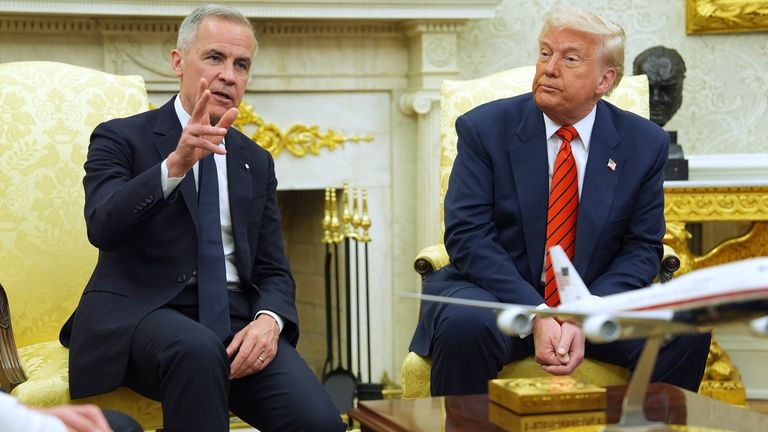
Carney’s response signals a strategic shift. Rather than engaging in public rhetoric, the Canadian prime minister hinted at reviewing “energy infrastructure corridors” in the Great Lakes region — language widely interpreted by analysts as referencing Line 5, a pipeline that transports crude oil and natural gas liquids from Western Canada through key U.S. states. Line 5 supplies a large portion of Michigan’s propane and supports refineries that fuel much of the Midwest. By drawing attention to energy leverage, Carney reframed the confrontation from border logistics to national energy security.
Markets reacted swiftly. Currency traders monitored the Canadian dollar closely, while energy futures in the Midwest experienced sharp volatility. Investors appeared to recognize that the dispute extends beyond tariffs or bridge staffing. The interconnected nature of U.S.–Canada trade means that pressure on one side reverberates across both economies. Business leaders and labor unions, particularly those tied to the auto sector, are watching carefully as potential disruptions could threaten jobs and production stability.
The political implications are equally significant. Trump’s strategy of maximizing leverage through hardline negotiation faces a new test against a leader with deep experience in global finance and crisis management. Carney, a former central banker, is approaching the standoff through economic calculus rather than political theater. By signaling potential countermeasures that impact supply chains and energy flows, he is applying pressure not only to the White House but also to influential domestic stakeholders who rely on stable cross-border commerce.
As negotiations unfold, three paths appear possible: a quiet compromise that allows the bridge to open on schedule, a deeper escalation that widens into an energy and trade conflict, or a long-term recalibration of Canada’s trade focus toward Europe and Asia. The outcome will shape not only the future of the Gordie Howe International Bridge but also the broader trajectory of U.S.–Canada relations. What began as a dispute over border staffing now carries implications for supply chains, energy security, and North America’s economic future.