ROLLS-ROYCE’S QUIET ENGINE TEST COULD UPEND CANADA’S FIGHTER JET FUTURE
Canada’s biggest defense decision in generations may no longer be settled. While Ottawa officially committed in 2022 to buying 88 F-35 Lightning II jets, a quiet development in Europe is forcing officials to re-examine everything. Unpublicized engine testing linked to Rolls-Royce has reopened a question many thought was closed: should Canada remain locked into an American-controlled fighter ecosystem, or is a viable path toward true military autonomy emerging?

The F-35 deal, originally priced at roughly $19 billion CAD, has since ballooned. By 2025, Canada’s Auditor General warned costs could reach $27.7 billion, with full lifecycle and weapons integration potentially pushing the total past $33 billion. Beyond cost, the aircraft ties Canada deeply into U.S. software, sustainment, and export-control frameworks. Every major upgrade, maintenance cycle, or capability change flows through Washington and Lockheed Martin, leaving Ottawa with limited sovereign control over its own air force.
That dependency is precisely why the Saab Gripen E is back in serious discussion. Designed for cold weather, short runways, and dispersed operations, the Gripen was built to operate from highways with minimal ground crews—conditions that mirror Canada’s Arctic reality. Lower operating costs and flexible avionics architecture make it attractive. Yet until now, one obstacle remained decisive: the Gripen E relies on the American-built General Electric F414 engine, placing it squarely under U.S. ITAR export controls.
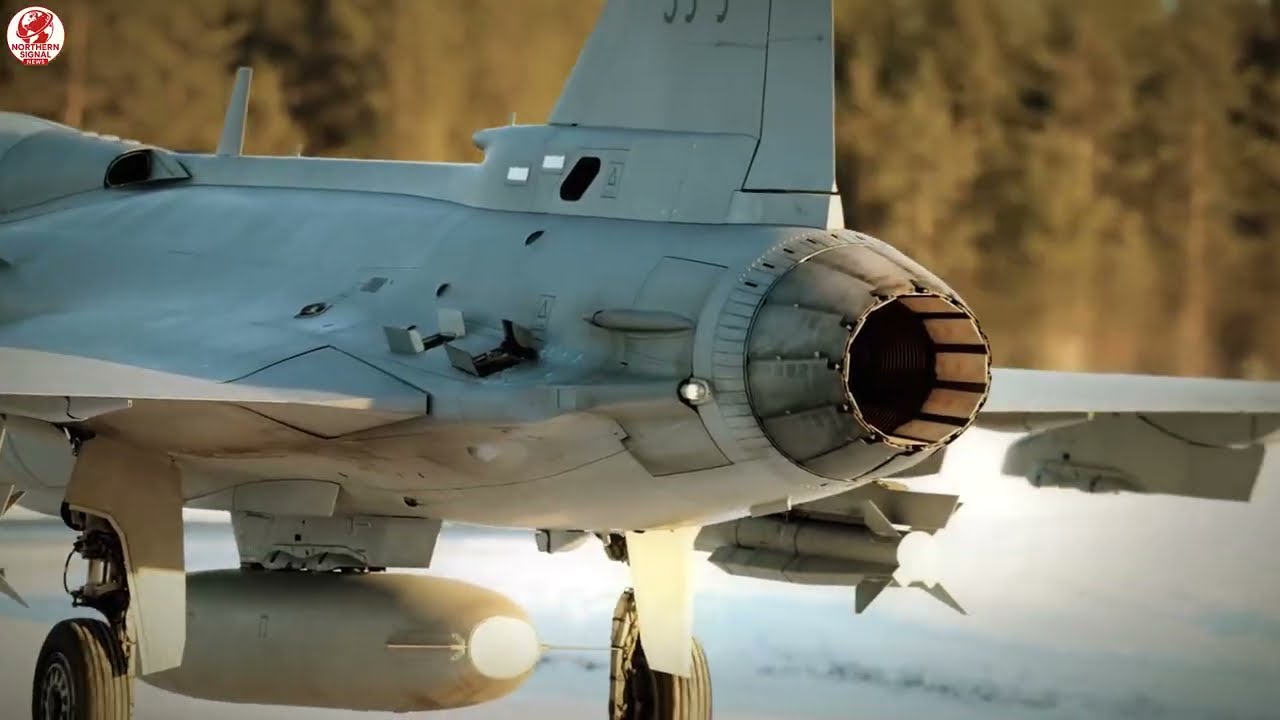
This is where Rolls-Royce enters the picture. Defense analysts say Saab has explored re-engining the Gripen with a European powerplant derived from the EJ200 family, currently used in the Eurofighter Typhoon. If successful, such a move would remove U.S. jurisdiction from the supply chain entirely. Canada would be able to maintain, upgrade, and potentially export aircraft without American veto power. No program has been officially confirmed, and experts stress that re-engining an active fighter platform would take years. Still, the strategic implications are enormous.
The Arctic is the real battleground in this debate. The F-35 has passed laboratory cold-weather tests, but U.S. Defense Department reports acknowledge real-world readiness issues in extreme conditions. Canada, responsible for patrolling vast Arctic airspace and the increasingly strategic Northwest Passage, requires aircraft that can launch reliably from remote locations with limited infrastructure. Gripen’s doctrine—dispersal, fast turnaround, and austere basing—aligns closely with those demands, even if it lacks the F-35’s fifth-generation stealth profile.
None of this means Canada is abandoning the F-35. Prime Minister Mark Carney’s government is formally reviewing the contract amid rising Canada–U.S. trade and security tensions, not canceling it. Washington has already warned that walking away could strain NORAD, underscoring how tightly fighter procurement is bound to alliance politics. The choice facing Ottawa is no longer just about jets. It is about whether collective security and technological sovereignty can coexist—or whether Canada must ultimately choose which price it is willing to pay.