Two U.S. Carrier Strike Groups Converge Near Iran as Nuclear Talks Stall

As nuclear negotiations in Europe edged toward another uncertain deadline, the United States moved two carrier strike groups closer to Iranian waters, assembling the largest concentration of American naval power in the region in more than two decades.
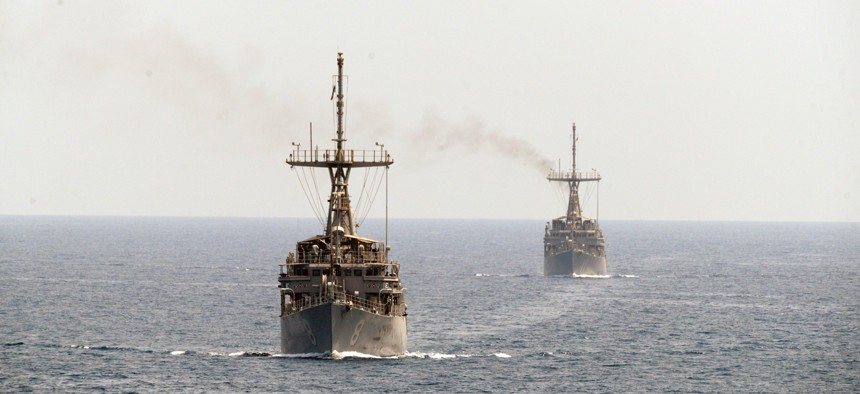
The deployment places the USS Gerald R. Ford in the Mediterranean and the USS Abraham Lincoln in the Arabian Sea, flanked by guided missile destroyers and supported by an array of advanced aircraft. Together, the two groups represent a formidable show of force at a moment when diplomacy over Iran’s nuclear program appears fragile.
American officials have framed the buildup as deterrence — a signal intended to dissuade Tehran from escalating maritime confrontations or accelerating sensitive nuclear activities. Iranian leaders, for their part, have described the deployment as provocation, warning that U.S. vessels in the region could become targets if hostilities erupt.
The immediate backdrop to the naval surge includes a series of tense encounters in and around the Strait of Hormuz, the narrow maritime corridor through which roughly one-fifth of the world’s oil supply transits. On Feb. 3, according to U.S. Central Command, Iranian Revolutionary Guard Corps (IRGC) vessels and a drone approached a U.S.-flagged commercial tanker at high speed. An American destroyer intervened, escorting the ship to safety. The same day, a U.S. fighter aircraft operating from the Lincoln shot down an Iranian drone that had approached the carrier.
While no shots were exchanged between surface vessels, the dual incidents underscored how quickly miscalculation could draw the two countries into direct confrontation.

The arrival of the Ford strike group significantly expands American operational capacity. The carrier, the newest and most technologically advanced in the U.S. fleet, was designed with electromagnetic catapults and enhanced sortie-generation capabilities. In combination with the Lincoln’s air wing, the United States now has the ability to project sustained airpower across the Persian Gulf, the Gulf of Oman and deep into Iranian territory, should orders be given.
Iran has responded with military exercises of its own. In mid-February, the IRGC conducted naval drills that included swarming tactics by fast attack craft and live-fire components. Iranian officials announced a temporary closure of sections of the Strait during the exercises and reiterated longstanding claims that American warships could be sunk in the event of war.
Yet beneath the rhetoric, analysts say Iran faces mounting internal pressures. The IRGC, long the backbone of the Islamic Republic’s security architecture, has endured leadership losses and equipment attrition over the past year. Several senior commanders were killed in Israeli strikes during the 2025 conflict, and elements of Iran’s air defense network were degraded.
Research organizations including the Hudson Institute and the International Crisis Group have argued in recent analyses that the Islamic Republic is entering a period of structural strain, exacerbated by economic sanctions and uncertainty surrounding eventual political succession. While predictions of imminent collapse have often proved premature in Iran’s four-decade history, few dispute that elite cohesion is under stress.
The IRGC’s influence now extends well beyond the battlefield. Over the years it has developed into a sprawling institution with economic holdings, infrastructure projects and intelligence networks that permeate Iranian society. Any fracture within its command structure would carry implications not only for Iran’s domestic stability but also for regional security.
Complicating matters further, China and Russia conducted joint naval drills with Iran in mid-February, an exercise that placed foreign vessels in proximity to U.S. forces. American planners must account for the presence of Russian and Chinese sensor platforms in any contingency, raising the risk that a localized clash could ripple outward.
Diplomacy remains the variable that could alter the trajectory. Talks in Geneva concluded without a breakthrough, and technical teams are scheduled to reconvene in Vienna. President Trump has publicly set a March deadline for progress, warning of consequences if negotiations fail. Iranian officials have signaled willingness to continue discussions but reject what they describe as coercive pressure.
For now, the aircraft carriers remain on station, their decks crowded with strike fighters and surveillance aircraft. Each side insists it seeks to avoid war. Yet the density of forces in confined waters — combined with hardened political positions — leaves little margin for error.
Whether the naval buildup proves to be leverage that nudges both parties back toward compromise, or the prelude to a more dangerous chapter, may depend less on the warships themselves than on decisions made in quiet rooms thousands of miles away.