🔥 BREAKING: Donald Trump’S POLICY PUSH MEETS RESISTANCE — Mark Carney HOLDS FIRM 🇺🇸🇨🇦
As the mandated 2026 review of the United States–Mexico–Canada Agreement approaches, trade tensions between Washington and Ottawa are resurfacing in unusually direct terms.

In recent remarks, representatives aligned with former President Donald Trump outlined a series of policy concerns they say should be addressed in discussions with Canada. The list spans longstanding American objections: expanded access to Canada’s dairy market, changes to digital media regulations, the removal of certain provincial alcohol restrictions, adjustments to government procurement rules, and greater alignment on energy policy.
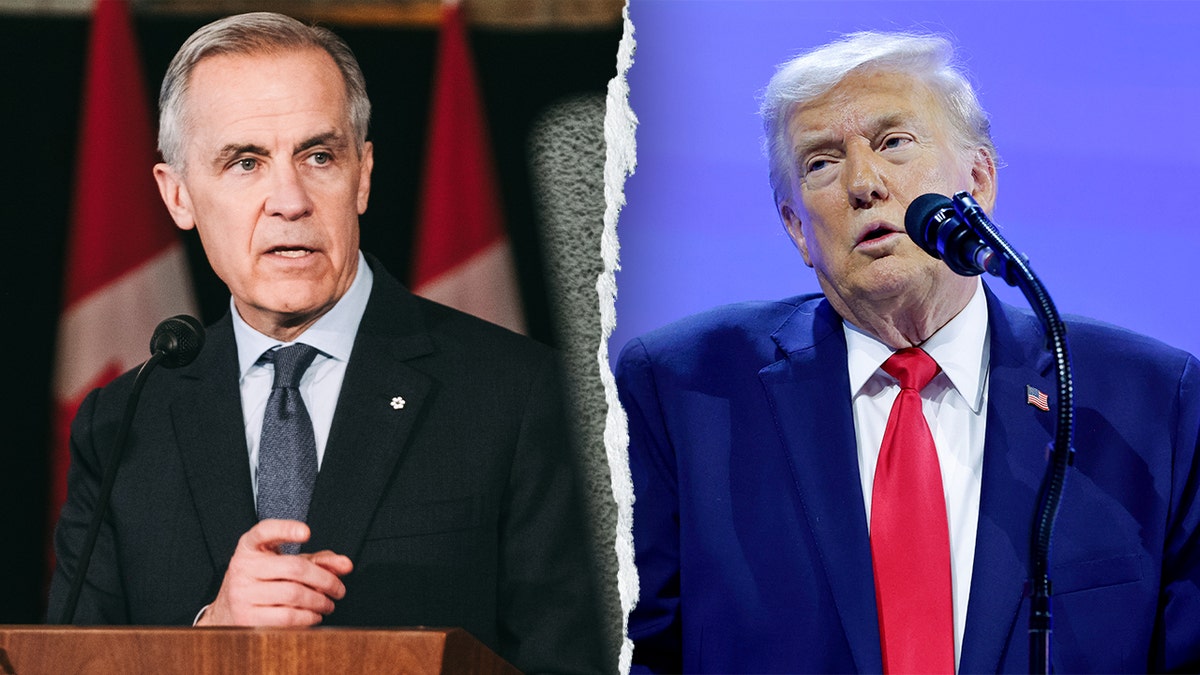
Canada’s prime minister, Mark Carney, has signaled little willingness to concede ground on those issues, framing them instead as matters of domestic sovereignty and economic stability. In public statements, he has suggested that Ottawa sees the coming review not as a one-sided test of resolve but as a negotiation in which both countries face significant stakes.
The exchange underscores a broader reality: the economic interdependence between the United States and Canada remains deep, even as political rhetoric on both sides grows sharper.
Dairy has long been a flashpoint. American officials have criticized Canada’s supply management system, which sets production quotas and maintains tariffs to stabilize prices for domestic farmers. U.S. producers argue that the system limits their access to the Canadian market despite concessions made under the original agreement and its successor. Canadian leaders, however, maintain that dismantling supply management would destabilize rural communities without meaningfully addressing structural overproduction in the United States. For Ottawa, the issue is as much about internal political commitments as it is about trade arithmetic.
Digital policy represents a newer, but increasingly prominent, area of friction. Canada has adopted legislation requiring large technology platforms to compensate domestic news organizations for the distribution of their content. American technology companies have objected, arguing that such rules impose disproportionate costs and could set precedents beyond Canada’s borders. Supporters of the Canadian approach say it is an effort to sustain a shrinking media sector and to rebalance bargaining power between publishers and global platforms. Any attempt by Washington to challenge these measures in trade talks would place commercial interests alongside sensitive debates over media independence and cultural policy.
On alcohol, the dispute centers on provincial practices that American officials contend restrict access to store shelves for U.S. producers. Canadian provinces control liquor distribution, creating a patchwork system that has periodically drawn complaints from trading partners. Some Canadian officials have hinted that broader tariff questions — including separate duties imposed in recent years — cannot be disentangled from these provincial concerns. That linkage suggests Ottawa may be prepared to use targeted measures as leverage if negotiations intensify.
Government procurement rules add another layer of complexity. “Buy American” provisions have become a fixture of U.S. industrial policy debates, particularly after pandemic-era supply chain disruptions exposed vulnerabilities in critical sectors. Canada has historically sought reciprocal access to public contracts, arguing that open procurement benefits both economies. If Washington presses for tighter mirroring of its domestic preference policies, Ottawa could respond by reinforcing its own “Buy Canadian” initiatives, reflecting a global trend toward more defensive trade strategies.
Energy may be the most strategically significant issue of all. The United States relies heavily on Canadian oil, natural gas, electricity and a growing list of critical minerals essential for clean energy technologies. While cross-border energy trade has traditionally been insulated from political turbulence, evolving climate policies and infrastructure debates have complicated that stability. Canadian officials have emphasized that national control over energy policy is nonnegotiable, particularly as the country seeks to balance environmental commitments with its role as a major exporter.
Behind the rhetoric lies a shared vulnerability. The United States is Canada’s largest trading partner by far, but Canada is also one of the United States’ most significant export markets. Integrated supply chains — in automobiles, agriculture, energy and advanced manufacturing — mean disruptions reverberate quickly across the border. American manufacturers depend on Canadian inputs; Canadian industries rely on American consumers. A breakdown in negotiations would not produce clear winners.
The coming review is therefore less a contest of dominance than a test of how two deeply entwined economies manage friction in an era of heightened nationalism. Both governments face domestic political pressures: American officials seeking to demonstrate toughness on trade, and Canadian leaders wary of appearing to yield to external demands.
For now, neither side appears eager to trigger a rupture. But as 2026 approaches, the public framing of demands and refusals suggests that the process will be closely watched, not only in Washington and Ottawa but across industries that depend on the quiet predictability of cross-border commerce.
What is clear is that the relationship is no longer defined solely by the assumption of automatic alignment. Instead, it is shaped by negotiation — and by a recognition that interdependence can be both a source of strength and a point of leverage.