For decades, Canada entered trade negotiations with the United States carrying an unspoken assumption: proximity meant dependency. The world’s largest economy was not just Canada’s biggest trading partner, but its unavoidable one. Pressure, even when uneven, was absorbed. Compromise was expected. That posture is now changing—and not through confrontation, but through restraint.
The moment arrived without spectacle. Asked to reopen long-protected sectors of its economy, Canada’s response was neither defensive nor theatrical. It was simply final. Certain demands, officials said, were “not negotiable.” Those two words landed with unusual force in Washington, not because of their tone, but because of what they implied: Canada was no longer bargaining from fear.
The immediate dispute centered on familiar terrain—dairy supply management, digital services taxes, provincial procurement rules, retaliatory alcohol restrictions. On the surface, the list looked like routine trade friction. But stripped of rhetoric, the demands revealed something more telling. They targeted consumer sectors and regulatory irritants rather than the industrial arteries that actually sustain North American growth: steel, aluminum, autos, energy, and critical minerals.
That contrast mattered. When a superpower presses hardest on milk quotas and streaming taxes, it signals less strength than vulnerability. And Canada responded by reframing the conversation entirely.
Instead of arguing over concessions, Ottawa pivoted to fundamentals. Integrated auto supply chains. Aluminum production powered by cheap, clean hydroelectricity. Forest products, steel inputs, and minerals essential to electric vehicles and defense manufacturing. These were not threats. They were reminders—of how deeply American industry relies on Canadian inputs that cannot be replaced quickly or cheaply.
Aluminum offered the clearest illustration. Producing it is brutally energy-intensive. Canada’s hydroelectric system gives it a decisive advantage, exporting aluminum that effectively saves the United States the equivalent of multiple Hoover Dams’ worth of electricity. Replacing that supply domestically would require massive new power generation—an undertaking measured in decades, not months. Canada, by contrast, can sell the same material to Europe or Asia, where demand is growing.
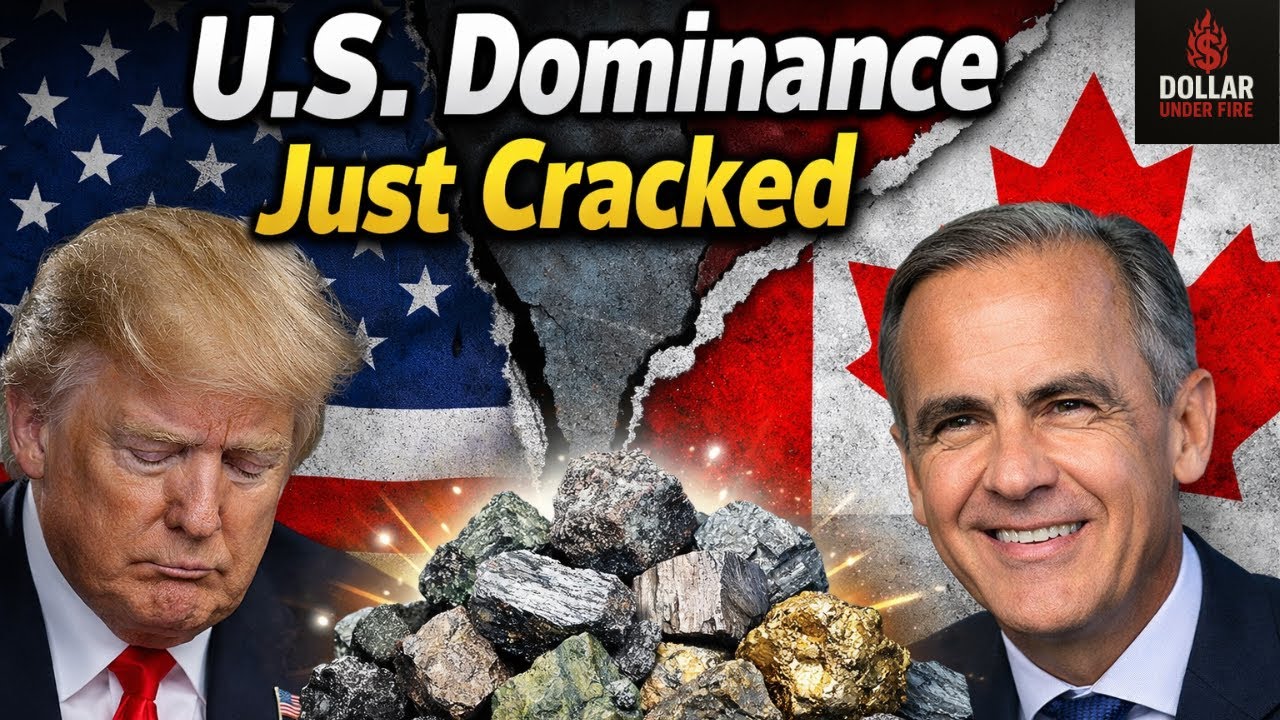
The same logic applies to critical minerals. Canada’s Ring of Fire in Northern Ontario contains vast reserves of nickel, chromite, cobalt, and rare elements essential to batteries, aerospace, and modern weapons systems. For years, access to those resources was treated as automatic, a function of geography and alliance. That assumption is eroding.

Rather than framing the Ring of Fire as a shared North American asset, Canada’s leadership has emphasized national priorities first—domestic value-added production, Indigenous consent, and long-term sovereignty over extraction and processing. Access for partners is now described as possible, not guaranteed. That shift—from assumed entitlement to negotiated opportunity—represents a quiet but profound change.
Washington’s traditional leverage relied on a belief that Canada had nowhere else to go. That belief no longer holds. Canada has ports on three oceans, expanding Atlantic and Pacific shipping capacity, and active trade agreements with Europe and Indo-Pacific economies. Energy corridors are increasingly oriented westward and overseas rather than exclusively south. These are not emergency pivots; they are the result of years of planning that tariffs only accelerated.
Even retaliatory measures once expected to cause pain have produced unexpected outcomes. Provincial bans on U.S. alcohol, introduced after American tariffs, boosted domestic producers. Canadian wine and spirits sales surged, distilleries expanded, and local supply chains strengthened. The message was subtle but clear: pressure did not produce collapse; it produced adaptation.
Politically, Canada has paired calm strategy with selective disruption. While federal leadership has emphasized patience and predictability, provincial figures have been willing to apply blunt pressure, including direct appeals to American voters. The contrast is not a split but a division of labor—precision alongside provocation, reassurance alongside leverage. It signals unity without uniformity, and comfort with friction rather than fear of it.

What is unfolding is not a rupture in the Canada-U.S. relationship. Cooperation remains possible and likely. But the terms have changed. Canada is no longer negotiating from a position of assumed weakness. It has alternatives—real ones—and alternatives reshape behavior.
The deeper lesson for Washington is uncomfortable but unavoidable. Tariffs lose their bite when they accelerate self-reliance. Demands lose their force when the other side is not cornered. And proximity no longer guarantees dependency in a world of diversified supply chains and global competition for resources.
Canada is not closing doors. It is setting boundaries. When it says “not negotiable,” it is not posturing—it is reflecting leverage built on energy, minerals, infrastructure, and choice. That leverage does not shout. It waits.
And once a country negotiates from confidence instead of fear, the balance of power does not snap back. It resets.