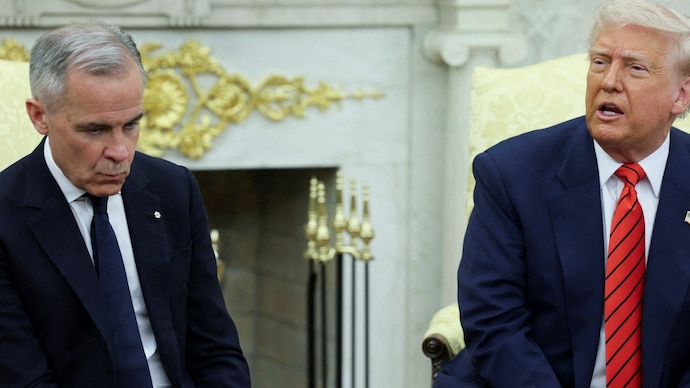
In his first major address on Indian soil, Mark Carney delivered more than a policy speech — he unveiled a strategic doctrine. Speaking in Mumbai before global investors and policymakers, Carney outlined a world reshaped by financial crises, pandemics, energy shocks, and geopolitical fracture. Without directly naming Donald Trump, he described an era of weaponized trade, tariff leverage, and conditional market access that is redefining global economics. His message was unmistakable: Canada will not be coerced.
Carney framed the past two decades as a stress test that exposed the fragility of extreme global integration. From financial instability to supply chain disruptions, he argued that major powers are increasingly using economic interdependence as a strategic tool. Tariffs have become leverage. Financial infrastructure has become influence. Supply chains have become pressure points. In that environment, he noted, countries can no longer assume that multilateral institutions alone will provide protection. Strategic autonomy, he suggested, is becoming a necessity.
When asked about the possibility of a lasting 15% U.S. tariff regime, Carney responded with measured realism. Washington has signaled that access to its market may involve costs, whether through tariffs, regulatory shifts, or investment commitments. Rather than focusing on short-term turbulence, Carney emphasized long-term structural positioning. Temporary trade measures, he explained, operate within defined legal and time constraints. The larger issue is how nations build resilience beyond any single policy cycle.
That resilience, according to Carney, requires structural competitiveness. Canada is reducing its marginal effective tax rate on investment to 13%, below U.S. levels and roughly half the G7 average. A 100% “super deduction” for manufacturing, infrastructure, R&D, clean energy, and EV investments aims to attract capital and accelerate growth. Regulatory reforms promise to fast-track major projects in cooperation with provinces. The approach centers on strengthening fundamentals rather than reacting to volatility.
Diversification also stood at the core of his message. If reliance on one market increases vulnerability, broadening partnerships reduces risk. Carney highlighted deeper engagement across Europe and the Indo-Pacific, with India positioned as a long-term economic partner. The strategy seeks balanced integration — maintaining openness while reinforcing domestic capacity and expanding trusted alliances.
Ultimately, the speech signaled a strategic recalibration. While tariff debates continue to dominate headlines, Canada is emphasizing investment, defense expansion, and durable partnerships. The contrast between short-term policy swings and long-term structural planning is becoming more visible. Whether this approach reshapes North American trade dynamics remains uncertain, but Canada’s direction is clear: build leverage through strength, diversification, and sustained global engagement.