🔥 BREAKING: TRUMP ERUPTS After JIMMY KIMMEL & ARNOLD SCHWARZENEGGER OBLITERATE Him LIVE ON TV — SAVAGE LATE-NIGHT TAKEDOWN SENDS STUDIO INTO ABSOLUTE CHAOS ⚡
In the long and often combustible relationship between Donald Trump and late-night television, ridicule has never been merely entertainment. It has functioned as a pressure point, probing the former president’s deep investment in image, dominance, and public validation. A recent convergence of commentary by Jimmy Kimmel and Arnold Schwarzenegger offered a striking illustration of how humor, when aimed precisely, can provoke disproportionate reaction.
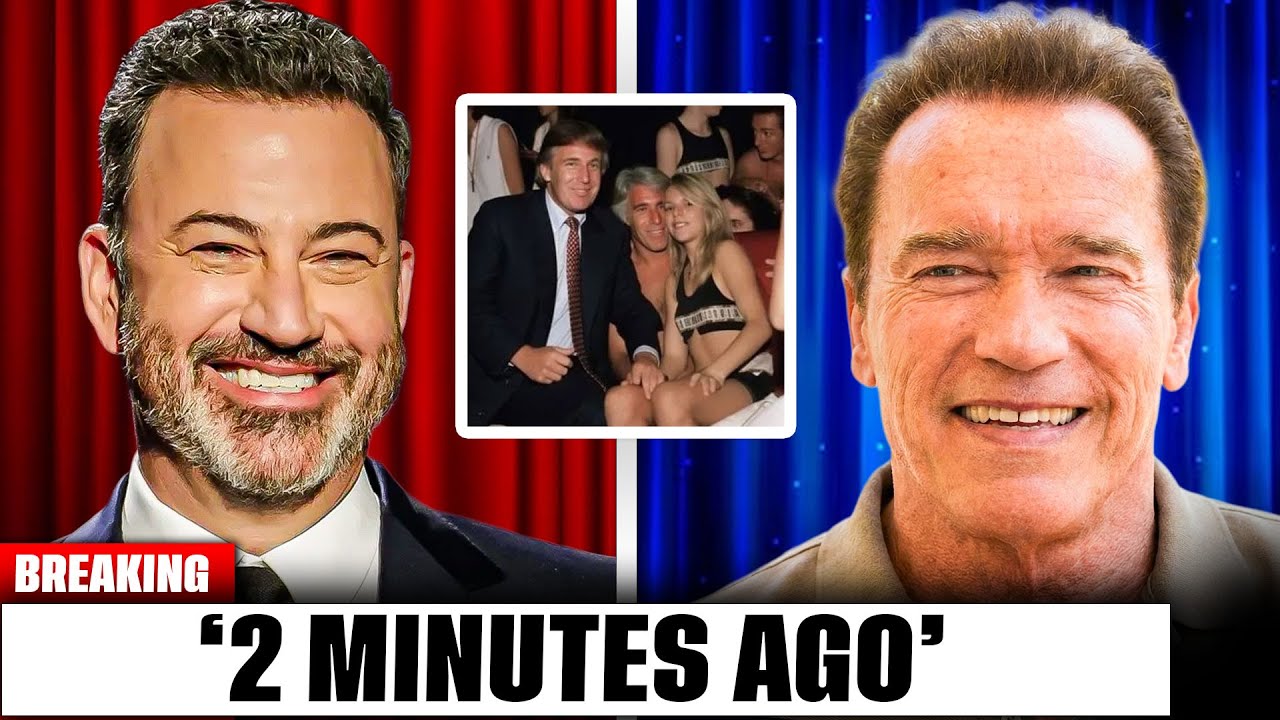
The episode centered not on policy or legislation, but on something far more personal: Trump’s self-reported physical and symbolic stature. When Trump was booked into the Fulton County jail in August 2023 on charges related to efforts to overturn the 2020 election, official records listed his height and weight as 6-foot-3 and 215 pounds. The figures immediately became fodder for public skepticism, with photographs contradicting the claim and social media erupting in disbelief.
For months, Kimmel had been unable to address the moment directly due to the Writers Guild strike that temporarily shuttered late-night programming. When his show returned in October, he wasted little time. His first major guest was Schwarzenegger — a seven-time Mr. Olympia, former Republican governor, and widely regarded authority on physical conditioning. The setup was deliberate.
What followed was not an aggressive denunciation, but a carefully calibrated exchange that blended humor with implication. Asked whether Trump could plausibly weigh 215 pounds, Schwarzenegger dismissed the idea with amused incredulity, suggesting instead that the former president might benefit from exercise rather than self-flattery. The studio audience erupted, and the clip rapidly circulated online, drawing millions of views.
The exchange resonated not because it settled a factual dispute — no official medical disclosure followed — but because it struck at the core of Trump’s public persona. His brand has long depended on projecting strength, success, and superiority, whether measured in wealth, ratings, or physical vigor. To be laughed at by Schwarzenegger, a figure who embodies a different and more literal version of strength, undermined that image in a way few political critiques could.
The moment also revived a long-running feud between Trump and Schwarzenegger dating back to 2017, when Schwarzenegger took over as host of The Celebrity Apprentice. Trump, still listed as an executive producer after entering the White House, repeatedly attacked the show’s ratings and mocked Schwarzenegger’s performance, suggesting personal resentment over declining viewership.
Kimmel’s broader commentary extended beyond the weight joke, situating it within a pattern. Trump has frequently made demonstrably false or exaggerated claims — about crowd sizes, election outcomes, cognitive tests, and television ratings — and has often responded angrily when challenged. In this sense, the late-night segment functioned less as a roast than as a case study in how fragile narratives react when punctured.

Schwarzenegger, for his part, has increasingly positioned himself as a critic of Trump not from the political left, but from within a traditional Republican framework. He has publicly condemned Trump’s behavior following the January 6 attack on the Capitol, invoking historical memory from his Austrian childhood and drawing parallels between authoritarian rhetoric and democratic erosion. That context lent additional weight to what might otherwise have been dismissed as a celebrity jab.
Trump’s response followed a familiar pattern. Rather than ignoring the mockery, he lashed out on social media, reviving old grievances about ratings, loyalty, and respect. The reaction only amplified the original joke, reinforcing the perception that satire had landed precisely where it hurt most.
The episode illustrates a broader dynamic in American politics, where late-night television has become an informal arena for accountability. While comedians do not produce legislation or verdicts, they shape public perception by distilling complex patterns into moments that are easily understood and widely shared.
In this case, the substance was not Trump’s weight, but his inability to tolerate contradiction. The laughter was not merely at the joke itself, but at the predictability of the response.
As Trump continues to dominate political discourse — whether as a candidate, defendant, or cultural figure — moments like this reveal why satire remains potent. Not because it changes minds overnight, but because it exposes contradictions that formal debate often leaves untouched. When image is everything, humor can be destabilizing. And when vanity is challenged publicly, the reaction can say more than any punchline ever could.