Trump Called Canada’s Water a “Big Faucet” — Ottawa’s Quiet Countermove Changed the Game
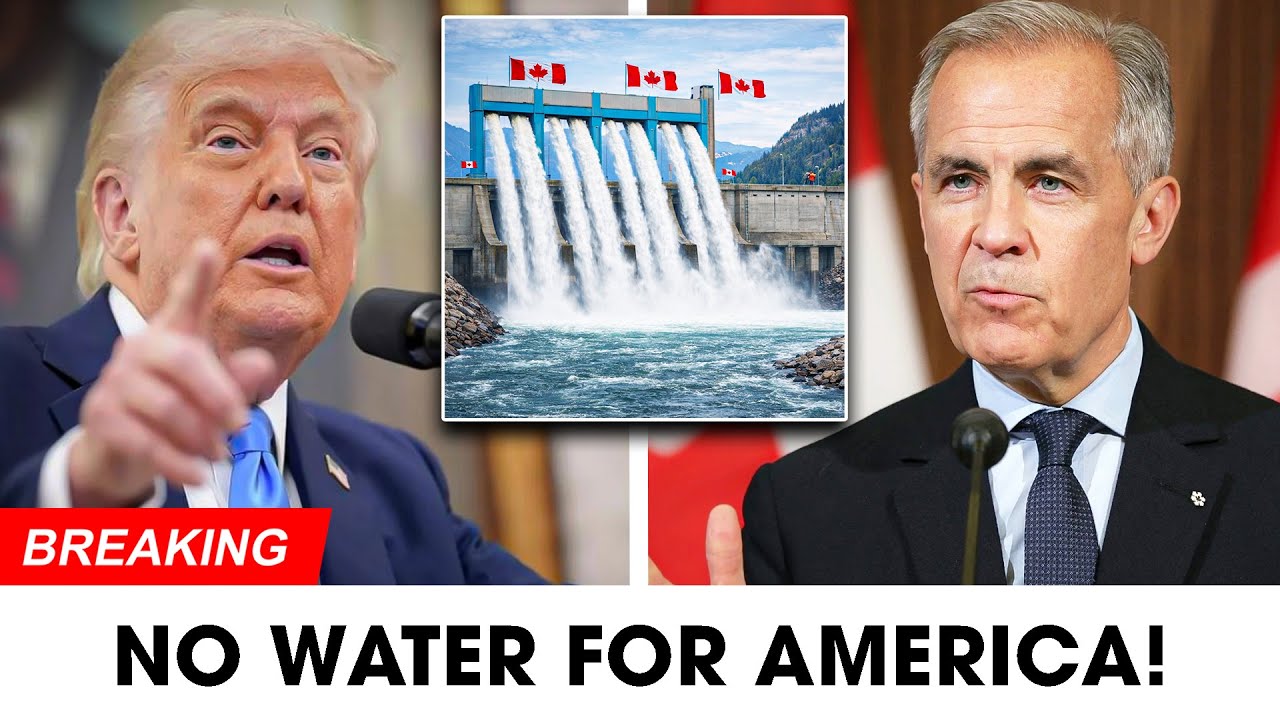
Donald Trump’s offhand description of Canada’s water as a “giant faucet” that could be turned on to relieve drought in California initially sounded like familiar political bravado. But the remark struck a nerve in Ottawa, transforming what had long been treated as a technical, cooperative environmental issue into a high-stakes question of sovereignty, power, and national strategy. Water, once assumed to be safely outside trade politics, suddenly became a flashpoint in Canada–U.S. relations.
Trump’s framing was deceptively simple: vast quantities of Canadian water, he argued, flow uselessly into the Pacific and could easily be redirected south. He spoke of massive valves that could be opened in a single day, minimizing the complexity of transboundary river systems and decades-old agreements governing them. During the 2024 campaign, he repeated the claim, suggesting California could receive more water than it would ever need if the United States gained access to northern sources.

In Canada, the response was swift and unusually unified. Federal and provincial leaders rejected the premise outright, arguing that freshwater is not an export commodity but a public resource inseparable from sovereignty. British Columbia Energy Minister Adrian Dix described Trump’s remarks as a direct confrontation, while a coalition of 85 environmental and Indigenous organizations issued a joint statement declaring that Canada’s water is “not for sale.” Scientists reinforced the point, warning that climate change is already reducing flows and that the idea of surplus water is largely a myth.
What began as rhetoric soon translated into real pressure. The Trump administration paused negotiations to modernize the 61-year-old Columbia River Treaty, injecting uncertainty into one of North America’s most stable cooperation frameworks. Reports later suggested Trump raised water agreements in private calls, arguing that Canada benefited unfairly. Even foundational accords like the 1909 Boundary Waters Treaty and Great Lakes agreements were suddenly viewed as potential bargaining chips, alarming policymakers on both sides of the border.
The stakes are enormous. The Great Lakes supply drinking water to more than 30 million people, while the Columbia River Basin underpins roughly 40 percent of U.S. hydroelectric generation and supports billions of dollars in agriculture. Experts warned that destabilizing these treaties could disrupt flood control, power generation, and environmental monitoring across the continent. Water was no longer just a bilateral issue; it was becoming entangled with energy security, food systems, and public health.
Prime Minister Mark Carney framed the moment as a strategic turning point, warning that pressure over land, resources, and water represented a long-term challenge rather than a passing dispute. Instead of responding with confrontation, Ottawa quietly shifted course. Water was declared unequivocally off-limits in trade-style negotiations, while Canada began reinforcing its autonomy through investments rather than threats.
That strategy took concrete form in the Arctic. Ottawa committed hundreds of millions of dollars to strengthen the Hudson Bay Railway and upgrade the Port of Churchill, creating a more resilient northern trade corridor. The port has already tripled its capacity for critical minerals and completed successful shipping seasons to Europe, reducing reliance on U.S. routes without provoking direct conflict. It was a structural adjustment, not a rhetorical one.
Canada’s response revealed a broader lesson in modern geopolitics. Rather than trading away sovereignty under pressure, Ottawa chose to build leverage through infrastructure, legal clarity, and strategic geography. Trump’s “big faucet” comment may have been intended as a show of strength, but it ultimately accelerated Canada’s rethinking of power. In an era where essential resources are increasingly politicized, Canada signaled that its advantage lies not in concessions, but in quietly expanding its options.