As New Epstein Documents Emerge, President Trump Faces a Renewed Test of Power, Credibility, and Control
When the Justice Department released a new batch of documents connected to the Jeffrey Epstein investigation, the disclosures did not arrive as a single dramatic revelation. Instead, they surfaced incrementally—through internal emails, flight records, and previously unseen correspondence—producing a slow but unmistakable swell of political pressure now confronting President Donald J. Trump at the center of American power.
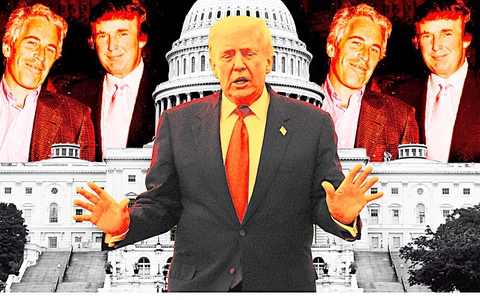
The records, drawn from files reviewed years earlier by federal prosecutors, renewed attention on Epstein’s network of associations and travel. Among the names appearing repeatedly was that of Mr. Trump, now serving his second term in the White House. According to flight logs referenced in the materials, Trump traveled aboard Epstein’s private aircraft multiple times in the mid-1990s, more frequently than he has previously acknowledged in public statements.
The documents do not accuse the president of criminal conduct. But their release has reopened a set of unresolved questions—about proximity, judgment, and transparency—that carry particular weight when attached to a sitting president. In Washington, where perception often rivals policy in consequence, the timing has proven politically combustible.
What distinguishes this episode from earlier iterations of the Epstein story is the institutional response it has triggered. Coverage of the disclosures has appeared prominently in media outlets that have historically been sympathetic to Mr. Trump, including publications owned by Rupert Murdoch. Their reporting, largely factual and stripped of interpretive cushioning, has marked a departure from past patterns in which controversies surrounding the president were often reframed or minimized.

That shift has not gone unnoticed inside the administration. According to people familiar with internal discussions, senior officials have expressed frustration at the inability to contain the narrative, particularly as it breaks through media ecosystems once considered reliable defenses. The White House has pushed back forcefully, characterizing some reporting as misleading and reiterating that no wrongdoing has been alleged.
Still, the renewed scrutiny has exposed a familiar tension that has followed Mr. Trump throughout his political career: the challenge of maintaining narrative dominance in the face of documentary evidence that resists simplification. As excerpts circulated online, social media platforms erupted with resurfaced interviews, archival footage, and past remarks, many now viewed through a harsher lens.
Late-night television hosts and cable news commentators framed the moment less as a legal reckoning than as a test of institutional trust. The Epstein case, long emblematic of elite impunity and systemic failure, has become a vessel for broader public anxieties—about secrecy, accountability, and the extent to which powerful figures are insulated from consequence.
Behind the scenes, the fallout has extended beyond the West Wing. Several Republican lawmakers, including some aligned closely with the president, have publicly called for full transparency around the Epstein files, framing disclosure as essential to restoring public confidence. Their statements underscore a growing unease within the president’s own coalition, where loyalty to Trump now competes with pressure from a base increasingly skeptical of closed-door governance.
The debate has also revived questions about declassification. Mr. Trump has previously suggested that releasing sensitive files—on matters ranging from national security to historical assassinations—could help rebuild trust in government. On Epstein, however, he has expressed caution, citing the risk of false or damaging information harming innocent people. Critics have seized on that ambivalence, arguing that it contrasts sharply with reports of behind-the-scenes efforts to limit the scope of disclosures.
None of this alters the legal posture of the Epstein case itself. Epstein is dead. Ghislaine Maxwell has been convicted. The documents represent historical records, not new indictments. Yet politics, particularly at the presidential level, rarely turns on legal thresholds alone. It is shaped by credibility, consistency, and the public’s sense of whether leaders are forthcoming when scrutiny intensifies.
For Democrats, the moment has reinforced arguments that the Trump administration’s governing style—marked by confrontation with the press and resistance to oversight—has deepened mistrust in institutions. For Republicans, it has highlighted an internal dilemma: whether defending the president at all costs risks prolonging a controversy that shows little sign of fading.
Perhaps most revealing is what the episode says about the media environment itself. When outlets once counted on to blunt controversy instead present developments plainly, it signals a recalibration driven less by ideology than by audience expectations. Readers appear increasingly unwilling to accept dismissal without documentation or reassurance without disclosure.
In that sense, the Epstein files are not merely about revisiting a dark chapter of the past. They are about the present—about how power responds when long-buried records resurface, and about whether transparency can coexist with political survival at the highest level of government.
For President Trump, the documents have reopened a narrative he has long sought to put to rest. Whether this moment becomes a turning point, or simply another test weathered, may depend less on what remains hidden than on how openly the administration confronts what is now plainly in view.