When Laughter Becomes a Test of Power
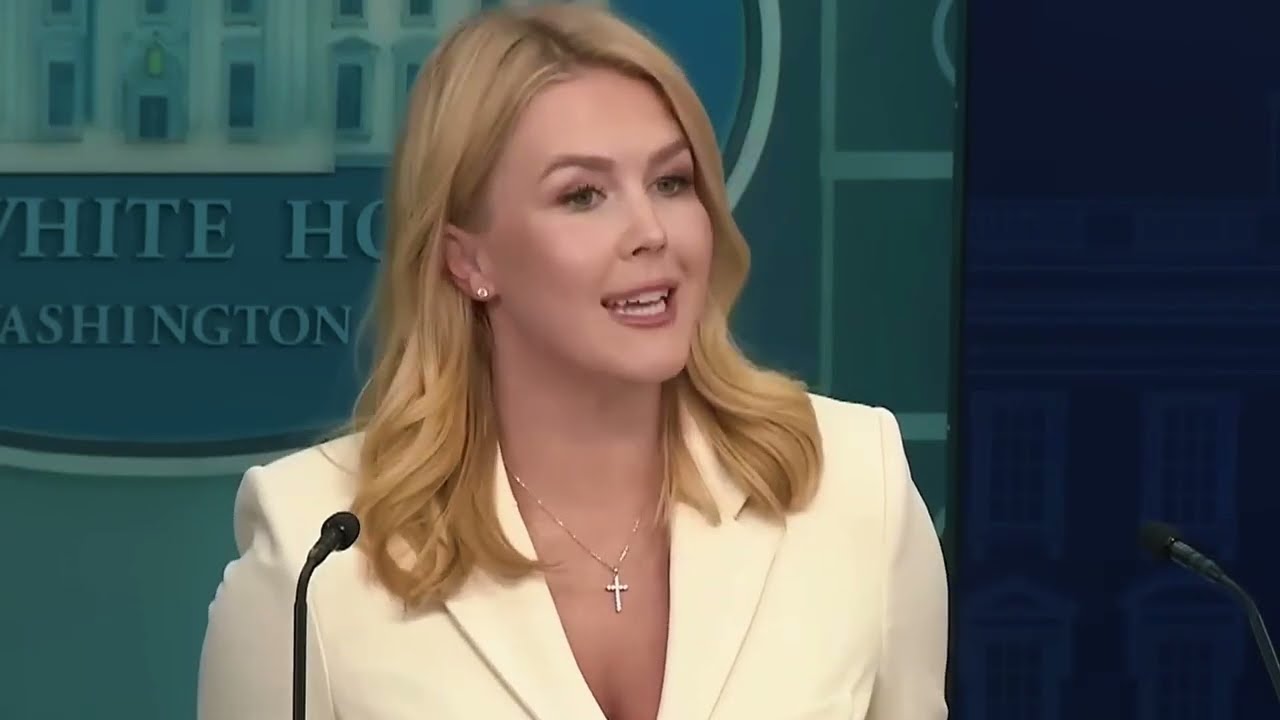
In the landscape of American late-night television—where comedy is often treated as a lighthearted escape from politics—there are moments when laughter suddenly carries the weight of an indictment. Jimmy Kimmel’s recent monologue, aimed squarely at Donald Trump and his spokesperson Karoline Leavitt, was one such moment.

At first glance, it appeared to be a familiar routine: a talk-show host delivering jokes, a politician serving as the target, and an audience laughing on cue. But as the segment unfolded, it became clear that this was not merely comedy. It was an examination of power, of the fragility of political ego, and of how those closest to the center of authority respond when they lose control of the narrative.
Kimmel opened with a calm, almost detached tone before gradually constructing a familiar portrait of Donald Trump—a figure who consistently casts himself as a victim of the media, the elite, and unseen conspirators, and this time, of a late-night comedy show. The jokes were not aimed solely at Trump himself but extended to the ecosystem surrounding him, in which Karoline Leavitt has emerged as a symbol of unwavering loyalty.

In Kimmel’s telling, Leavitt was not simply a spokesperson. She was portrayed as the guardian of the Trump narrative, ever ready to polish, defend, and rationalize every statement, no matter how contradictory or implausible. Loyalty, in this framing, becomes a performance—so earnest that it veers into the absurd.
What made the segment resonate was not direct accusation, but contrast. On one side stood Trump, a man who frequently declares himself a champion of free speech, yet appears unable to tolerate becoming the subject of ridicule. On the other was a comedian, using humor as a tool to question power, accountability, and truth.
According to individuals close to Mar-a-Lago, Trump’s reaction to the monologue was anything but restrained. He was reportedly watching live, pacing, venting, and expressing fury over what he viewed as a personal affront. While such accounts are difficult to independently verify, they align strikingly well with the public image Trump has cultivated over years—a political figure who rarely lets personal mockery go unanswered.
Equally telling was the public response. Clips of the segment spread rapidly across social media, not simply because they were funny, but because they tapped into a broader cultural fatigue: exhaustion with displays of power built on ego, and a desire to see those displays challenged, even if only through satire.
Political comedy has long occupied a peculiar place in American history, serving as a distorted mirror that reflects truth in uncomfortable ways. From Mark Twain to Jon Stewart, laughter has often been the safest means of saying the most dangerous things. In this moment, Jimmy Kimmel stepped firmly into that tradition—not as an activist, but as a storyteller.
In the end, what lingers after the laughter fades is not the question of who won or lost. It is a deeper one: How strong is a democracy if its leaders cannot tolerate mockery? When a joke is enough to provoke rage, perhaps the problem lies not in the laughter—but in the insecurity it exposes.