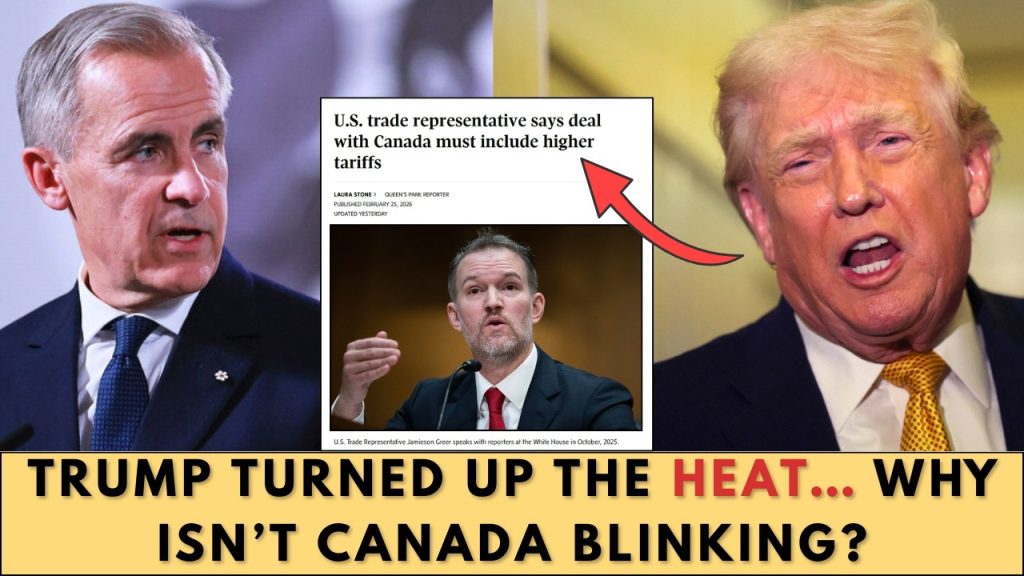
When a senior American trade official suggested this week that Canada would need to accept higher tariffs as the price of any new bilateral agreement, the remark was framed in Washington as routine negotiating pressure. In Ottawa, it was received as something else: confirmation that the assumptions underpinning North America’s economic partnership are shifting. Prime Minister Mark Carney’s response was not a televised rebuke or a rushed delegation to Capitol Hill. Instead, it was quieter — and potentially more consequential.
For decades, Canada’s economy has been oriented overwhelmingly southward. Roughly three-quarters of its merchandise exports flow to the United States, supported by deeply integrated supply chains in autos, energy, agriculture and aerospace. That integration has long been described as mutually beneficial and structurally stable. But in an era of revived tariff threats and transactional rhetoric, Canadian officials increasingly describe it as concentrated risk.
The latest friction centers on familiar terrain: dairy protections, provincial liquor policies and broader market access. American negotiators argue that Canada’s supply management system unfairly shields domestic producers. Canadian leaders counter that such systems are political commitments embedded in rural economies and trade agreements alike. Yet the subtext of the recent exchange was more pointed. The suggestion that Canada must accept higher tariffs before talks meaningfully proceed was interpreted by some in Ottawa as a test of leverage.
Mr. Carney’s strategy, according to advisers, is to reduce the degree to which such leverage can be exercised. Over the past year, his government has accelerated trade outreach in the Indo-Pacific, deepened engagement with the European Union and Gulf states, and emphasized export diversification targets that would, in theory, lower the share of Canadian trade tied to a single partner. The approach is incremental rather than dramatic, but its cumulative aim is clear: insulate Canada from abrupt policy swings in Washington.
That insulation will not materialize overnight. Supply chains cannot be rerouted as quickly as speeches can be delivered. Canadian energy infrastructure, for example, is physically oriented toward the American market. Automotive production is synchronized across the border, with components crossing multiple times before final assembly. Still, diversification is not solely about volume; it is about optionality. Even modest expansion in alternative markets can alter the psychology of negotiations.

In Washington, reactions have been mixed. Some officials dismiss Ottawa’s diversification drive as aspirational, noting the gravitational pull of the American consumer market. Others acknowledge that middle powers are increasingly hedging against volatility in U.S. trade policy. The concern is not that Canada will disengage — such a move would be economically self-defeating — but that it will negotiate with greater patience and less urgency.
Markets have so far remained steady, suggesting that investors view the rhetoric as part of a familiar cycle. But beneath the surface, executives in export-oriented sectors are recalculating exposure. If tariff threats become recurrent rather than episodic, companies may accelerate efforts to qualify alternative buyers or shift portions of production. That dynamic, once set in motion, can reshape trade patterns over time.
There is also a political dimension. Mr. Carney’s positioning allows him to project firmness at home without escalating confrontation abroad. By speaking of resilience and diversification rather than retaliation, he avoids triggering an immediate spiral. At the same time, he signals that Canada will not negotiate from a posture of visible anxiety. For a government that has framed economic security as a pillar of national sovereignty, the optics matter.
None of this implies rupture between two deeply intertwined economies. The United States remains Canada’s indispensable partner, and vice versa. Yet the tone of recent exchanges reflects a broader recalibration underway in global trade, where long-standing alliances are increasingly filtered through domestic political calculations. In that environment, even close neighbors reassess assumptions.
Whether Canada’s diversification strategy meaningfully shifts leverage will depend on execution rather than aspiration. Trade missions and memoranda of understanding must translate into contracts, infrastructure and sustained demand. But the signal has been sent. Ottawa is preparing for a world in which access to the American market is not unconditional — and in which negotiating space is expanded not by confrontation, but by alternatives.