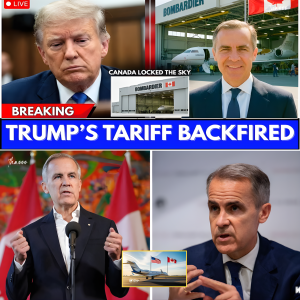
Trump’s 50% Tariff Threat on Canada Backfires, Throwing U.S. Aviation Into Chaos
In what was meant to be a bold “America First” power play, President Donald Trump’s threat to impose a massive 50% tariff on Canadian-made aircraft has instead ignited turmoil inside the U.S. aviation industry, exposed deep legal vulnerabilities, and revealed how dangerously interconnected North American aerospace has become.
Rather than crippling Canada’s aerospace champion, Bombardier, the move has largely backfired—creating uncertainty for airlines, investors, military planners, and regulators in the United States itself. Within hours of the announcement, the damage appeared less external and more self-inflicted.

A Social Media Threat That Shook Global Aviation
On Thursday, January 29, 2026, a single social media post from President Trump sent shockwaves through global aviation markets. The message was blunt: unless Canada immediately certified a series of American-made Gulfstream business jets, the United States would impose a 50% tariff on all Canadian-built aircraft—and potentially decertify them entirely.
At first glance, the threat appeared to be a familiar trade tactic, aimed at protecting a prestigious American manufacturer. But aviation is not steel, lumber, or consumer goods. Aircraft operate within a tightly regulated global safety system where trust, not tariffs, keeps planes in the air.
Why Aircraft Certification Is Sacred
Aircraft certification is the foundation of aviation safety. Every plane flying commercially must receive a type certificate from national regulators such as the U.S. Federal Aviation Administration (FAA) or Transport Canada. These certifications confirm that an aircraft meets strict engineering and safety standards.
Because the process is so complex and technical, countries rely on mutual recognition agreements. When the FAA certifies a U.S. aircraft, Canada typically validates that approval, and vice versa. This system has worked for decades precisely because it is apolitical.
Once politics enters certification, trust evaporates—and without trust, global aviation grinds to a halt.
The Gulfstream Dispute and a Dubious Claim
President Trump’s frustration centered on Canada’s alleged refusal to certify several Gulfstream models, including the G500, G600, G700, and G800. The White House framed the issue as unfair protectionism designed to shield Bombardier from American competition.
However, industry experts quickly challenged that narrative. Certification applications typically depend on customer demand, and records show that Transport Canada had previously authorized aspects of Gulfstream operations years earlier. The claim that Canada was illegally blocking certification appeared far less clear-cut than suggested.
The Nuclear Option: Decertification
The response from the White House was unprecedented. Alongside the tariff threat, the president suggested decertifying all Canadian-built aircraft in the United States.
Decertification would instantly make an aircraft illegal to operate in U.S. airspace. Unlike tariffs, which affect future sales, decertification threatens planes already flying. Aviation experts described the move as “weaponizing safety regulation,” something never before attempted in a trade dispute.
Immediate Chaos Inside the United States
The fallout was swift. Bombardier’s stock fell, while private jet buyers froze purchases amid fears of tariffs or grounding. Bombardier responded calmly, noting that thousands of Canadian-built aircraft fly daily in U.S. airspace and warning of “significant impact on air traffic and the flying public.”
The White House soon attempted to clarify, claiming existing aircraft would not be affected. But the contradiction between presidential rhetoric and official clarification only deepened uncertainty—anathema to an industry that depends on regulatory clarity.
America’s Regional Airlines at Risk
The true scale of the backfire became clear when analysts examined U.S. regional aviation. According to aviation data firm Cirium, more than 5,400 Canadian-made aircraft currently operate in the United States, nearly 2,700 of them built by Bombardier.
Bombardier’s CRJ regional jets form the backbone of U.S. regional air travel. American Eagle, Delta Connection, and other carriers rely heavily on these aircraft to connect smaller cities to major hubs. Grounding them, even temporarily, would trigger a transportation crisis.
As one aviation expert bluntly put it: grounding Canadian-built jets would be “a national air travel disaster.”
A Supply Chain That Cuts Both Ways
The North American aerospace industry operates as a single ecosystem. Bombardier aircraft may be assembled in Canada, but their engines, avionics, and systems are often manufactured in U.S. states like Ohio, Arizona, and Kansas.
A 50% tariff on Canadian aircraft would ripple backward through this supply chain, reducing orders for thousands of American suppliers. The intended punishment of a Canadian company would instead hit U.S. workers and manufacturers.
The Military Irony
Perhaps the most striking irony is the U.S. military’s reliance on Bombardier platforms. The U.S. Air Force and Army operate modified Bombardier Global jets for advanced intelligence, surveillance, and communications missions.
Threatening the certification of Bombardier aircraft puts Washington in the bizarre position of undermining platforms that support its own military operations.
The Legal Wall Trump Likely Cannot Cross
Legal experts were quick to raise a critical question: does the president even have the authority to decertify aircraft?
The consensus answer is no. Certification authority rests with the FAA, an independent regulator whose decisions must be based solely on safety. Former Transportation Department Inspector General Mary Schiavo warned that politicizing certification would shatter the FAA’s credibility and invite global retaliation against U.S.-certified aircraft.
Any attempt to force decertification would likely trigger massive lawsuits from airlines, leasing companies, and aircraft owners.
Canada’s Strategic Silence
Canada’s response has been notably restrained. Bombardier issued a measured statement, and Ottawa avoided public escalation. The strategy appears deliberate.
Why escalate when the threat is legally questionable, economically self-destructive, and causing chaos primarily inside the United States?
A Lesson in Unintended Consequences
What began as an aggressive attempt to pressure Canada has instead exposed how fragile economic coercion becomes in an interconnected global system. The tariff threat rattled U.S. markets, endangered regional air travel, threatened American suppliers, and raised serious legal and safety concerns.
The ultimate irony is that Bombardier barely needed to respond. The United States, in attempting to shut Canada out, risked shutting itself in.
In the modern global economy, power is not merely the ability to issue threats—but the wisdom to understand their consequences. And in this case, the consequences are landing much closer to home.