The Belfast Rupture: When the ‘Enough is Enough’ Cry Met a Seven-Word Silence
BELFAST — For decades, the peace in Northern Ireland has been a meticulously curated silence, held together by high-level diplomacy and a weary public consensus. But this week, that silence was shattered by the roar of burning tires and the rhythmic percussion of riot shields against stone. In the streets of Belfast and Derry, the air is no longer filled with the quiet optimism of a post-conflict society, but with the acrid smoke of a social contract in mid-combustion. What began as localized friction over migrant accommodation has rapidly devolved into a fundamental challenge to the state’s ability to maintain order, signaling a deeper fracture forming beneath the surface of the United Kingdom’s most complex territory.

The visual evidence from the ground—sirens, shattered glass, and volatile riot lines under immense pressure—tells a story of a society reaching a historical breaking point. While national broadcasters have maintained a tone of cautious restraint, the digital landscape is flooded with raw footage of a “rupture” that feels less like a political protest and more like a systemic collapse. For months, the pressure has been mounting over migrant housing sites and perceived threats to public safety. Now, that pressure has found its release in a hard-edged movement whose mantra is as simple as it is devastating: “Enough is enough”.
The geography of the unrest is telling. Crowds have filled key junctions, physically severing the arteries of the city in a display of defiance that government reassurances have failed to quell. Residents in these areas claim that official promises of security and managed integration have failed to materialize, leading to a hardening of both the language and the mood of the populace. In a land where the memory of “The Troubles” is never truly buried, the sight of smoke rising over residential blocks carries a weight that transcends the immediate debate over migration policy.
Behind the closed doors of Stormont, the atmosphere is reportedly one of controlled panic as officials weigh a series of emergency interventions. According to sources close to the deliberations, leadership is currently considering:
-
The mobilization of emergency security reinforcements to regain control of the streets.
-
A radical acceleration of asylum processing measures to address the logistical backlog fueling local resentment.
-
The implementation of expanded crowd-control authorizations to prevent the further spread of violence.
However, the most telling moment of the week didn’t occur on a barricade, but within the sterile confines of a press room. When a journalist pointedly asked whether leadership had “lost control” of the situation, the official response was a haunting seven-word sentence that stalled the room into an uneasy quiet. There was no elaboration, no policy pivot, and no reassurance—just a silence that many interpreted as a signal of deep-seated institutional paralysis. In the vacuum of that silence, the anger on the streets has only found more room to grow.
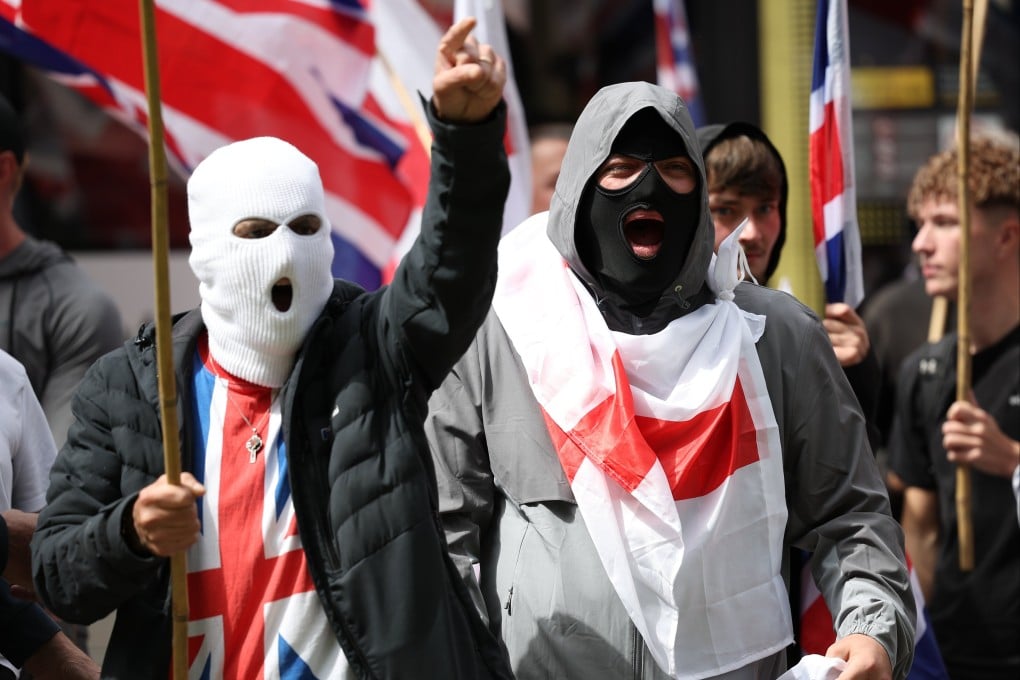
The digital dimension of this conflict cannot be overstated. Clips of the unrest are spreading with viral intensity, some flagged by platforms for “graphic unrest,” serving as a digital accelerant for a disillusioned public. This is a modern insurgency, where the narrative is being written on smartphones faster than the government can issue a rebuttal. The footage of riot lines under pressure serves not just as news, but as a recruitment tool for those who feel that the traditional political process has abandoned them.
What makes this moment particularly dangerous is the intersection of old scars and new anxieties. Northern Ireland is a place where “us versus them” is a narrative written into the very architecture of the cities. By introducing the complex global issue of migration into this existing tribal framework, the government has inadvertently created a volatile new chemistry. The “Enough is Enough” slogan has become a catch-all for a variety of grievances, ranging from the cost of living to a perceived loss of cultural identity, all directed at a government that appears increasingly out of touch.
As Northern Ireland sits on this volatile edge, the question is no longer whether this is an isolated flashpoint. The smoke over Belfast is a signal of a deeper structural gully widening between the governed and the governors. In the coming days, the government’s ability to move beyond seven-word silences and into decisive, transparent action will determine whether this rupture can be healed, or if the “streets erupting” will become the new permanent reality of the North.
The world is watching as the North’s fragile peace undergoes its most rigorous stress test in a generation. If the response from the halls of power remains limited to “emergency reinforcements” without addressing the underlying fears of the residents, the rupture may become permanent. For now, Belfast and Derry remain on edge, waiting for a signal that someone, somewhere, is actually in control.