In a combative House hearing last spring, Representative Seth Magaziner, a Rhode Island Democrat, pressed Homeland Security Secretary Kristi Noem on a question that was both legally narrow and morally freighted: how a 4-year-old U.S. citizen with stage 4 cancer ended up on a deportation flight.
Magaziner’s line of questioning, and Noem’s refusal to provide documentation in the moment, crystallized a broader dispute that has shadowed the Trump administration’s immigration enforcement: whether speed and spectacle have come at the expense of basic procedural safeguards—and whether the government is relying on a thin theory of “parental choice” to justify outcomes that look, to critics, like the removal of American citizens.
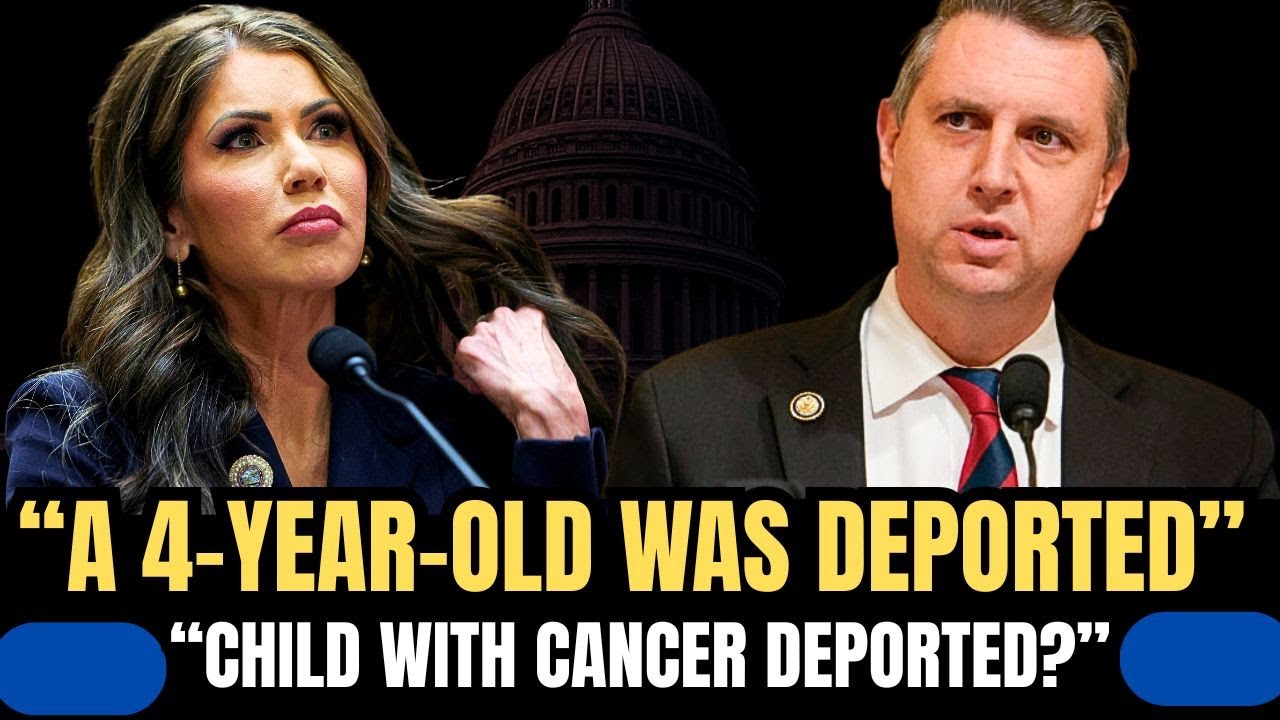
The specific case Magaziner cited has been described in litigation and public reporting as part of a series of removals in April 2025 involving two mothers and several children, including three U.S. citizen children ages 2, 4 and 7. Lawyers and advocates say the families were detained during routine check-ins with immigration authorities in Louisiana, held without meaningful access to attorneys or relatives, and then flown to Honduras. One of the citizen children, a boy, had been receiving treatment in the United States for stage 4 kidney cancer, according to a lawsuit later filed on the families’ behalf. American Civil Liberties Union+1
The administration has denied that U.S. citizen children were “deported,” emphasizing that their mothers decided to keep the families together rather than separate. In statements described in news reports, officials said immigration officers asked the mothers whether they wished to be removed with their children or to have the children placed with a designated caregiver in the United States. Critics argue that the distinction is rhetorical: the government paid for the flights, controlled the detention, and created the conditions under which “consent” was ostensibly given.
That debate over consent is the hinge point—legally and politically. In the hearing, Magaziner asked Noem what evidence supported the claim that a mother affirmatively agreed to have her U.S.-citizen children removed. Noem did not produce a form, signature, or contemporaneous record; she said documentation would be provided later, according to accounts of the exchange. politico.com
Outside the hearing room, the dispute migrated into court filings. An April 2025 A.C.L.U. press release described two families deported by the ICE field office in New Orleans after being held “incommunicado,” with attorneys unable to reach them despite repeated attempts. The statement said one mother was given less than a minute on the phone before the call was cut off when her spouse tried to provide a lawyer’s contact information. American Civil Liberties Union

Months later, a lawsuit filed in federal court in Louisiana accused immigration authorities of denying due process, blocking access to counsel, and failing to allow parents to arrange care for their children—pointing to internal ICE policy guidance meant to prevent exactly that. The complaint describes the removal of the 4-year-old cancer patient as a breach of the agency’s own directive and argues the deportation interrupted life-saving medical care.
The case illustrates how immigration enforcement can produce outcomes that defy ordinary categories. The mothers are noncitizens subject to removal orders; the children, at least in three cases described by advocates and reporters, are U.S. citizens with an unconditional right to enter and remain in the country. Deporting a citizen is unlawful. But “deportation” is also an action typically applied to the removable parent. When parents are detained suddenly and prevented from contacting lawyers or relatives, the child’s fate can be decided by default: either the child goes with the parent now, or the child is separated, placed with someone else, or left to a rushed and opaque process.
The administration’s position—that the mothers chose family unity—has been met with skepticism not only by advocates but also by a federal judge in at least one related matter, according to reporting. The judge questioned whether the government had offered sufficient evidence that the family had a fair chance to decide whether a U.S. citizen child would remain in the United States.
What makes these cases especially combustible is their timing. In April 2025, the Supreme Court, ruling in a separate but related context involving removals under the Alien Enemies Act, underscored that noncitizens facing summary removal must receive notice and an opportunity to be heard—“within a reasonable time”—in a manner that allows them to seek judicial review before removal occurs.

While that order addressed a specific legal pathway, it amplified an already heated argument: that the government cannot treat hearings and lawyer access as optional when the consequence is irreversible expulsion.
In the Magaziner exchange, this procedural critique became the point. When oversight lawmakers ask whether a parent had access to counsel, whether a child’s medical continuity was considered, or whether a written policy was followed, they are not merely litigating compassion. They are testing whether power is being exercised with documentation and constraint—or with broad assertions that cannot be verified in real time.
The politics of such cases are also unusually volatile. The image of a seriously ill American child leaving the country under federal escort scrambles familiar partisan narratives, drawing condemnation that is less ideological than visceral. At the same time, it forces Democrats to argue for process rather than open borders, and it challenges Republicans to defend outcomes that look like collateral damage even to voters who support tough enforcement.
The risk for the administration is not only legal exposure in court, but erosion of public trust in the claim that immigration enforcement is targeted, careful, and lawful. The risk for critics is that outrage over exceptional cases may not produce structural change unless it translates into enforceable rules: guaranteed access to counsel, clear documentation of consent, mandatory time windows, and independent oversight when U.S. citizen children are involved.
For now, the question at the heart of Magaziner’s challenge remains the question that litigation will likely turn on as well: if “consent” is the administration’s defense, where is the proof—and what did the government do to ensure the choice was real?