By XAMXAM
For months, Washington’s attention has been fixed on louder confrontations—territorial rhetoric, tariff threats, public clashes over alliances. Yet while the political spotlight drifted north and overseas, a quieter transformation was unfolding inside Canada’s auto market. It did not arrive with a boycott, a press release, or a ministerial speech. It arrived in spreadsheets, shipping manifests, and customs data. And by the time the shift became visible, it was already well underway.
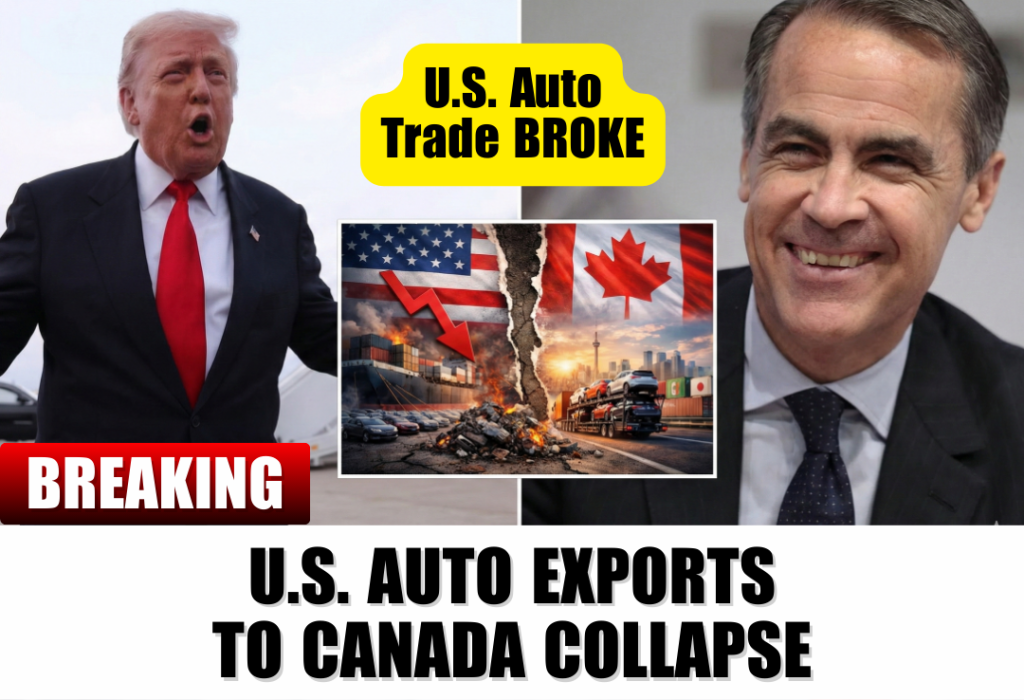
For decades, American-made vehicles formed the backbone of Canadian auto imports. In the 1990s, more than 70 percent of passenger vehicles entering Canada were built in the United States. Even through the 2010s, the share hovered near half. The logic was simple: a deeply integrated North American supply chain made borders feel administrative rather than economic. Factories, parts suppliers, and logistics hubs operated as a single system.
That assumption has now fractured.
By late 2025, only about 36 percent of passenger vehicles imported into Canada were manufactured in the United States—a collapse by historical standards. Demand did not vanish. Canadian consumers did not suddenly reject American brands. What changed was not taste, price, or technology. What changed was confidence in the system itself.
The trigger was policy volatility. As tariffs returned to the center of U.S. strategy under Donald Trump, they were framed not as safeguards but as leverage—tools to be deployed, withdrawn, and redeployed as negotiations evolved. Ottawa responded with precision rather than spectacle, imposing counter-tariffs on U.S.-built vehicles while carving out exemptions for automakers that still produced inside Ontario. The message was technical, not emotional: Canada would insulate itself from risk.
Markets understood immediately. Manufacturers did not wait for clarity on how long tariffs would last. They acted as if uncertainty itself were permanent. Shipments were rerouted. Sourcing was adjusted. Logistics were redesigned. Once those decisions are made, they rarely reverse quickly. New suppliers win contracts; new production lines gain priority. Contingency planning becomes architecture.
The result was diversification. As U.S. market share fell, alternatives surged. Mexico emerged as a major beneficiary, with vehicle exports to Canada surpassing previous annual records before the year was out. Japan and South Korea expanded their presence. Even American brands adapted. Tesla, facing counter-tariffs on U.S.-built cars, quietly redirected Canadian supply from its German plants. Subaru followed a similar path, increasing shipments from Japan while reducing reliance on U.S. production.
None of these moves were ideological. They were operational.
The irony is that the pain was not one-sided. Canada’s own auto sector absorbed shocks as well. Stellantis paused plans to manufacture the Jeep Compass in Ontario, shifting production to Illinois. General Motors announced the end of electric delivery van production at another Ontario facility. Honda delayed an $11 billion investment intended to anchor a Canadian EV supply chain. None of these companies blamed tariffs alone, but each decision unfolded in an atmosphere shaped by political unpredictability.

That unpredictability was reinforced from the top. When Trump publicly dismissed the relevance of the USMCA, suggesting it offered little real advantage, the signal was unmistakable. The agreement is approaching mandatory review. Without unanimous support, it could slip into annual renewals, shadowed by the possibility of withdrawal with six months’ notice. For an industry that plans investments decades ahead, that ambiguity is corrosive.
Automakers understand friction better than most. A single vehicle may cross borders multiple times before it reaches a showroom. When rules feel provisional, every crossing becomes a risk calculation. Executives fear unpredictability more than cost. A tariff you can plan for is manageable; a tariff that appears and disappears with political pressure is poison.
Even U.S. manufacturers have begun to say as much. Ford Motor Company has warned that tariff concessions favoring certain imports could give competitors a $5,000 to $10,000 cost advantage per vehicle. This is not foreign competition undercutting American labor. It is policy volatility eroding predictability.
What makes Canada’s shift consequential is not the loss of a single market share point. It is the precedent. For decades, American power in trade flowed from one assumption: indispensability. If you wanted scale, efficiency, and stability, you built with the United States at the center. The auto industry embodied that logic.
Now, that indispensability is being engineered away—not through confrontation, but through quiet redesign. Supply chains are being rebuilt to function even if U.S. participation becomes unreliable. Once that architecture exists, dependence rarely returns. Influence thins, disperses, and is routed around.
This was never really about cars. Vehicles are merely the visible symptom. Beneath them lies a deeper shift in how power works in global manufacturing. Trust—not tariffs, not slogans—has always been the foundation. When trust becomes conditional, companies do not protest. They prepare.
Canada did not walk away loudly. It adjusted. And in global trade, those silent adjustments are often the ones that matter most—because by the time the data makes them obvious, the old system is already gone.