By XAMXAM
In the days after President Donald Trump abruptly stepped back from threats to seize Greenland, two competing stories took hold almost immediately. In much of Europe and Canada, the episode was framed as a retreat — proof that unified resistance had forced Washington to abandon an outlandish idea. In Trump’s orbit, however, a very different narrative emerged: that the confrontation had been a classic feint, a deliberate escalation designed to extract long-term concessions that would only become visible later.

This clash of interpretations says less about Greenland itself than about how power is now narrated — and contested — on the global stage.
Trump’s initial remarks about Greenland had been maximalist, even by his standards. He spoke openly about acquisition, raised the specter of force and suggested that sovereignty was negotiable. Denmark pushed back. Greenland’s leaders rejected the premise outright. NATO allies warned that the language was destabilizing. Then, almost as suddenly, Trump changed tone. At Davos, he announced a vague “framework” with NATO partners and insisted the matter was resolved.
To critics, the absence of specifics was the tell. No treaty text. No formal transfer of authority. No public acknowledgment from Denmark or Greenland that anything fundamental had changed. From that perspective, Trump had provoked outrage, faced resistance, and quietly backed away — then declared victory anyway.
Supporters saw the same sequence and drew the opposite conclusion. In their telling, the threat itself was the tool. By raising the stakes, Trump forced NATO to refocus on Arctic security, accelerated military planning in the region and reopened discussions about American access to Greenlandic territory, mineral resources and missile defense infrastructure. What looked like a climbdown, they argue, was simply the moment when the pressure had done its work.
The truth, at least for now, sits uncomfortably between these claims.
There is little public evidence that the United States has gained formal sovereignty over any part of Greenland. Danish officials have denied agreeing to permanent American control of land or mineral rights, and Greenland’s government has reiterated that its future is not for sale. At the same time, it is also true that the Arctic has moved higher on NATO’s agenda and that American strategic interest in Greenland — long present but often muted — is now openly acknowledged again.
That duality is precisely what makes the episode politically combustible.
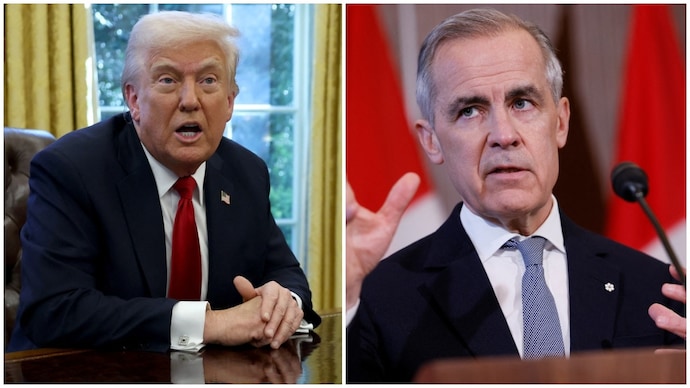
For Canadian Prime Minister Mark Carney, who had positioned himself as a vocal defender of sovereignty and a critic of intimidation politics, Trump’s declaration of success cut uncomfortably close to home. Even if no formal concessions were made, the mere suggestion that threats could yield strategic gains undermined the moral clarity Carney had emphasized. Resistance, in this framing, had not produced a clean victory; it had produced ambiguity.
And ambiguity is where Trump is often most comfortable.
Throughout his career, Trump has treated negotiations as performances as much as processes. The declaration of victory is rarely tied to a clear endpoint; it is a move in itself, designed to shape perception before facts harden. By insisting that he had “won” Greenland — or at least secured an “infinite deal” — he reframed the debate away from what was signed and toward who appeared to be in control.
That matters because international politics increasingly runs on narrative momentum. Allies respond not only to formal agreements but to signals about resolve, credibility and risk. When Trump claims success, even without documentation, he invites others to react — to deny it, qualify it or quietly adjust their assumptions.
In Europe, that has produced unease rather than celebration. Officials who initially welcomed de-escalation now find themselves clarifying that nothing fundamental was conceded, an exercise that keeps the issue alive instead of closing it. In Canada, it has sharpened a sense that pushback alone may not be sufficient if it is not paired with durable alternatives and alliances.
The Greenland episode also exposes a broader tension within NATO. The alliance depends on American power, yet it is increasingly wary of American unpredictability. When Washington escalates unilaterally and then announces success unilaterally, partners are left reacting after the fact, uncertain whether restraint or resistance actually shaped the outcome.
For Trump, that uncertainty is not a bug. It is leverage.
Whether any concrete “win” materializes from this episode will take years to assess. Military basing agreements, mining rights and missile defense systems leave paper trails eventually. If none appear, the claim of triumph will look hollow. If some do, even indirectly, the critics’ confidence will look premature.
What is already clear is that the fight over Greenland was never just about an island. It was about who gets to define success in a world where threats, optics and ambiguity now travel faster than treaties. Trump declared that he won. His opponents insist he did not. In the space between those assertions, the real consequences are still unfolding.