By XAMXAM
When Donald Trump remarked this week that “Canada lives because of the United States,” the comment initially sounded like one of his characteristic flourishes — blunt, hierarchical, and designed to provoke. But the response it drew from Mark Carney revealed something more consequential than a routine diplomatic spat. It exposed a quiet but growing shift in how Canada sees itself, and how willing it now is to say so aloud.
“Canada does not live because of the United States,” Mr. Carney said at a cabinet retreat in Quebec City, hours after the comment circulated from Davos. “Canada thrives because we are Canadian.” The line was unscripted, delivered without the hedging language that typically cushions cross-border disagreements. And it was not followed by a walk-back.
For decades, the relationship between the two countries has rested on an implicit understanding: asymmetry is real, but unspoken. The United States is larger, louder, and more powerful; Canada is smaller, pragmatic, and careful not to test the limits of its neighbor’s patience. Mr. Trump’s remark shattered that etiquette by saying the quiet part out loud — framing the relationship not as partnership, but as dependence.
Mr. Carney’s response was striking precisely because it refused that framing entirely.
Speaking days earlier at the World Economic Forum in Davos, Mr. Carney had already laid the intellectual groundwork. In a speech that drew a rare standing ovation, he argued that the era of pretending the global system still functions as advertised is over. Trade, finance, and even security, he said, have increasingly become tools of coercion rather than cooperation. Middle powers, Canada included, could no longer rely on silence as a survival strategy.
That theme carried directly into his rebuttal of Mr. Trump. Rather than disputing American contributions to Canada’s prosperity — which are real and substantial — Mr. Carney reframed the conversation around agency. Canada’s success, he argued, comes from deliberate choices: a diversified economy, public investment, social mobility, and institutions designed to spread opportunity rather than concentrate it.
It was a message aimed as much inward as outward. Mr. Carney spoke at length about Canada as a country where wealth, religion, and background do not determine destiny — a pointed contrast to the language of hierarchy embedded in Mr. Trump’s comment. “Our values don’t survive automatically,” he said. “They have to be defended.”
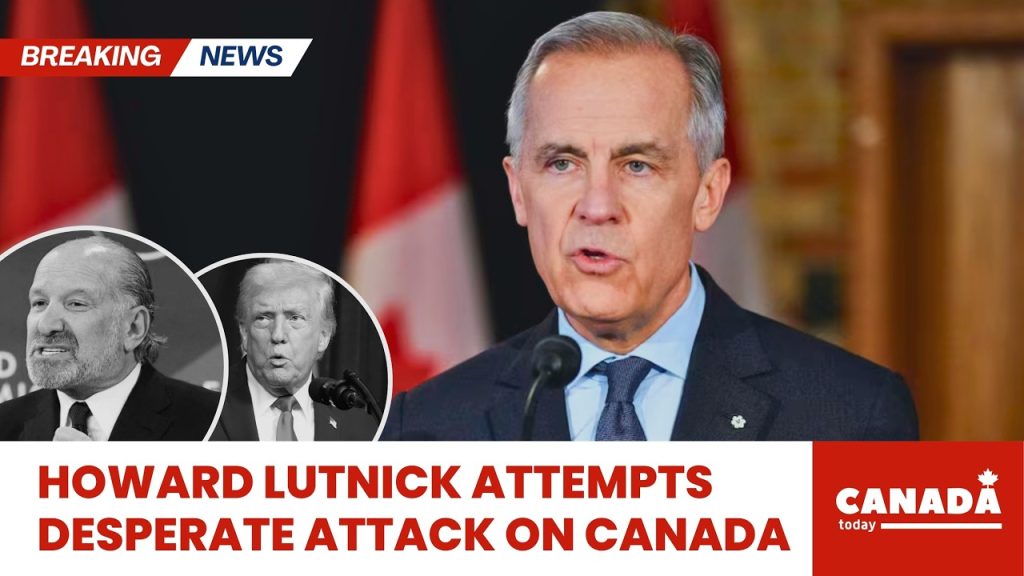
The reaction in Washington suggested the message landed uncomfortably. Howard Lutnick, the U.S. Commerce Secretary, warned publicly that Canada’s growing engagement with China could complicate the upcoming review of the U.S.-Mexico-Canada Agreement. The remarks carried a familiar subtext: diversification would come at a price.
Yet that warning underscored precisely what has changed. For much of the postwar period, Canada’s overwhelming reliance on the American market made such pressure effective. Today, that dependence is narrowing. Ottawa has accelerated trade ties with Europe, Asia, and the Middle East, while investing heavily in domestic capacity — from critical minerals to artificial intelligence and defense manufacturing.
Mr. Carney leaned into that shift rather than downplaying it. He spoke of a Canada doubling defense spending, removing internal trade barriers, and positioning itself as both a “bastion” — secure and resilient — and a “beacon,” open and pluralistic in a world trending toward exclusion.
What unsettled Washington was not hostility, but confidence. Mr. Carney did not threaten retaliation, nor did he frame his remarks as anti-American. Instead, he closed off a category of language that had long gone unchallenged. Canada, he implied, would no longer accept being spoken about as though its legitimacy flowed from someone else’s approval.
That posture carries risks. The economic relationship remains deeply intertwined, and the United States retains enormous leverage. But the alternative — continuing to absorb public condescension in the name of stability — may have begun to look riskier still.
In that sense, the exchange marked a subtle rupture. Mr. Trump attempted to reassert hierarchy. Mr. Carney responded by denying the premise altogether. The result was not a shouting match, but a reframing — one that suggests the old habits of deference may no longer be automatic.
Canada is not turning away from the United States. But it is, increasingly, turning toward itself — and saying so plainly.