By XAMXAM
PARIS — What began as rhetorical brinkmanship from Washington has hardened into one of the most consequential Arctic realignments in decades. As Donald Trump escalated public threats about acquiring Greenland — even refusing to rule out military force — Canada chose not to disappear into diplomatic caution. Instead, it aligned openly with Denmark, backed sovereignty with action, and helped transform Greenland from an assumed American-managed space into a defended, multilateral one.
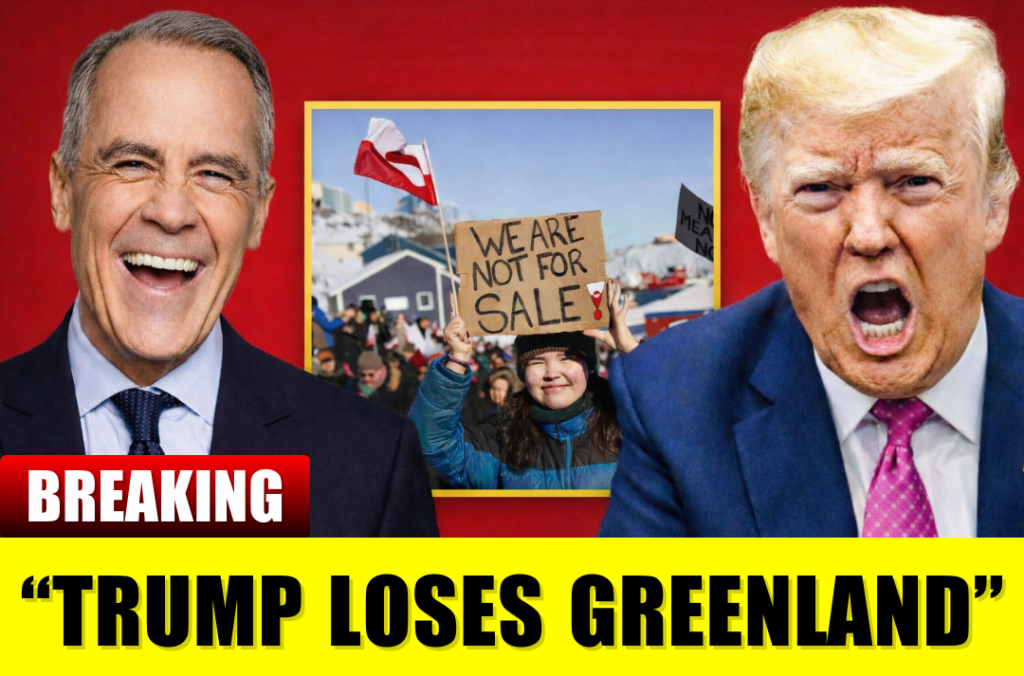
Standing beside Denmark’s prime minister, Mette Frederiksen, Canada’s leader, Mark Carney, delivered an unusually direct statement: Greenland’s future belongs to Greenland and Denmark alone. No threats. No coercion. No outside power treating territory as a bargaining chip. Hours later, Ottawa announced plans to open a permanent Canadian consulate in Nuuk, Greenland’s capital.
The move was more than symbolic. A consulate brings diplomats, security coordination, intelligence visibility, and daily institutional presence. At a moment when Washington was testing how far pressure could go, Canada embedded itself physically in Greenland’s political and security ecosystem. The message to allies and adversaries alike was clear: sovereignty would be defended through presence, not patience.
For decades, Arctic geopolitics operated under an unwritten rule. The United States dominated militarily, allies deferred quietly, and Greenland existed within a carefully managed balance — Danish sovereignty, American bases, NATO coordination, and no open challenges to borders. That equilibrium held because it remained invisible. Trump shattered it by moving from speculation to entitlement.
By framing Greenland as a “security necessity” and refusing to exclude force, Washington turned a background theater into a frontline crisis — not with Russia or China, but within NATO itself. Once allied territory was treated as negotiable, silence ceased to be safety. For Canada, whose Arctic territory spans nearly 40 percent of its landmass, the implications were immediate. If Greenland could be pressured, no Arctic border was truly secure.
Ottawa’s response triggered a chain reaction. Denmark was no longer standing alone. Greenland was no longer isolated. What Washington framed as a bilateral issue rapidly became multilateral. France, Germany, the United Kingdom, Italy, Spain, and Poland joined Canada and Denmark in publicly affirming Greenlandic sovereignty. Frederiksen warned that forced acquisition would strike at the foundation of NATO — an unthinkable statement only a few years ago.
The strategic stakes are substantial. Greenland sits astride the Greenland–Iceland–United Kingdom (GIUK) gap, the maritime corridor that controls movement between the Arctic and the North Atlantic. Russian submarines must pass through it. NATO reinforcements depend on it. The island anchors early-warning systems critical to North American missile defense at Pituffik Space Base, formerly Thule Air Base. Nothing in Greenland currently denies the United States access to these capabilities. The push for ownership, rather than access, has therefore been widely interpreted as a bid for control.
Greenland’s resource potential deepens the tension. Beneath its ice lie rare earth elements essential for electric vehicles, advanced batteries, semiconductors, and modern weapons — resources China largely dominates globally. As Arctic ice retreats, new shipping lanes, offshore hydrocarbons, and seabed minerals become more viable. Control over Greenland increasingly means influence over the rules governing Arctic trade, extraction, and surveillance for decades.
Rather than confront American power directly, allies pivoted toward denial and containment. The objective shifted from stopping the United States militarily to making unilateral action politically and operationally radioactive. Surveillance, not mass deployment, became the focus. Persistent monitoring — maritime patrol aircraft, satellites, undersea sensors, and coordinated naval activity — ensures that any move around Greenland is immediately visible, triggering automatic diplomatic and alliance responses.
Canada’s role proved pivotal. By choosing presence over neutrality, Ottawa altered the cost-benefit equation. Pressure produced unity rather than compliance. The threat of force ceased to function as leverage and became a liability. Greenland’s own leaders made their position explicit: if forced to choose, they would choose Denmark.
The crisis has already reshaped Arctic governance. Coordination among Canada, Denmark, and Nordic and European partners has tightened. American military power remains unmatched, but political leverage has eroded. The question is no longer whether the United States could act, but whether it could afford the fallout if it tried.
There are broader implications. Middle powers are watching closely. For years, they were told that real security required American systems and American approval. Canada demonstrated another path: diversify alliances, embed presence, and turn consent back into a prerequisite. It did so without confrontation, without exiting NATO, and without dramatic declarations of independence.
The Arctic did not erupt. It recalibrated.
Greenland has become the place where American power meets its limits — not through force, but through coordinated resistance. The episode has underscored a quiet truth of contemporary geopolitics: when pressure replaces partnership, allies adapt. And once they do, leverage rarely returns quietly.