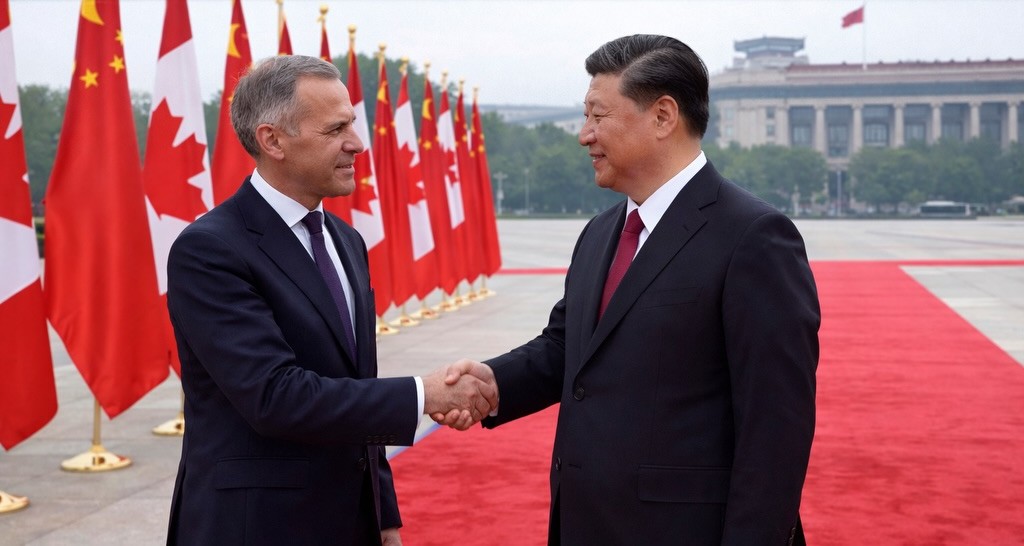
When Mark Carney stepped onto the tarmac in Beijing this week, he was greeted with a level of ceremony rarely afforded to visiting leaders. Red carpets were rolled out. Senior officials waited in formation. State media emphasized the “historic significance” of the visit. It was the first trip to China by a Canadian prime minister in eight years, and Beijing made certain the symbolism was unmistakable.
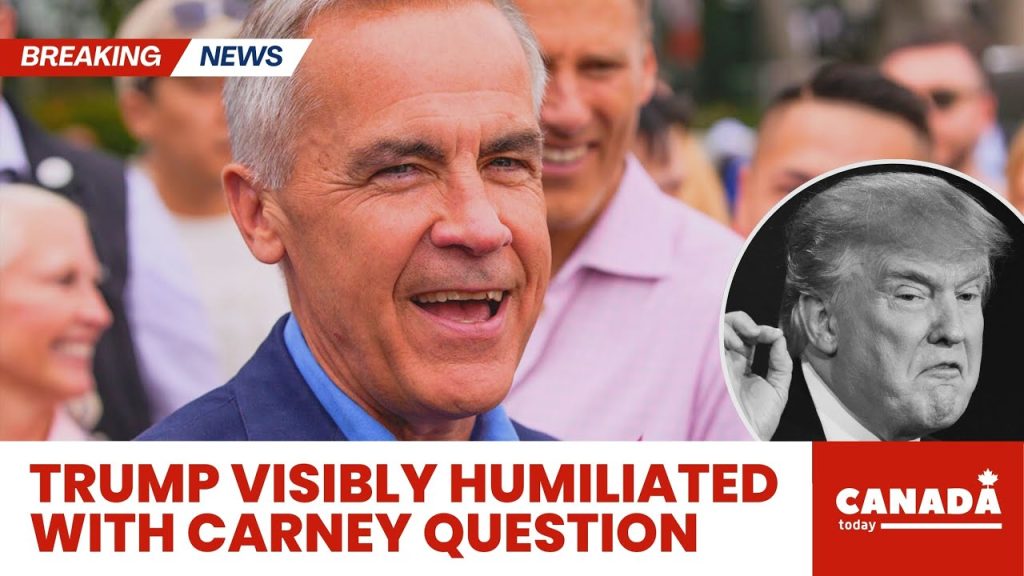
At nearly the same moment, thousands of miles away, Donald Trump was dismissing Canada to reporters, insisting that the United States did not need Canadian products, Canadian manufacturing, or Canadian cooperation. “It’s irrelevant to me,” he said, waving off questions about trade agreements and cross-border supply chains. The contrast between the two scenes — one leader elevated, the other irritated — underscored a deeper shift in global politics that is now coming into focus.
This was not a routine diplomatic stop. Chinese officials described Carney’s visit as a “reset,” language that in Beijing’s lexicon is reserved for moments of strategic recalibration. Carney’s invitation came directly from Xi Jinping, following months of quiet conversations between Ottawa and Beijing. In diplomatic terms, China was not merely receiving Canada; it was signaling that Canada mattered.
For years, Washington’s leverage over Ottawa rested on a simple assumption: that Canada had nowhere else to go. The United States was Canada’s dominant trading partner, its largest export destination, and its unavoidable economic anchor. Under that reality, American pressure — whether through tariffs, trade threats, or public rebukes — carried weight. Canada could object, but it ultimately had to accommodate.
That assumption is now eroding.
Carney, a former central banker known for methodical risk management rather than political theatrics, has made diversification a central pillar of his foreign policy. Europe has re-engaged with Canada through trade and security dialogues. Asian markets, long discussed but cautiously pursued, are now being approached with greater urgency. And China, the world’s second-largest economy, is no longer a distant variable but an active participant in Canada’s strategic calculus.
The discussions in Beijing were substantive. Agriculture featured prominently, with Canadian officials pressing for relief on tariffs that have weighed heavily on canola, pork, and seafood exporters for years. Even incremental movement on these fronts would offer tangible proof that diversification delivers real economic benefits, not just diplomatic headlines.
More consequential, however, were the conversations around electric vehicles and advanced manufacturing. Chinese firms are seeking opportunities to expand production abroad, building factories, battery supply chains, and supporting infrastructure closer to key markets. Canada, with its skilled workforce, access to critical minerals, and proximity to the U.S. border, is an attractive candidate.
The implications are not lost on Washington. Chinese-made electric vehicles assembled in Canada would compete directly with American manufacturers on price, technology, and scale — a prospect that unsettles an industry already struggling to keep pace with global rivals. It helps explain the sharp edge in Trump’s rhetoric. His frustration is not rooted in Canadian weakness, but in Canadian independence.
Pressure only works when alternatives are absent. Threats are effective only when targets are isolated. By expanding its options, Canada has reduced the potency of American coercion without severing ties to the United States. Carney has been careful to emphasize that this is not about choosing sides. Canada is not abandoning Washington; it is refusing to be hostage to any single partner.
That distinction matters. A country with options negotiates calmly. It can resist pressure without escalation. It can say no — or yes — on its own terms. This is the strategic space Carney is trying to carve out, and it is precisely what makes his approach unsettling to those accustomed to unquestioned leverage.
From Beijing’s perspective, the calculus is equally clear. Stabilizing trade with Canada serves China’s economic interests while signaling to other middle powers that engagement with Beijing does not require submission. It is a message aimed not just at Ottawa, but at capitals across Europe and Asia watching how this relationship unfolds.
Trump may insist that Canada does not matter. The scenes in Beijing tell a different story. As global markets adjust and alliances become more fluid, Canada is no longer waiting, no longer boxed in, and no longer moving solely at Washington’s pace. In an era defined by volatility, predictability has become a form of power — and for now, it is a power Canada is learning how to wield.