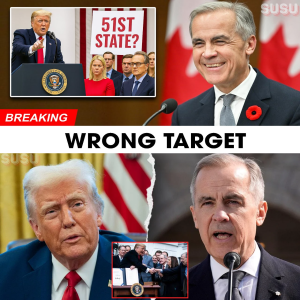
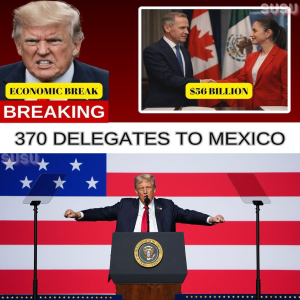
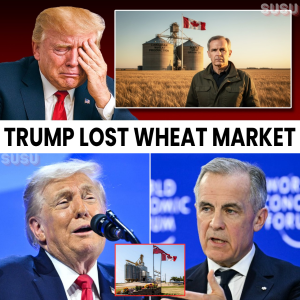
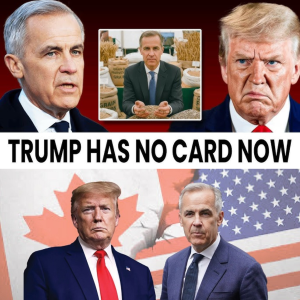
For months, Washington projected confidence. U.S. officials, analysts, and media voices repeated the same line: Canada would eventually fold. Tariffs, pressure, and political leverage would force Ottawa back into line ahead of the CUSMA review. The assumption was deeply ingrained — that the balance of power still flowed one way, and that American dominance in North American trade remained unquestioned.

That narrative quietly collapsed the moment U.S. Trade Representative Jameson Greer presented a detailed list of Canadian policies Washington wanted undone. What was meant to be a show of strength instead exposed something far more revealing: American dependence. Rather than issuing threats or outlining consequences, the U.S. publicly asked Canada to reverse policies that were already working — policies protecting Canadian agriculture, culture, procurement, and provincial autonomy.
The demands themselves told the real story. From dairy supply management to streaming regulations, provincial liquor retaliation, procurement rules in Ontario, Quebec, and British Columbia, and even Alberta’s electricity distribution framework, every complaint pointed to systems performing exactly as designed. These were not Canadian failures. They were leverage points causing measurable losses for U.S. industries — lost market share, declining profits, and reduced influence.
In dairy alone, the contrast is stark. Canada’s supply-managed system stabilizes farmer income, controls quality, and prevents destructive overproduction. The U.S. already has tariff-free access to Canadian dairy markets under quota agreements — quotas American producers have never fully filled. The issue is not access, but competitiveness. Canadian stability exposes inefficiencies in the U.S. system, and Washington’s frustration reflects that imbalance.
The same pattern appears in digital policy. Canada’s streaming legislation requires major U.S. platforms to reinvest in Canadian content and creators. Framed by Washington as discrimination, the reality is contribution. For decades, American tech firms extracted value from Canadian audiences without reinvesting domestically. The law corrected that imbalance, and its success has made it a dangerous precedent for U.S. dominance in the digital economy.
Provincial retaliation delivered the most unexpected blow. When the U.S. imposed tariffs on Canadian steel, aluminum, autos, and lumber, Washington assumed Canada’s response would be symbolic. Instead, provincial liquor boards coordinated quietly, removing American spirits from shelves. The impact was immediate and measurable. Major U.S. producers reported catastrophic revenue declines, proving that decentralized economic pressure can be more effective than federal retaliation — and far harder for Washington to negotiate away.
Throughout the process, Ottawa avoided public escalation. There were no dramatic press conferences or threats. Instead, the strategy was disciplined: hold firm where leverage mattered, concede selectively where costs were minimal, and allow American industries to feel the consequences of their own lobbying pressure. Moves attributed to M.a.r.k C.a.r.n.e.y were widely misread in Washington as weakness, when in reality they preserved Canadian leverage while exposing U.S. vulnerability.
Perhaps the most revealing admission came buried within Greer’s testimony itself. He acknowledged that CUSMA has worked — that U.S. exports to Canada and Mexico are up more than 50% since 2020, and that business and labor groups overwhelmingly support maintaining the agreement. Yet despite those benefits, Washington insisted renewal “is not in the national interest.”
That contradiction defines the crisis. The problem is not that CUSMA is broken. It is that it produces balance. It allows Canada to act independently, protect domestic priorities, and resist automatic compliance with U.S. demands. For an administration accustomed to dictating terms, balance feels like loss.
This moment marks a quiet but profound shift in North American trade dynamics. Canada is no longer negotiating from fear of disruption, but from confidence in interdependence. Supply chains are so deeply integrated that pressure cuts both ways — and Ottawa is now willing to let Washington experience that reality.
What Washington revealed unintentionally was not Canadian weakness, but American uncertainty. The trade war did not spiral out of control because Canada overreached. It unraveled because the old assumption of automatic U.S. dominance no longer holds. And once that assumption breaks, the entire structure of leverage changes with it.