Canada’s Gripen Moment: A Shock That Reopened a Seemingly Settled Decision
In Ottawa, defense procurements are supposed to end in quiet finality. After years of review, debate and political friction, Canada appeared to have closed the book on its next-generation fighter. Yet what was once treated as settled has returned to the foreground, unsettled by a Swedish proposal that reframed not only which aircraft Canada might fly, but how it defines sovereignty in the Arctic.
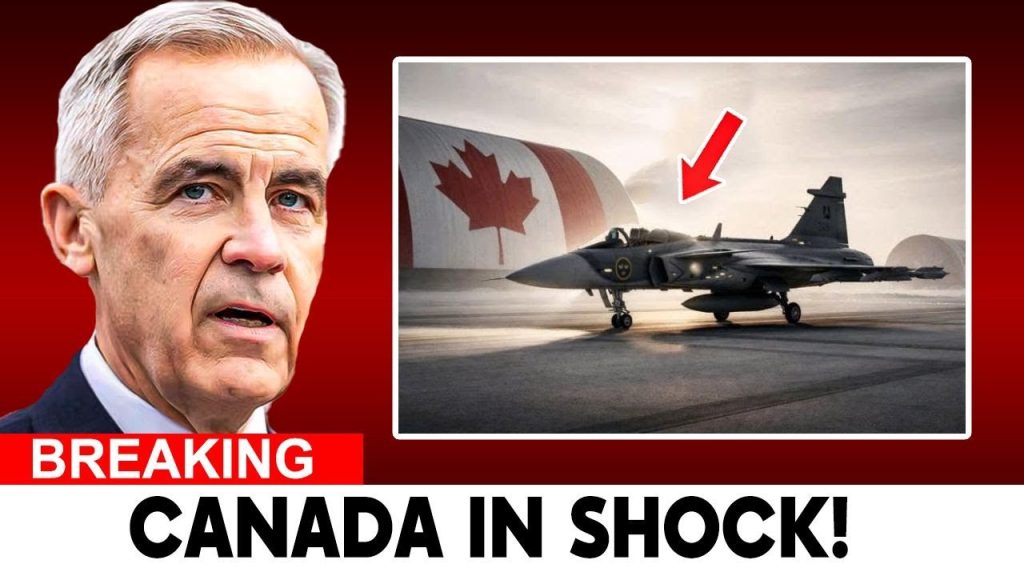
At the center of the renewed debate is Saab and its Gripen E fighter, an aircraft long cast as the leaner alternative to the stealth-centric F-35 Lightning II produced by Lockheed Martin. For years, the F-35 seemed to embody inevitability. Designed from inception to integrate seamlessly into American command-and-control systems, it aligned closely with Canada’s commitments under NORAD. On paper, the logic was compelling. Interoperability carried strategic weight.
But procurement logic rarely exists in isolation. Canada’s geography exerts its own discipline. A nation spanning nearly 10 million square kilometers, much of it Arctic and sub-Arctic, cannot rely solely on assumptions optimized for temperate bases and dense infrastructure. In the High North, winter temperatures regularly drop below minus 40 degrees Celsius. Runways are sparse, distances between installations vast. In such conditions, air power becomes less an emblem of technological prestige than a test of endurance.
The Gripen’s pitch has been rooted precisely in that harsh calculus. Developed during the Cold War by a neutral Sweden that anticipated its air bases might be among the first targets in any conflict, the aircraft was engineered to disperse. It can operate from short runways, land on highways and be serviced by small ground crews within minutes. Its operating costs, widely reported to be a fraction of those associated with the F-35, suggest a model that favors sustainability over supremacy. Where stealth reduces detection, the Gripen emphasizes electronic warfare — using advanced jamming systems and networked data links to disrupt adversary sensors before engagement.
These distinctions were not new. What changed was context. In March 2025, Canada’s defense minister signaled that Ottawa was reviewing alternative options. The statement did not cancel existing plans, but it punctured the aura of finality. Analysts began revisiting earlier evaluation criteria that had heavily weighted long-term software growth potential and full-spectrum integration with American systems. Those criteria had favored the F-35 decisively. Yet the question resurfaced: should projected advantages decades into the future outweigh immediate operational resilience in the Arctic?
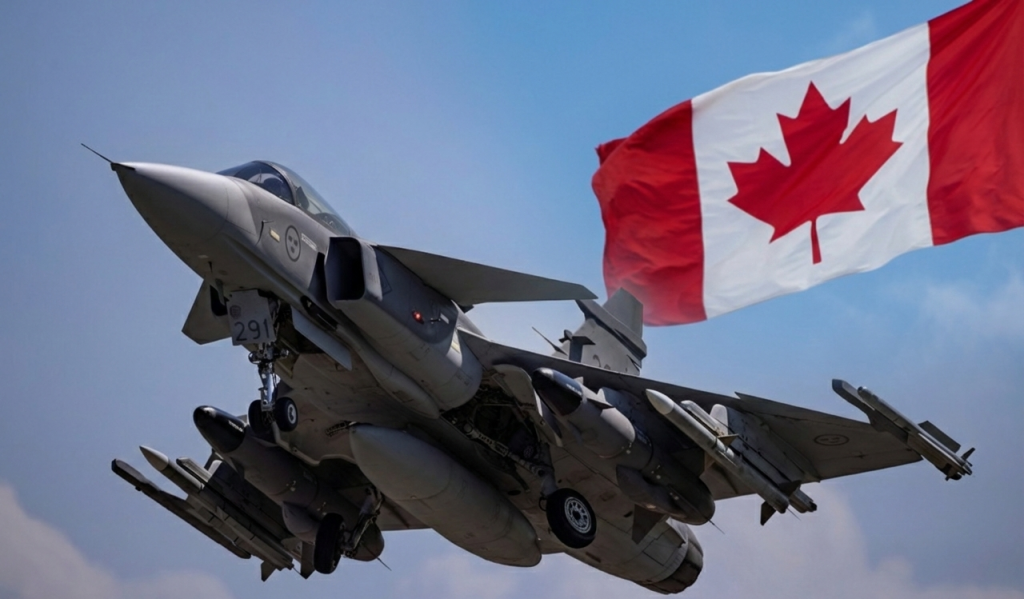
The debate quickly transcended performance metrics. Saab’s offer reportedly included assembling and maintaining the aircraft in Canada, transferring technical expertise and supporting thousands of domestic jobs. Framed that way, the proposal resembled an industrial strategy as much as a defense contract. In an era of supply-chain disruption and heightened sensitivity to foreign dependence, industrial participation has acquired new strategic meaning. Defense procurement increasingly doubles as economic statecraft.
Washington responded with visible concern. American officials warned that diverging from the F-35 program could complicate coordination within NORAD, the binational command established during the Cold War to guard North American airspace. The implication was clear: interoperability is not merely technical but political. Shared platforms reinforce shared strategy. Yet Canada has operated older-generation fighters within NORAD for decades without fracturing the alliance. The question, then, is not compatibility in principle, but degree.
Complicating matters further is scale. The Royal Canadian Air Force is not large. Sustaining two distinct fighter fleets would strain training pipelines, maintenance infrastructure and logistics networks. A wholesale reversal, meanwhile, would entail financial and diplomatic costs. Defense procurement, once entangled with alliance expectations and industrial offsets, becomes resistant to clean exits. Every path carries trade-offs.
What the Gripen episode ultimately reveals is less about one aircraft’s superiority over another and more about Canada’s strategic self-definition. Is sovereignty best secured through seamless alignment with the United States’ defense ecosystem, or through diversified capabilities that maximize domestic control over sustainment and upgrades? The answer may not be binary. But the fact that the question has resurfaced at all suggests that the era of automatic alignment is giving way to a more granular calculation.
For now, Ottawa has not announced a dramatic pivot. Contracts move slowly; alliances slower still. Yet the shock of reconsideration has altered the tone. A procurement once described as decided now reads as contingent. In that shift lies a broader signal: that middle powers, even those bound by the closest of alliances, are reassessing how industrial capacity, operational doctrine and geopolitical leverage intersect. Canada’s fighter debate has become a mirror — reflecting not only the aircraft it might choose, but the strategic identity it seeks to project in a colder, more uncertain world. ✈️🌍