Canada Draws a Line as Trump’s Backchannel Strategy Comes Into Focus
Over the past several months, something unusual has been unfolding in Canada–US relations. Former U.S. President Donald Trump has not limited his pressure on Canada to tariffs, threats, or public rhetoric. Instead, he has increasingly relied on indirect channels — informal contacts, political outsiders, and figures operating outside official diplomatic structures.
This week, that strategy surfaced again in a way that Ottawa moved quickly to shut down.
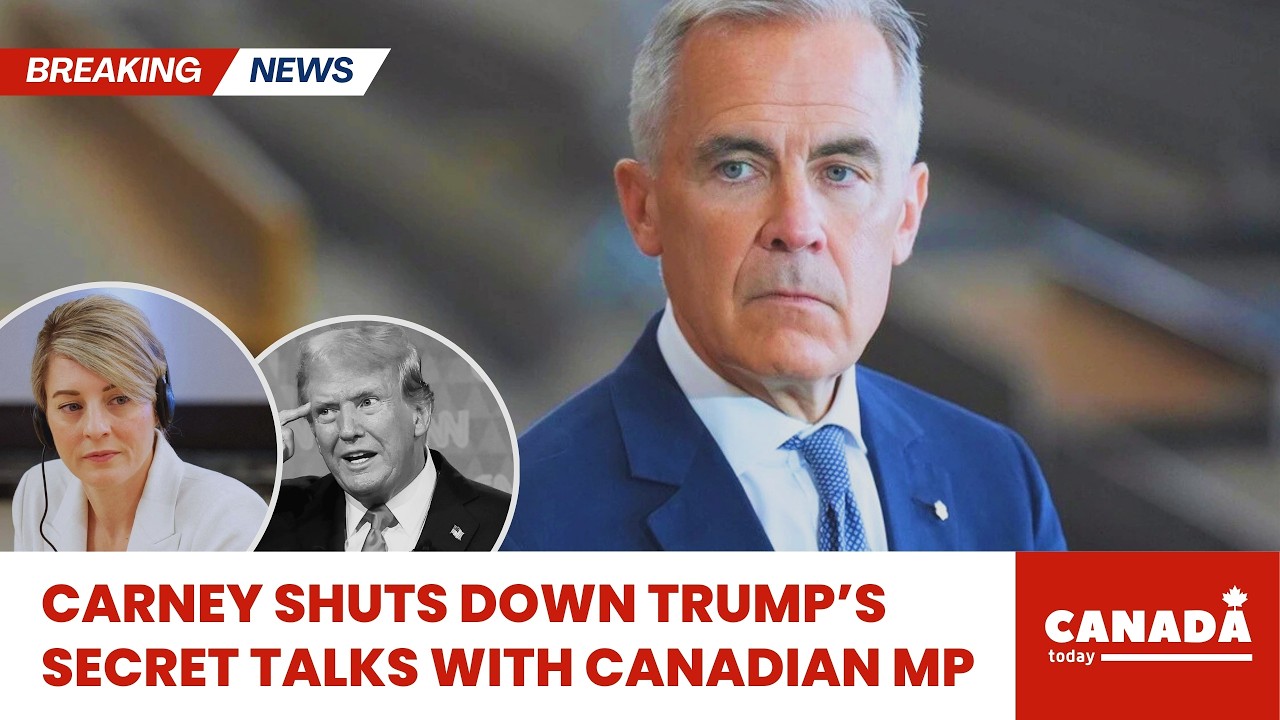
A Conservative Member of Parliament traveled alone to Washington, claiming he was attempting to help Canada’s trade negotiations with the United States. Within hours, Prime Minister Mark Carney and Foreign Affairs Minister Mélanie Joly decisively rejected the move — not with anger or theatrics, but with clarity and institutional authority.
In doing so, they exposed a broader tactic that has been quietly unfolding beneath the surface of Canada–US diplomacy.
An Unusual Diplomatic Detour
When Conservative MP Jamil Jivani announced that he was heading to Washington, he framed the trip as a bipartisan, patriotic effort to support Canada’s trade negotiations.
“I’m going to Washington because I want to help Prime Minister Mark Carney be successful in negotiating a trade deal with the United States,” Jivani said, acknowledging that the move might seem counterintuitive given partisan differences.
On its face, the explanation sounded cooperative. In reality, it was highly unusual.
Trade negotiations are not conducted by individual MPs acting independently. They are managed through formal diplomatic channels — coordinated by the Prime Minister’s Office, Global Affairs Canada, and Canada’s professional diplomatic corps. Jivani is not the opposition’s trade critic. He holds no formal mandate to represent Canada in negotiations, nor does he have authority to engage with U.S. officials on Canada’s behalf.
Yet he presented himself as someone capable of influencing sensitive international discussions.
That raised immediate questions in Ottawa and beyond.
Diplomacy Is Not Freelance Work
Mark Carney’s response was swift but carefully calibrated. Rather than attacking Jivani personally, Carney reframed the trip as a media-driven move rather than a diplomatic necessity.
Canada, Carney emphasized, already maintains constant contact with the U.S. administration at senior levels. There is no shortage of official communication. There is no vacuum requiring ad hoc intermediaries.
The message was unmistakable: Canada’s foreign policy is not conducted through freelance political excursions.
Carney also noted that Jivani is not the official opposition’s trade critic, reinforcing the point that the MP’s actions were disconnected from any recognized negotiating role. The implication was clear — this was about visibility, not diplomacy.

Questions of Transparency and Motive
As the controversy grew, another issue surfaced: who was paying for the trip?
Was it privately funded? Covered by public money? Paid for by party resources? At the time of reporting, no clear answer had been provided. That lack of transparency only deepened skepticism.
At a time when Canadian workers are concerned about tariffs, manufacturing job losses, and economic uncertainty, symbolic trips without authority or accountability are politically risky. For many observers, the move looked less like a contribution to national interest and more like an attempt to build personal political capital.
The repeated emphasis on Jivani’s relationship with U.S. Vice President JD Vance further fueled suspicion. Informal access, when disconnected from institutional oversight, can weaken a country’s negotiating position rather than strengthen it.
Trump’s Persistent Targeting of Canada
The episode cannot be separated from a broader reality. Donald Trump has repeatedly targeted Canada in his rhetoric — from suggesting Canada should become the “51st state” to questioning its sovereignty and mocking key Canadian industries.
“We don’t need their cars. We don’t need their lumber,” Trump has said, dismissing long-standing trade ties. He has repeatedly described the Canada–US border as an “artificial line,” language that goes far beyond normal trade disputes.
Analysts in Washington have noted that Canada appears to occupy a disproportionate amount of Trump’s political attention. This is not accidental.
Trump’s negotiating style relies on unpredictability, pressure, and public spectacle. Canada’s deep economic integration with the United States makes it especially vulnerable to this approach.
Manufacturing Uncertainty as Strategy
That strategy was visible again in Trump’s recent threats against Canadian-made aircraft. He floated massive tariffs over certification issues that regulators were already addressing, creating immediate market turbulence.
As with many Trump-era threats, the legal authority behind the move was unclear. But clarity is rarely the point.
Trump’s method is consistent: generate instability first, dominate headlines, and let uncertainty do the work. Clarifications, if they come at all, arrive later.
Markets may learn to price in this behavior. Governments cannot.
Defense, Sovereignty, and Strategic Dilemmas
The uncertainty extends beyond trade. Canada’s fighter jet procurement — particularly its involvement in the F-35 program — has become entangled in political pressure. Ottawa now faces difficult strategic choices.
Should Canada continue integrating its military infrastructure with a partner that repeatedly threatens economic retaliation? Or should it diversify toward European suppliers, even at the risk of straining relations with Washington?
There are no easy answers. Every option carries economic, strategic, and diplomatic consequences. Trump’s unpredictability only makes long-term planning more complex.
Mélanie Joly Draws the Line
Foreign Affairs Minister Mélanie Joly’s response to the Jivani episode was especially significant. She made it clear that Canada speaks with one voice in international negotiations.
No individual MP — regardless of intent — has the authority to freelance foreign policy.
Joly emphasized that diplomacy requires discipline, coordination, and trust between allies. Her message was aimed not only at domestic audiences, but at Washington as well. Canada will not allow internal political divisions to weaken its negotiating position.
This was an institutional line being drawn.
The Bigger Picture
Observers increasingly describe Trump’s behavior using the so-called “TACO” framework — “Trump Always Chickens Out.” He makes maximalist threats, dominates the news cycle, and then partially retreats.
But even temporary threats carry real costs. Markets react. Jobs are affected. Confidence erodes.
The Jivani episode may seem minor in isolation, but it reflects something much larger. Canada is navigating one of the most volatile periods in its modern relationship with the United States. In this environment, discipline matters. Coordination matters. Credibility matters.
By shutting down unauthorized diplomatic freelancing, Mark Carney and Mélanie Joly reinforced a simple but powerful principle: Canada negotiates as a unified state, not as a collection of individual actors.
In an era of political turbulence and pressure politics, that unity may be Canada’s strongest defense.