By XAMXAM
In December 2025, standing at the White House, Donald Trump returned to a theme that has defined his Arctic posture for nearly a year. Greenland, he said, was essential to American national security. The implication was unmistakable: sovereignty, diplomacy, and consent were secondary to strategic necessity.
While Washington spoke in the language of pressure, Ottawa responded with something else entirely—institutions, infrastructure, and relationships. Without confrontation or spectacle, Canada has begun positioning itself as the central stabilizing force in the Arctic, reshaping the region’s future not through threats, but through permanence.
The divergence could hardly be clearer. As Trump escalated rhetoric over Greenland—sending envoys, hinting at economic coercion, and refusing to rule out force—Canada opened a consulate in Nuuk, Greenland’s capital. It was a small act with large symbolism. Canada joined a short list of countries with a diplomatic presence there, but unlike the others, Ottawa arrived not as a claimant or a patron, but as a neighbor.
That distinction matters. Canada’s Arctic engagement rests on proximity, shared interests, and shared people. Inuit communities span both northern Canada and Greenland, binding the two societies in ways that cannot be manufactured through power projection. Canadian officials framed the consulate not as a geopolitical move, but as recognition that Arctic governance begins with relationships, not maps.
This approach extends far beyond diplomacy. Over the past two years, Canada has invested billions of dollars in Arctic infrastructure: satellite communications designed for high-latitude operations, new naval patrols through the Northwest Passage, and a network of northern operational support hubs intended to serve both civilian communities and military needs. These are not symbolic gestures. They are long-term commitments that create facts on the ground.
At the center of this strategy is Mark Carney, whose government has treated the Arctic less as a frontier to be claimed than as a system to be maintained. Carney’s Arctic security policy emphasizes dual-use infrastructure, indigenous consultation, and multilateral coordination—an approach that contrasts sharply with the zero-sum logic embedded in Trump’s Greenland rhetoric.
The stakes are enormous. Climate change is transforming the Arctic from a frozen buffer into a navigable, resource-rich corridor. Melting ice is opening shipping routes that could shorten global trade flows by thousands of miles. Beneath the ice lie critical minerals—rare earth elements, lithium, and other materials essential to electric vehicles, renewable energy, and advanced defense systems.
Russia and China understand this. Moscow has spent years militarizing its Arctic coast, while Beijing has declared itself a “near-Arctic state” and invested heavily in polar research and resource access. Against that backdrop, Western cohesion matters. And here, Trump’s posture has unsettled allies.
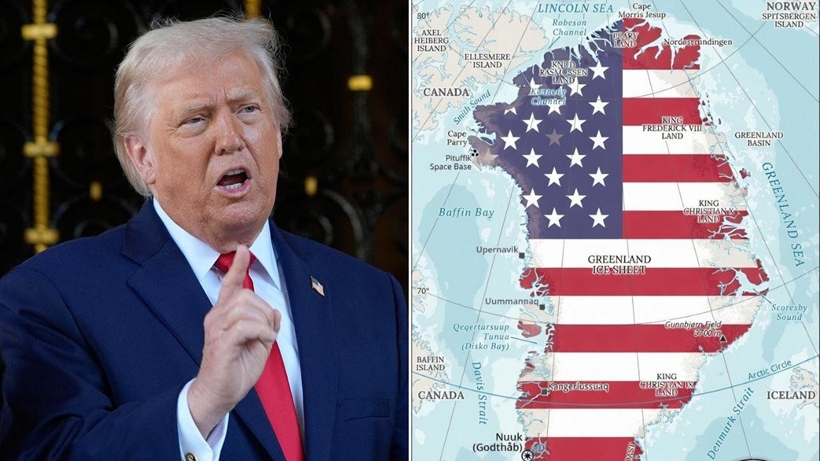
European leaders have reacted with visible unease to American annexation talk. Greenland’s own government has been unequivocal: the territory is not for sale. Polls show overwhelming opposition among Greenlanders to U.S. control. In that environment, pressure has proved counterproductive. It has pushed Arctic partners toward those who emphasize respect for sovereignty rather than leverage over it.
Canada has benefited from that shift. Its Arctic investments are increasingly viewed in Europe as stabilizing rather than provocative. Nordic countries—Denmark, Norway, Sweden, Finland, and Iceland—have intensified coordination with Ottawa on high-north security, maritime surveillance, and infrastructure resilience. These are practical conversations about patrol aircraft, coast guard cooperation, and shared monitoring, not abstract debates about ownership.
There is also a deeper strategic consequence. NATO, built on collective defense, has no mechanism to address a scenario in which one member threatens another’s territory. Even the suggestion strains trust. By contrast, Canada’s approach reinforces alliance norms: consultation, consent, and shared responsibility.
The result is a quiet rebalancing. The Arctic’s future is increasingly shaped by those who build capacity rather than issue ultimatums. Canada’s consulate in Nuuk is emblematic of that philosophy. It is not a claim, but a commitment—an acknowledgment that influence in the Arctic will belong to those who show up consistently, invest locally, and stay for the long haul.
Two decades from now, the Arctic may look very different. Shipping lanes may be routine. Mineral extraction may be central to global supply chains. Surveillance and communications networks will define security. In that future, control will not be determined by who demanded the most, but by who prepared the most.
For now, the contrast is stark. One vision treats the Arctic as a prize to be taken. The other treats it as a shared space to be governed. As Trump continues to press Greenland in words, Canada has already begun securing the region’s future in deeds.