By XAMXAM
PARIS — On a cold January morning, standing beside Mette Frederiksen, Canada’s prime minister delivered a message that resonated far beyond diplomatic protocol. Mark Carney stated plainly that Greenland’s future belonged to Greenland and Denmark alone — not to threats, not to coercion, and not to outside powers treating sovereignty as a bargaining chip.
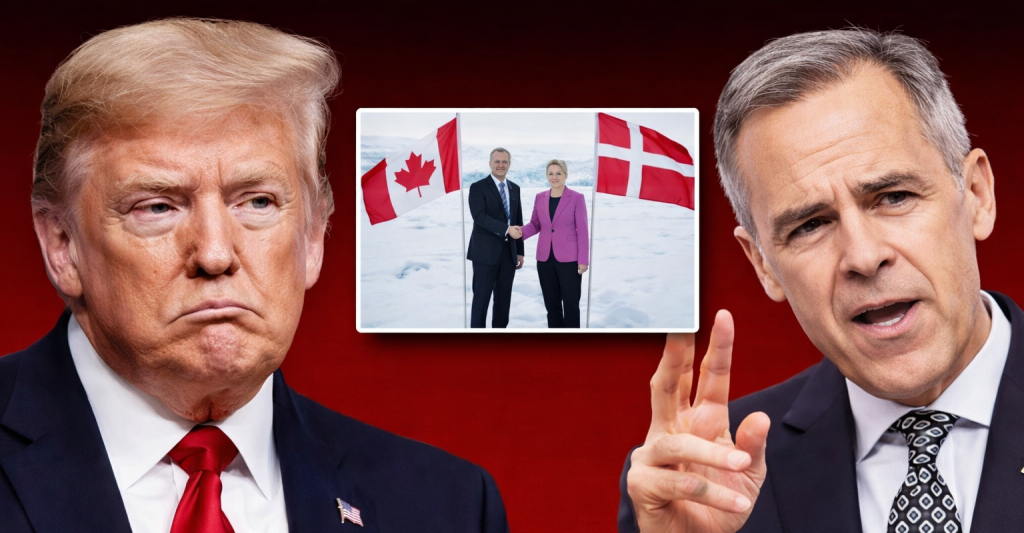
The timing was unmistakable. Only hours earlier, Donald Trump had revived his long-dormant ambition of acquiring Greenland, this time adding a jarring qualifier: that military force remained “on the table.” What once sounded like a rhetorical curiosity was now framed as an option of statecraft.
That shift shattered a quiet assumption that had governed Arctic politics for decades. The United States led security efforts, allies coordinated, and territorial borders among partners were understood to be inviolable. Greenland — a vast island of ice and rock, tied to Denmark while hosting a critical American military presence — sat at the center of that balance.
When Washington moved from hypotheticals to demands, allies were forced to choose where they stood.
Carney’s answer went beyond words. Canada announced plans to open a permanent consulate in Nuuk, Greenland’s capital, establishing a long-term diplomatic presence. Ottawa dispatched its foreign affairs minister and its governor general to the island, while beginning closer coordination on Arctic security with Nordic partners. The message was clear: Canada was aligning openly with Denmark, even if it meant pushing back against Washington.
Instead of expanding American leverage, the pressure produced resistance.
Greenland rarely dominates global headlines, yet its strategic value is immense. Sitting between North America and Europe, it straddles routes growing more important as Arctic ice retreats. Shipping lanes once considered theoretical are becoming seasonally viable. Beneath the ice and surrounding waters lie rare earth minerals essential for batteries, electronics, and advanced defense systems, along with potential oil and gas reserves. As climate change reshapes the region, Greenland has transformed from a remote territory into a geopolitical prize.
The United States already maintains a foothold through its military installation at Pituffik Space Base, a cornerstone of early-warning missile defense. For decades, that arrangement existed without controversy. Denmark retained sovereignty, Greenland expanded autonomy, and American forces operated with allied consent.
Trump’s renewed rhetoric altered that equilibrium. By treating annexation as a security option, Washington signaled that territorial sovereignty among allies might be negotiable. In Copenhagen, the message landed as a warning rather than reassurance. If Greenland could be pressured, then alliance membership alone no longer guaranteed respect for borders.
Trust, once shaken at that level, reshapes how countries calculate risk.
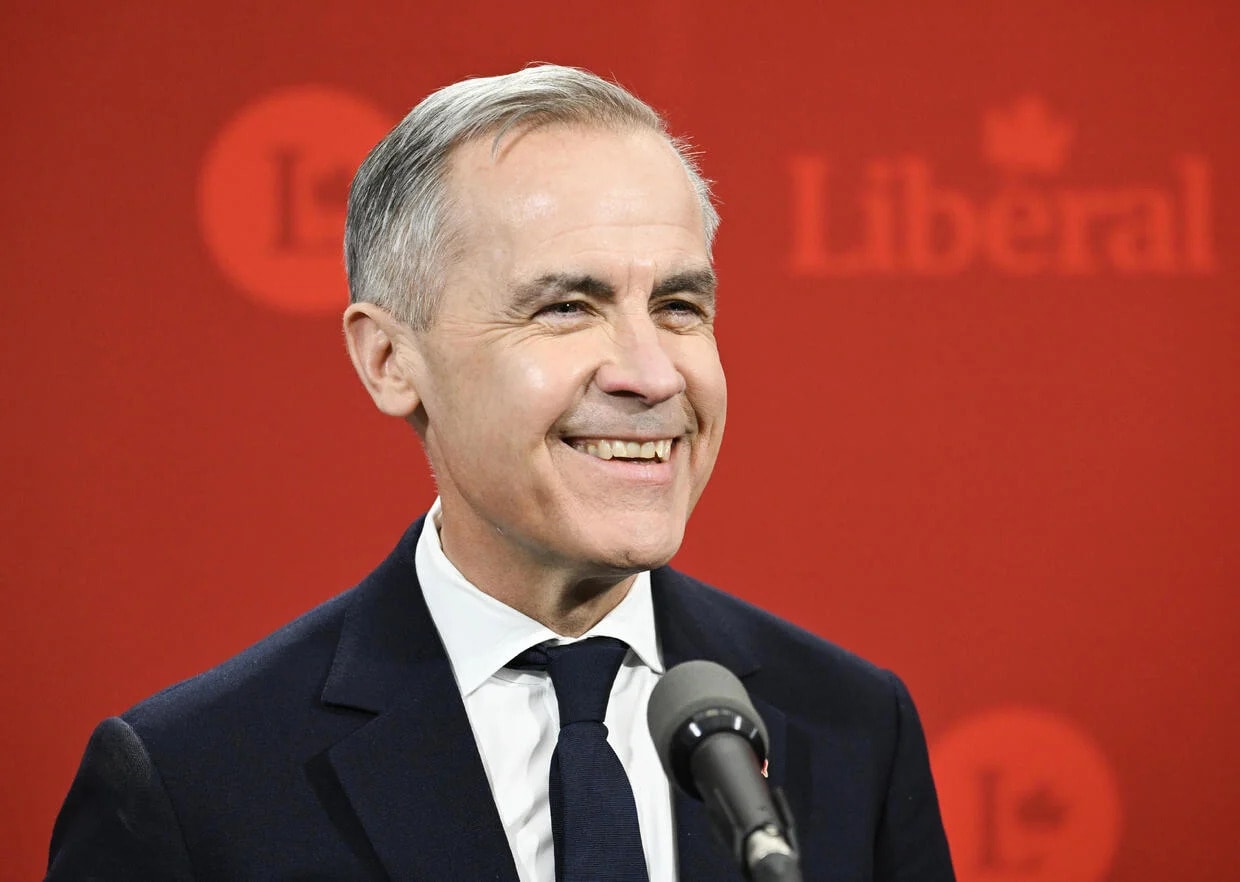
Canada’s response reflected a broader shift. Rather than hedging, Ottawa took a visible stand. The decision to send Governor General Mary Simon — an Inuk with deep ties to Arctic communities — carried symbolic and political weight. It underscored indigenous self-determination, highlighted shared circumpolar connections, and reinforced that Greenland is not merely an asset, but a society.
European allies moved quickly. France, Germany, the United Kingdom, Italy, Spain, and Poland joined Denmark and Canada in issuing a joint statement affirming that Greenland belongs to its people and that decisions regarding its future rest with them alone. Seven NATO members publicly rejected territorial claims against another ally — an unusually direct rebuke within a coalition built on collective defense.
Frederiksen went further, warning that an American annexation of Greenland would effectively end NATO as it is known. The implication was stark: an alliance cannot survive if one member threatens the territory of another.
Trump appeared to assume protests would be muted and temporary. Instead, coordination intensified without Washington at the center. Canada and Denmark deepened cooperation with Nordic states. Arctic security discussions expanded beyond traditional American leadership. Joint exercises and planning increasingly reflected a shared assumption that U.S. positions might conflict with allied sovereignty.
The consequences extend beyond the Arctic. When borders are treated as flexible by a leading power, others seek alternatives to protect themselves. Influence shifts not through confrontation, but through the withdrawal of consent. Greenland is not becoming American territory. But American authority in the region is no longer taken for granted.
Carney has framed Canada’s stance not as defiance, but as principle. Self-determination, sovereignty, and territorial integrity, he has argued, are foundations of stability — especially in regions growing more strategically valuable. In standing with Denmark, Canada signaled that alliances endure only when respect flows in all directions.
The Arctic is entering a new phase. Cooperation continues, but no longer depends on unquestioned leadership from a single capital. Partners are learning they can align, protect their interests, and move forward together. The line drawn in Paris did more than block an ambition. It marked a shift in how power, trust, and sovereignty are negotiated at the top of the world.