JUST IN: CARNEY REVEALS TRUMP’S SECRET BRIDGE MEETING — CONGRESS DEMANDS ANSWERS
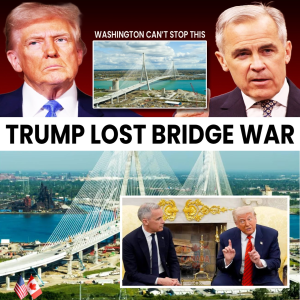
Canada’s prime minister Mark Carney has ignited a political firestorm after revealing details surrounding a quiet Washington meeting that preceded Donald Trump’s sudden threat to block the opening of the nearly $6.5 billion Gordie Howe International Bridge. The bridge, funded entirely by Canada and designed to modernize the busiest trade corridor in North America, was supposed to symbolize cross-border cooperation. Instead, it has become the center of a high-stakes controversy involving private wealth, federal power, and international trade.
The timeline is what set off alarms on Capitol Hill. Only hours before Trump publicly warned he would try to stop the bridge from opening, U.S. Commerce Secretary Howard Lutnick reportedly met with representatives tied to the privately owned Ambassador Bridge, the long-dominant crossing between Windsor and Detroit. That coincidence immediately raised questions about whether private business interests were exerting influence over national policy—especially as the new public bridge threatens to introduce competition into a corridor historically controlled by a single private operator.
Democrats in Congress moved quickly. The House Oversight Committee has now demanded emails, text messages, and calendar records tied to the meeting, seeking to determine whether Trump’s threat was coordinated or influenced by private financial concerns. Lawmakers argue that when billions of dollars in cross-border trade are at stake, secret meetings between wealthy donors and senior officials cannot be dismissed as routine. The investigation is no longer speculative—it is now a formal probe with subpoena power looming.

The economic stakes are enormous. The Gordie Howe International Bridge is engineered to dramatically expand capacity, reduce congestion, and protect supply chains that underpin the U.S. and Canadian economies. Automotive manufacturing, agriculture, logistics, and tourism all depend on reliable border flow, with vehicle parts often crossing the border multiple times before final assembly. Analysts warn that delaying the bridge’s opening could cost up to $7 million per week in direct losses, with ripple effects that would hit factories, workers, and consumers on both sides of the border.
Supporters of the project say the controversy highlights a deeper issue: whether public infrastructure decisions are being distorted by private monopolies facing competition. Critics argue that threatening a publicly funded, treaty-backed project to protect a private revenue stream would undermine trust in rule-based trade and bilateral agreements. Defenders of the private bridge owner counter that business leaders have a right to advocate for their interests—but Congress is now tasked with determining where advocacy ends and undue influence begins.
As documents are gathered and scrutiny intensifies, the bridge has become more than steel and concrete. It is now a test of transparency, accountability, and the boundaries between wealth and power in Washington. If investigators find no coordination, the administration may weather the storm. If evidence suggests alignment between private financial stakes and federal threats, the fallout could escalate into a full-blown political scandal. One thing is certain: what was meant to be a symbol of U.S.–Canada partnership is now a flashpoint demanding answers—and Congress is no longer waiting quietly.