Canada’s Quiet Rail Bet Signals a Shift in North American Trade
For more than a century, geography shaped the logic of North American trade. Western Canada’s grain, minerals and industrial goods moved along rail lines that bent southward, crossing into the United States before reaching global markets. The arrangement was not always the shortest route, nor the cheapest. But it was reliable, deeply embedded and backed by American rail corridors and port infrastructure that had long functioned as the continent’s default arteries.
That assumption is now being tested.
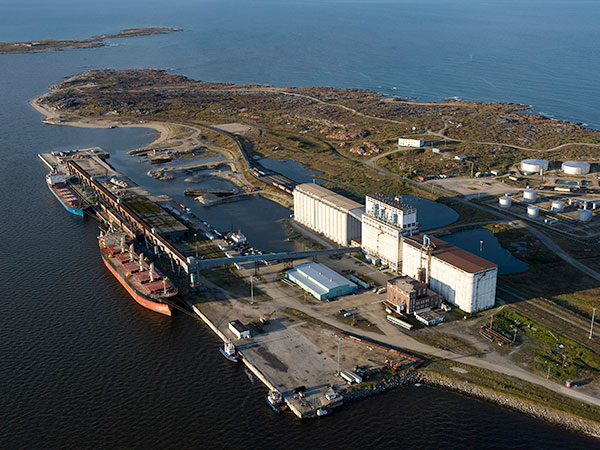
In late 2025, the Canadian federal government and the province of Manitoba committed $262 million to rebuild the Hudson Bay Railway to full Class I standards — a technical designation that carries strategic weight. The upgrade transforms a line long regarded as marginal into one capable of handling heavy, high-volume freight. The goal is straightforward: create a viable northern trade corridor to the Port of Churchill, giving Canadian exporters a direct path to Europe that does not depend on American infrastructure.
The move comes as Ottawa reassesses its economic posture under sustained trade pressure from President Donald Trump. Tariffs, regulatory threats and an increasingly transactional tone in bilateral negotiations have underscored a vulnerability long understood but rarely addressed: when much of your export capacity flows through someone else’s system, leverage is never entirely your own.
The Hudson Bay Railway has always embodied that tension between ambition and limitation. Conceived in the early 20th century, it promised prairie farmers a shorter route to European markets. But the line cut across unforgiving terrain. Permafrost shifted beneath its tracks; flooding routinely washed out sections; extreme cold strained steel and timber. The shipping season through Hudson Bay was narrow, often restricted to four months when ice conditions permitted safe passage. Over time, grain producers favored the predictability of southern routes, even at higher cost.

By the 1990s, federal confidence had waned. The railway and port were sold to the American firm Omnitrax for a nominal sum. Investment lagged. A major flood in 2017 severed the line entirely, isolating Churchill and reinforcing perceptions that the corridor was more relic than resource.
Its revival began not with grand federal strategy but with local intervention. In 2018, a coalition of 41 First Nations communities and northern municipalities acquired the railway and port, forming the Arctic Gateway Group. What initially appeared symbolic has since become strategic. The 2025 funding commitment marks a decisive shift: the line will no longer operate at the margins.
Class I status matters because it signals permanence and capacity. Heavy unit trains — the backbone of modern bulk logistics — require robust roadbeds, high-grade rails and consistent maintenance standards. The reconstruction addresses longstanding engineering vulnerabilities, stabilizing track over permafrost and reinforcing bridges and culverts against extreme weather. Advanced monitoring technologies, including ground-penetrating radar and sensor networks, allow for predictive maintenance rather than reactive repair.
For exporters, reliability often outweighs theoretical efficiency. Long-term contracts hinge on the confidence that shipments will not stall midway through a supply chain. By elevating the Hudson Bay Railway to the same operational tier as major continental corridors, Canada is making a statement not only about trade routes but about durability.
The commodities that could flow north are central to the Canadian economy. Grain remains foundational. Saskatchewan and Manitoba are among the world’s largest producers of wheat and canola. For shipments bound for Europe, the distance to Churchill is shorter than the journey to Pacific ports. Potash — of which Saskatchewan accounts for the majority of global supply — is another candidate. Nearly all of it is exported, and historically much has transited through American networks.
Critical minerals may prove even more consequential. Northern deposits of nickel, lithium and cobalt — materials essential to batteries and renewable energy systems — are drawing increased attention from European buyers seeking diversified supply chains. Direct rail access to an Arctic port offers an alternative pathway that bypasses U.S. intermediaries. The Arctic Gateway Group has already completed mineral shipments to Europe in consecutive seasons, demonstrating operational viability.
None of this suggests that American ports will be sidelined overnight. The United States remains Canada’s largest trading partner, and integrated supply chains are deeply entrenched. But infrastructure, once built, reshapes incentives. Capacity attracts volume; volume attracts investment; investment creates constituencies that defend the new status quo.
Trade power rarely shifts in dramatic announcements. It moves gradually, through steel laid across muskeg and concrete poured in quiet harbors. Canada’s northern rail bet does not sever its economic ties to the United States. It does, however, reduce the cost of saying no.
In an era when policy uncertainty can redirect billions in commerce, alternatives matter. By rebuilding a line many had written off, Ottawa is signaling that sovereignty in trade is not declared — it is engineered.