🚨🔥 JUST IN: Mark Carney Responds After Bridge Dispute With Donald Trump — Strategic Signals Ripple Across North American Infrastructure
A political dispute over a nearly completed international bridge linking the United States and Canada has drawn renewed attention to the deep economic ties between the two countries and the infrastructure that sustains them.
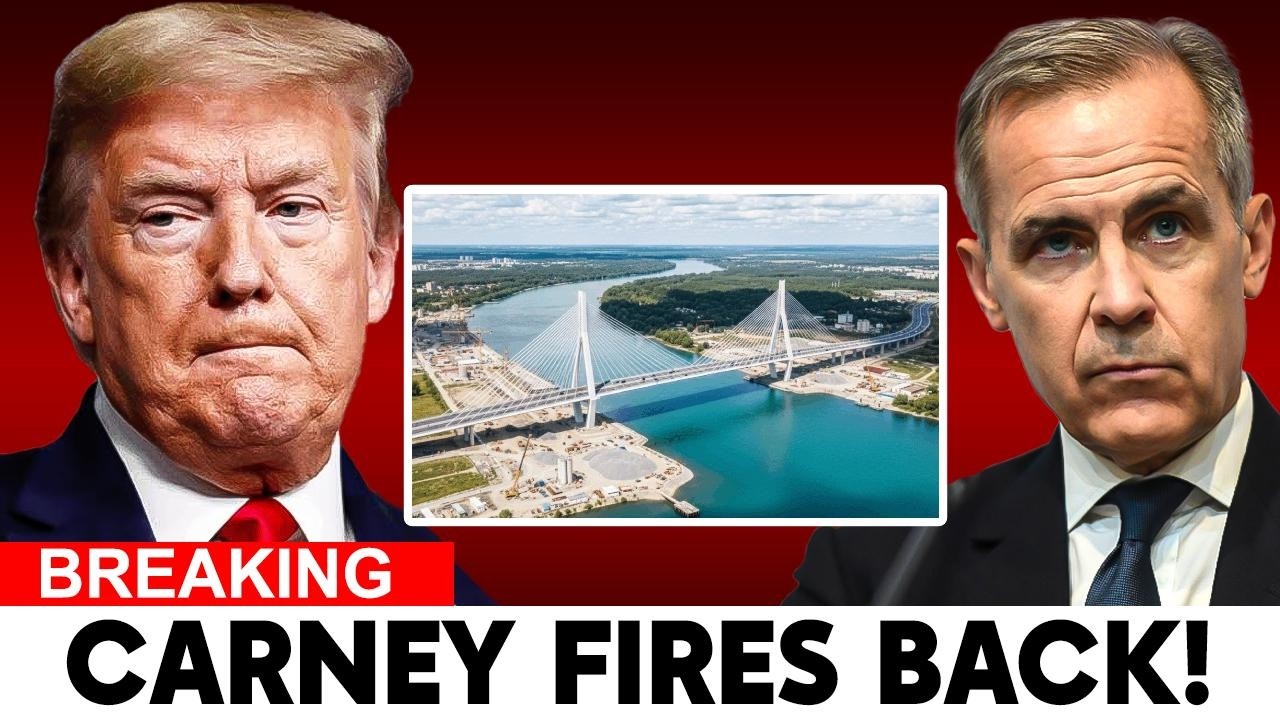
The controversy emerged after former U.S. president Donald Trump suggested on social media that the United States might block the opening of the Gordie Howe International Bridge, a multibillion-dollar project intended to connect Detroit and Windsor, Ontario. The remarks quickly transformed what had long been viewed as a technical infrastructure project into a broader debate about trade, sovereignty and political leverage.
The bridge, scheduled to open in 2026 after more than a decade of planning and construction, represents one of the largest infrastructure investments along the U.S.–Canada border. Costing roughly $6.4 billion and largely financed by Canada, it is designed to ease congestion and strengthen the flow of goods through the Detroit–Windsor corridor, one of the busiest commercial crossings in North America.
Nearly a quarter of all trade between the United States and Canada passes through this region. The corridor plays a particularly central role in the automotive industry, where supply chains span the border and vehicle components often cross multiple times before final assembly.
Modern car manufacturing depends on that rhythm. Engines, transmissions, electronics and body panels frequently move between factories in Michigan and Ontario before becoming part of finished vehicles sold across North America. Even short disruptions at the border can force assembly lines to slow or halt, creating ripple effects for suppliers, logistics firms and workers.
The new bridge was conceived in part to address such vulnerabilities. It will connect Ontario’s Highway 401 directly with Interstate 75 in Michigan, allowing freight trucks to bypass city streets and reach major highways more efficiently. Researchers at the University of Windsor have estimated that the improved connection could reduce transit times for commercial vehicles by up to 20 minutes per trip.
Over decades, those time savings could translate into billions of dollars in economic value for industries that rely on predictable shipping schedules.
The project also aims to diversify a trade corridor that has historically depended heavily on a single crossing: the privately owned Ambassador Bridge. Opened in 1929, that bridge has long carried the majority of freight traffic between the two cities.
Logistics analysts and national security officials have warned for years that reliance on a single commercial crossing creates risk. Mechanical failures, protests or accidents could disrupt trade for days. The new bridge, they say, provides a crucial layer of redundancy.
Despite those advantages, the project has faced sustained political and legal resistance over the years. The owners of the Ambassador Bridge spent millions supporting a ballot initiative that would have required statewide approval before any new international crossing could be built. Michigan voters rejected that proposal, and subsequent legal challenges failed in court.
Construction moved forward under an unusual financing arrangement reached in 2012. Canada agreed to fund the bridge itself, as well as highway connections and customs facilities on both sides of the border. In return, toll revenue will go toward recovering the initial investment, after which the proceeds will be shared.
Under that agreement, the state of Michigan holds joint ownership of the bridge despite contributing no upfront construction funding.
Officials in Canada have emphasized that the project was developed through years of negotiations with American authorities. In 2013 the U.S. government granted the required presidential permit, and federal agencies later allocated funding to support customs and inspection operations at the crossing.
Former Canadian central banker and prime minister Mark Carney responded to the recent dispute by focusing on those agreements and the broader economic relationship between the two countries. Speaking in Ottawa, he described the bridge as a symbol of cooperation designed to strengthen trade and mobility between the neighboring economies.

Rather than escalating the dispute publicly, Carney emphasized that the project’s legal framework and financing arrangements had already been established years earlier. The bridge, he said, was built to serve mutual economic interests.
Officials in Michigan from both political parties echoed that argument. Former governor Rick Snyder, who helped negotiate the original agreement, has written that the project provided Michigan with shared ownership of a major infrastructure asset without requiring upfront state spending.
Current governor Gretchen Whitmer and several members of the state’s congressional delegation have also emphasized the importance of maintaining stable cross-border commerce.
Beyond the automotive sector, industries ranging from agriculture to energy rely on efficient border crossings. Perishable foods, refined fuels and industrial equipment all move through the Detroit–Windsor gateway daily.
Roughly 8,000 trucks are expected to cross the new bridge each day once operations begin. Thousands of workers also travel across the border between Windsor and Detroit for employment, underscoring the economic interdependence of the two cities.
Federal regulatory steps toward opening the bridge have continued. In early 2026, the U.S. Department of Homeland Security issued a final rule designating the crossing as an official port of entry within the Port of Detroit, allowing customs and immigration services to operate there.
The rule described the bridge as part of a broader effort to improve the efficiency of border operations and facilitate trade between the United States and Canada.
For now, the dispute has highlighted how infrastructure projects can become entangled in broader political debates, even when the underlying agreements and economic logic appear settled.
Yet the bridge itself — rising above the Detroit River and nearing completion — remains a tangible reminder of the extensive cooperation that underpins the North American economy. Whether the political rhetoric surrounding it subsides may determine how smoothly that cooperation continues in the years ahead.