🚨🔥 JUST IN: Canada UNVEILS ARCTIC DEFENSE UPGRADE — Radar Expansion and Submarine Investments Reshape Northern Strategy ❄️🌊
For generations, Canada’s Arctic strategy rested on geography, diplomacy and a quiet understanding with Washington that sovereignty disputes would be managed, not forced. That equilibrium is now giving way to something more muscular.
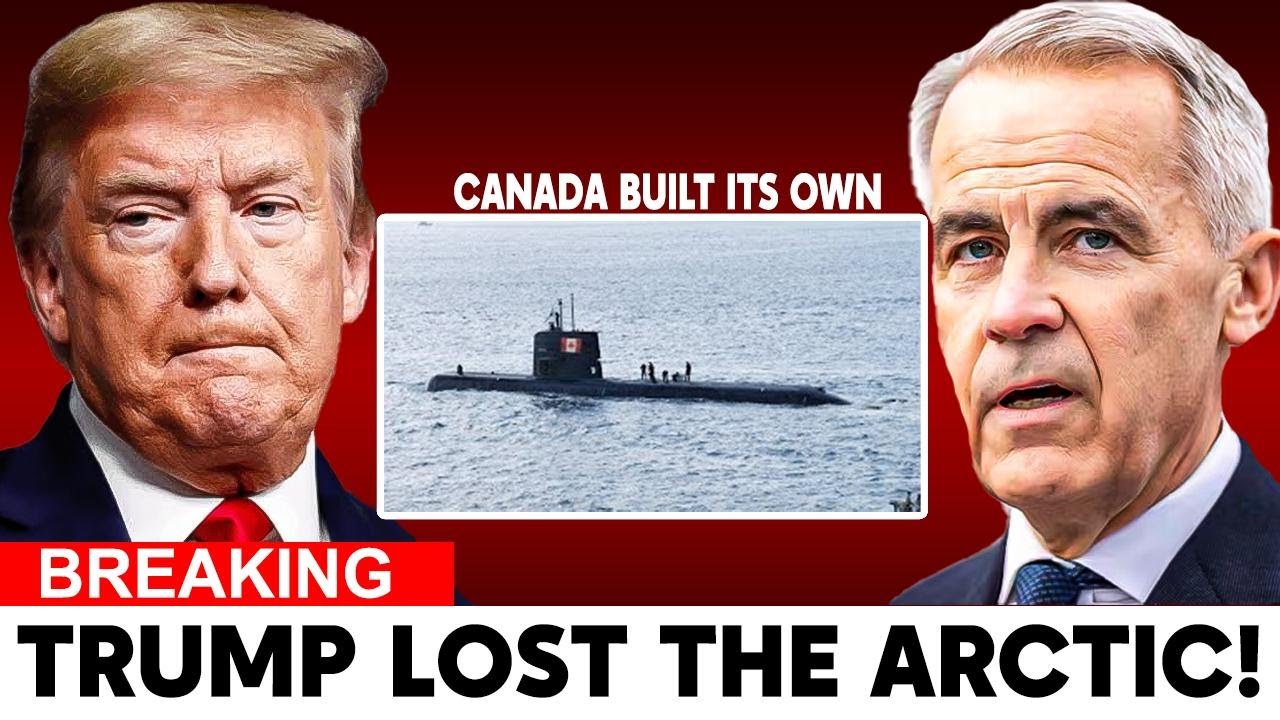
Prime Minister Mark Carney recently unveiled two finalists for what officials describe as the largest submarine procurement in Canadian history: a fleet of 12 conventionally powered submarines designed to operate under Arctic ice for weeks at a time. The announcement came alongside plans for a new over-the-horizon radar network capable of detecting threats from as far as 3,000 kilometers away.
Together, the projects signal a decisive shift. Canada is no longer content to assert Arctic sovereignty primarily through legal arguments and allied goodwill. It intends to enforce it with steel, sensors and sustained presence.
The timing is not accidental. In late 2025, former President Donald Trump released a national security strategy that described the Western Hemisphere as a zone of reinforced American dominance and singled out the Arctic as a strategic priority. The document revived language associated with the Monroe Doctrine and emphasized the importance of securing vital maritime routes, including the Northwest Passage — the sea lane that threads through Canada’s Arctic archipelago, linking the Atlantic and Pacific Oceans.
For decades, the legal status of the Northwest Passage has been managed through studied ambiguity. Canada considers the waters internal; the United States has long viewed them as an international strait. The 1988 Arctic Cooperation Agreement allowed American icebreakers to transit the passage with Canada’s consent, preserving each side’s legal position while avoiding confrontation.
Mr. Trump’s strategy unsettled that arrangement. Its language suggested that in a crisis, Washington would not accept constraints on access to routes it deemed essential to national defense. For officials in Ottawa, the implication was clear: sovereignty without capability could prove illusory.
The new submarine program is the most visible response. Ottawa has invited bids from Germany’s ThyssenKrupp Marine Systems and South Korea’s Hanwha Ocean, with a contract expected in 2026. The proposed vessels would be capable of traveling roughly 3,500 nautical miles and conducting covert patrols for 21 days, including sustained operations beneath sea ice — a demanding requirement that few conventional submarines are built to meet.
The projected cost, ranging from 20 to 60 billion Canadian dollars depending on configuration and infrastructure, reflects both ambition and urgency. Officials say the boats will be tailored from the outset for Arctic conditions, rather than retrofitted for cold-water performance.
Beyond their technical specifications, the submarines represent a strategic departure. Canada has historically relied heavily on American systems, training pipelines and logistical support for advanced defense capabilities. The new fleet is intended to operate without depending on U.S. combat systems or approval, enabling persistent underwater surveillance of the Northwest Passage and other northern approaches.
If acquired and deployed as planned, the submarines would allow Canada to monitor maritime traffic continuously and to assert control over contested waters without direct United States Navy involvement. For a country with the world’s longest coastline — much of it ice-bound and sparsely populated — that shift is profound.
The submarine program is only one element of a broader transformation. Canada is investing 38.6 billion Canadian dollars in modernizing the North American Aerospace Defense Command, or NORAD, the binational U.S.-Canadian command responsible for continental defense. As part of that effort, Ottawa is developing a new over-the-horizon radar system in partnership with Australia, adapting technology pioneered in Australia’s Jindalee Operational Radar Network.
Unlike traditional radar, which is limited by the curvature of the Earth, high-frequency over-the-horizon systems can detect aircraft and ships thousands of kilometers away by bouncing signals off the ionosphere. Canada’s planned network will consist of multiple transmitter and receiver sites across the north, with initial capability expected by the end of the decade and full operation in the early 2030s.
Crucially, the infrastructure will be Canadian-owned and operated, even as it remains interoperable with allied systems. Officials describe the approach as cooperative but autonomous — preserving flexibility in an era when Arctic geopolitics is increasingly crowded by Russian military activity and growing Chinese interest in polar routes.
Public opinion appears to have shifted alongside policy. Polling in recent months has shown broad agreement among Canadians that Arctic sovereignty must be actively exercised to remain credible. Political leaders across provinces that once balked at major federal defense spending have expressed support for Arctic investments, citing both economic opportunity and national security.
The permanence of these projects underscores their strategic weight. Submarines delivered in the 2030s could remain in service into the 2070s. Radar installations, once built, become fixtures of the landscape. Communications satellites designed to function above 70 degrees north latitude will fill long-standing coverage gaps that have hindered sustained operations in the high Arctic.
Taken together, the initiatives amount to a recalibration of Canada’s role in the north. Rather than merely complementing American power, Ottawa is building the means to act independently if required.
The Arctic is warming at roughly four times the global average, opening waters that were once impassable and heightening interest in shipping lanes and resource extraction. As ice retreats, questions once confined to diplomatic communiqués are becoming operational realities.
For Canada, the lesson appears to be that sovereignty in the 21st century Arctic will not be secured by maps and memorandums alone. It will depend on the ability to see, to patrol and, if necessary, to act — even in the silent expanse where ice and distance once seemed sufficient guardians.