The Middle Power Fortress: How a $4-Billion Radar Deal Signals a Strategic Divorce from Washington
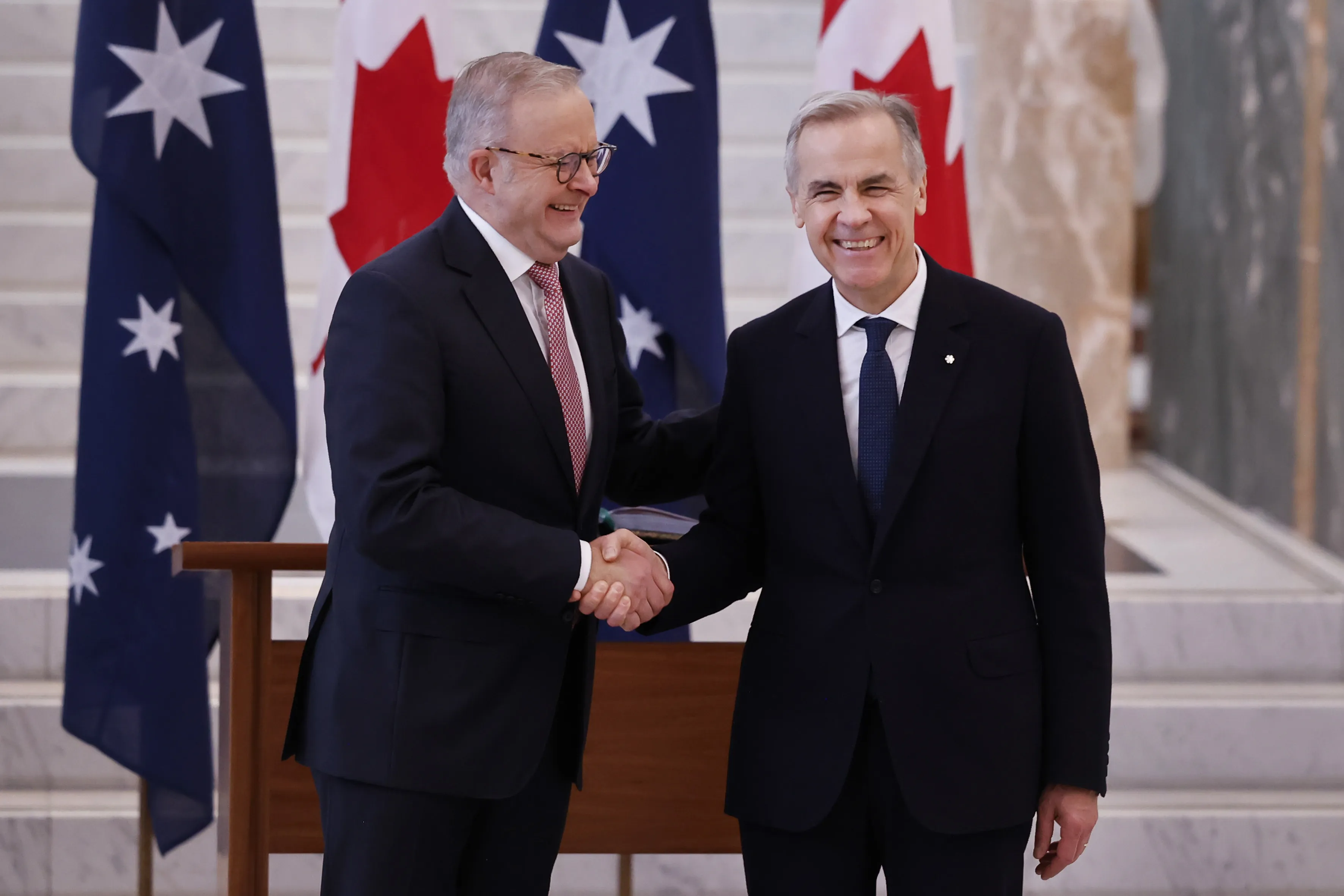
CANBERRA — In the high-stakes world of international arms dealing, the loudest messages are often delivered in the quietest boardrooms. This week, as Prime Minister Mark Carney became the first Canadian leader to address the Australian Parliament in nearly two decades, the subtext was unmistakable: the era of North American defense dependency is over.
The centerpiece of this shift is a historic $4-billion defense contract—the largest defense export in Australian history—for a revolutionary “Over-the-Horizon” radar system. While the technology itself is transformative, the real shockwave is centered on the recipient. According to defense insiders, the U.S. Pentagon was next in line for this specific surveillance suite. In a move that has left Washington reeling, Canada reportedly “jumped the line,” securing the deal and the technology before the United States could finalize its own procurement.
The Architecture of Autonomy
The radar system in question is a marvel of modern physics. Unlike conventional units that are limited by the curvature of the Earth, this system bounces signals off the ionosphere, allowing operators to monitor ships, aircraft, and hypersonic missiles up to 3,000 kilometers away.
For Canada, the strategic logic is defensive. The system will be deployed across the Arctic—from the Alaskan border to the North Pole—replacing the obsolete North Warning System built during the Cold War. Coupled with a $420-million investment in permanent Arctic military hubs and year-round airfields, the deal represents a “Second Wave” of national infrastructure designed to secure the North without seeking American permission or financing.
The “Rudd Factor” and the Trump Rift
The acceleration of the Canada-Australia axis is being traced back to a specific moment of diplomatic friction in October 2025. During a bilateral meeting at the White House, President Donald Trump reportedly humiliated the Australian Ambassador, Kevin Rudd, in front of global cameras, citing Rudd’s past criticisms of his administration.
The fallout was immediate. When the Trump administration subsequently denied Australia’s request for steel and aluminum tariff exemptions—despite 80 years of shared military history—the calculation in Canberra shifted. “Eighty years of loyalty, and this is what we got back,” noted one Australian diplomat. “Ambassador mocked. Exports taxed. The demolition of the special relationship was internal, not external.”
The $9.5-Billion Diversification
Mark Carney has wasted no time in capitalizing on this geopolitical vacuum. In a whirlwind 10-day tour spanning three continents, the Canadian Prime Minister has locked in $9.5 billion in deals that bypass the U.S. dollar entirely.
Before landing in Sydney, Carney was in New Delhi, where he and Prime Minister Narendra Modi signed a landmark $2.6-billion uranium deal. The contract secures Saskatchewan nuclear fuel for Indian reactors through 2035—a timeline that creates a decade of economic “stickiness” independent of Washington’s trade whims. Modi, once at odds with Ottawa over diplomatic disputes, praised Carney’s “transformative leadership,” signaling a total rehabilitation of the Canada-India relationship.
Davos and the “Rupture”
The intellectual framework for this movement was laid out by Carney at the World Economic Forum in Davos this past January. In a speech that earned a rare standing ovation, Carney described the current state of global affairs not as a transition, but as a “rupture” of the U.S.-led order. His warning—”If we are not at the table, we are on the menu”—has become the rallying cry for a new coalition of middle powers.
Within 48 hours of that speech, Australian Prime Minister Anthony Albanese publicly sided with Carney, inviting him to Canberra. The result is a new, high-tech alliance built on critical minerals, sovereign defense technology, and long-term energy security.
The Permanent Reroute
Critics in Washington have dismissed these moves as “symbolic theater,” but the industrial reality suggests otherwise. A $4-billion radar system takes years to build and decades to operate; a uranium contract through 2035 cannot be torn up with a late-night social media post.

As Carney prepares to head to Japan for the next leg of his mission, the message to the world is clear: A country once told it “lives because of the United States” has just spent $9.5 billion proving it does not. The supply chains are rerouting, the defense alliances are hardening, and for the first time in the modern era, the most important table in the room is one where Washington does not have a seat.